This essay forms part of the series In the Company of Sadhus, presenting a carefully documented encounter in Kashi (Varanasi) that illuminates shared currents across dharmic traditions. The narrative centers on a saint popularly known as the “Pagal Baba,” whose austere presence and penetrating insights articulate a rigorous, experiential map of spiritual ascent—one that resonates with Hindu spirituality and finds conceptual affinities with Buddhist reflections on Shunya and Jain meditations on the limits of knowledge.
Approximately thirty-three years earlier, on a winter evening in Kashi, an initial darshan set this account in motion. At that time, Shri Hariprasad Vidyant Mahashay, formerly the Superintending Engineer of the province, had retired and settled in Varanasi. Known for generosity, devotion, and a guileless temperament, he had since childhood cultivated a natural inclination for satsang and the company of sadhus and saints. After making his acquaintance, he frequented long conversations that often drew other seekers; thus, several years of steady discourse unfolded.
In the course of these meetings, Vidyant Mahashay spoke with unusual reverence about a mad-looking sadhu whose presence, he felt, was wholly uncommon. Though the figure did not fit conventional expectations of ascetic decorum, the impression he left—rooted in a palpable, transcendent knowing—was unmistakable. The desire arose to initiate a dialogue in a setting conducive to sustained inquiry into Sadhana and first principles.
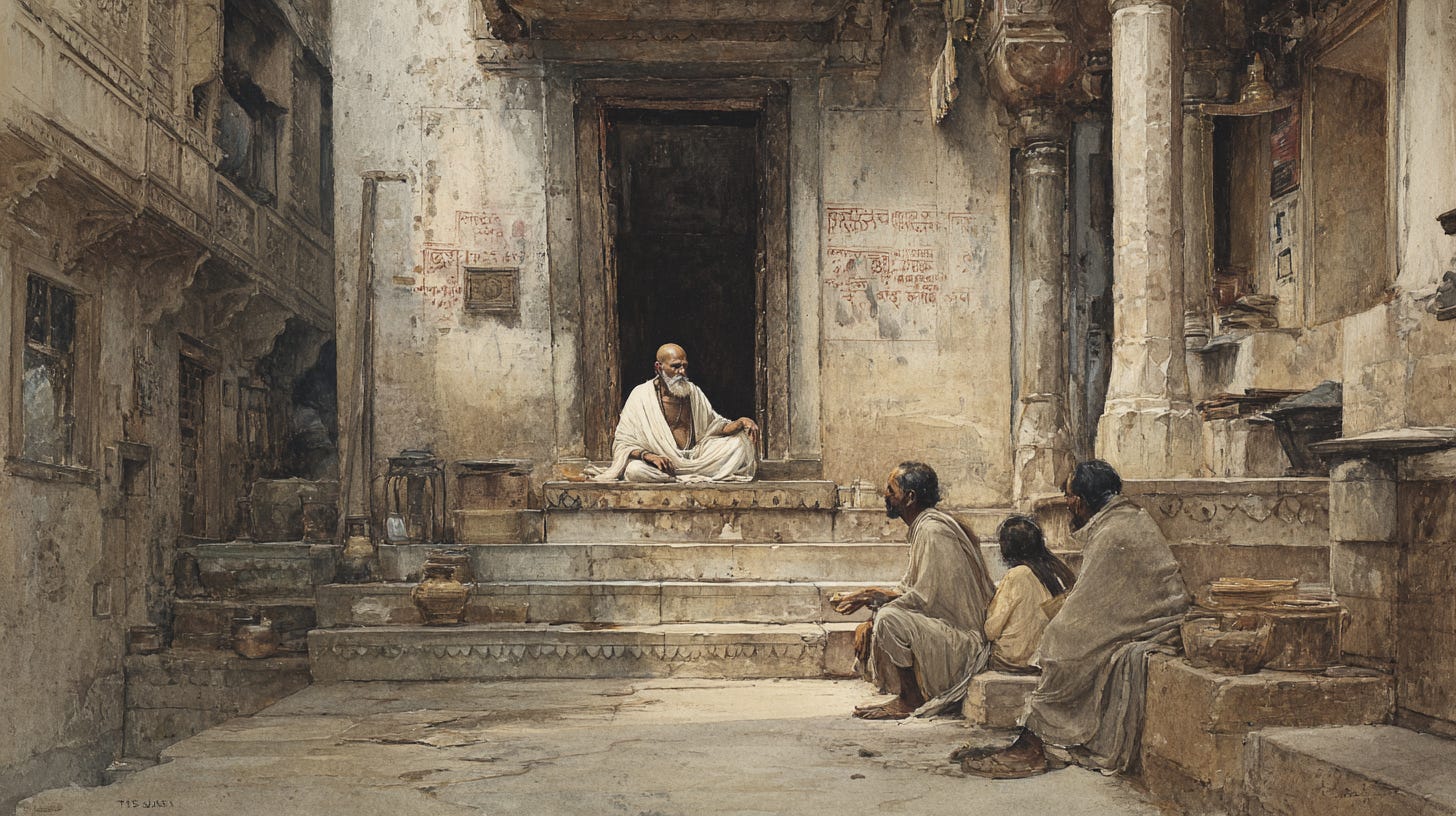
Responding without hesitation, the visit was undertaken the same day, in the spirit that auspicious work should not be delayed. It was December. Upon arrival at the residence, introductions were made and a quiet interval of waiting ensued. When the saint appeared, the habitual form of address—“Sadhu ji”—felt inapt. He wore a simple white garment, tied at the knees; there was no rosary, no matted locks, and the head bore dry, disheveled hair, seemingly unoiled. His age appeared to exceed fifty. The most striking feature was the eyes: unearthly, radiant, seemingly intoxicated yet inwardly alert, with a gaze at once steady and piercing.
After a brief exchange of courtesies, the reason for the visit was stated and a request made to engage in serious conversation. The saint agreed without reserve: any questions might be asked; answers would be given as best as possible. The atmosphere shifted to disciplined enquiry, attentive to experience and free of polemics—an approach consistent with the dharmic ethos of seeking truth through reasoned dialogue and tested practice.
Asked whether the long path of Sadhana had culminated in the true goal, he replied with notable clarity and humility. Along the way, countless visions and phenomena had arisen and then vanished. The true goal, he said, is Bhagavat-prapti, an attainment of extraordinary difficulty. He would not claim to have achieved it. The level of ordinary dwelling is the planetary field. From there, one must ascend to the solar sphere, the Jagat-Surya.
The exposition continued in systematic stages. The Jagat-Surya is one in the collective aspect (samashṭi) yet, in the individual aspect (vyaṣṭi), it differentiates into twelve parts—the Twelve Ādityas corresponding to the Sun’s forms in the zodiac. When this sphere is fully penetrated and discriminated, one attains the Sun whose nature is Praṇava (Oṃkāra). The Praṇava-Sun is likewise twelvefold in the individual mode. Rising beyond this, one gains the authority to enter the Bindu, called the Īśvara-Jyoti.
Upon piercing the Bindu, purity arises, and through direct perception one realizes a vast, immaculate effulgence, the Parameśvara-Jyoti. Yet even this is not the spotless effulgence, the Nirañjana Jyoti. From here alone, he said, the clue to the Nirañjana Jyoti is obtained. Abiding in that state is the Bhagavat-sthiti. In a spirit of rigorous honesty that unites the dharmic emphasis on humility before the Infinite—whether spoken of as śūnyatā, kevala-jñāna, or the ineffable Jyoti—he underscored that the ultimate path remains exceedingly arduous.
Prompted to clarify the role of Shunya, he affirmed its direct vision on this path. Only when each prior level is fully transcended does Shunya enter the field of vision, at which point the process of the cessation of activity (Kriyā-ruddha) begins—though even the piercing of Shunya still depends on Kriyā. After piercing one Shunya, a further level is attained, along with a specific action suitable to that level; when that action ceases, a vaster Shunya appears. Thus, many Shunyās unfold according to level, evoking a layered ontology of the Void familiar in broader Indic contemplative traditions.
The final Shunya, he noted, is called Ananta Shunya—the Infinite Void. At this threshold, even Mahāshunya must be pierced, or else direct realization of the Divine does not occur. Piercing the Ananta Shunya and realizing the spotless Nirañjana Jyoti beyond it is exceedingly difficult. With unwavering candor, he stated that he had pierced the Mahāshunya but had not yet gained the capacity to pierce the Ananta Shunya. He remained on this side of the Infinite Void, uncertain if that crossing would ever occur—an outlook that honors the shared dharmic emphasis on humility, method, and interior verification rather than assertion.
This account presents more than a singular voice from Kashi; it offers a comparative lens on concepts that gently converge across Hinduism, Buddhism, Jainism, and Sikhism—Shunya, the many-layered ascent, and the luminous Jyoti beyond name. The emphasis on disciplined practice (Sadhana), ethical clarity, and experiential knowledge encourages seekers of all dharmic paths to approach the Infinite with reverence, rigor, and unity of spirit.
To be continued.
Inspired by this post on Dharma Dispatch.