
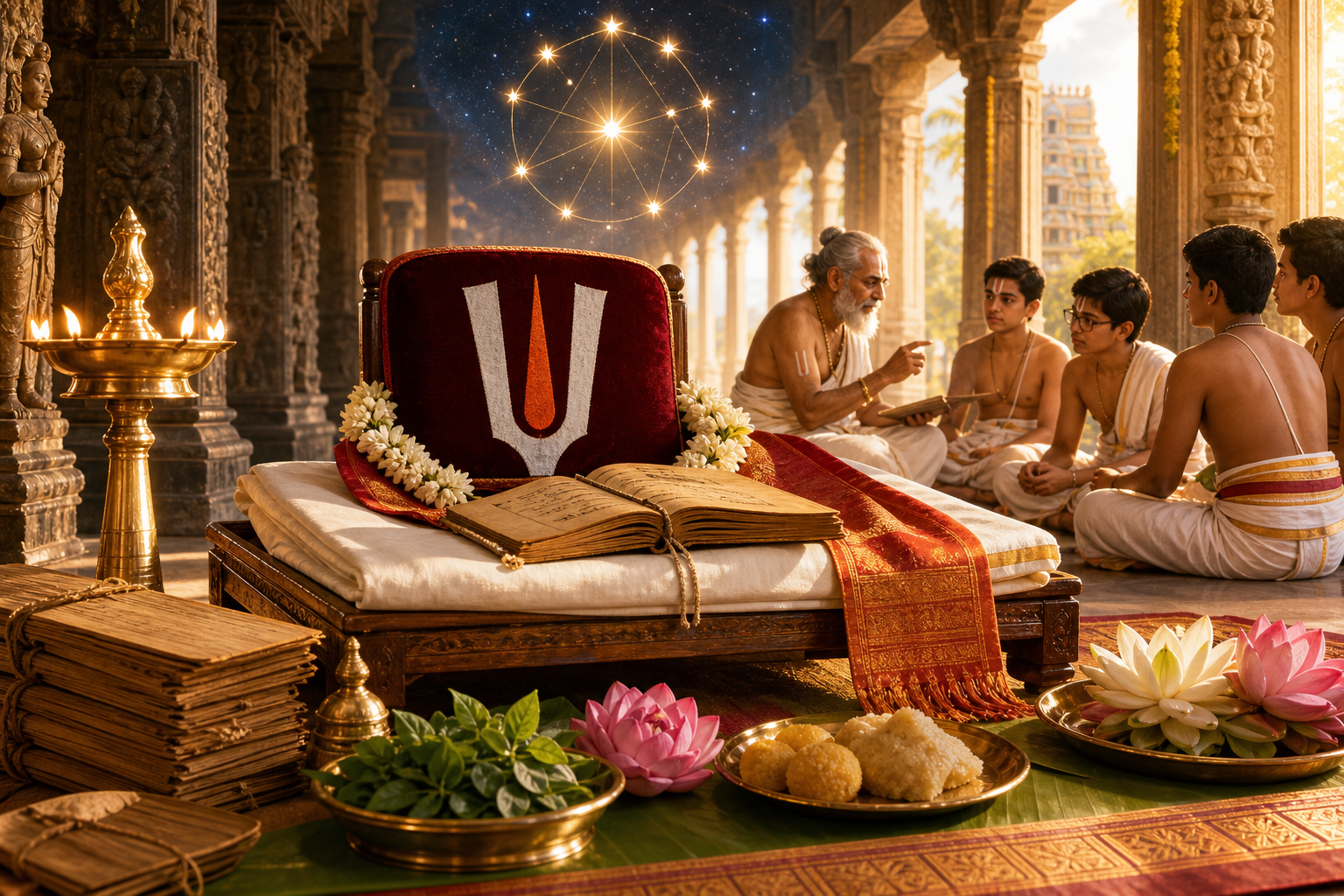
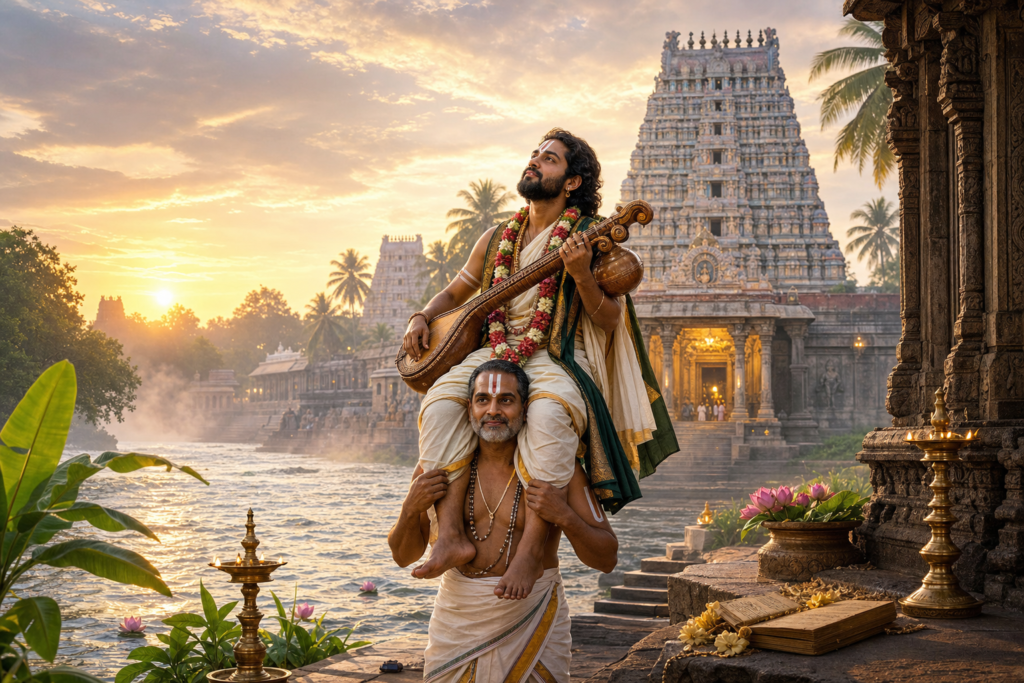
Nayanar Achan Pillai Thirunakshatram is an observance rooted in the Sri Vaishnava sampradaya, where remembrance is not treated as nostalgia but as a disciplined form of spiritual learning. The day honors Sri Nayanar Achan Pillai, a revered Acharya remembered as the adopted son, or svikara puthra, and principal disciple of Sri Periyavachan Pillai, the celebrated commentator often revered in tradition as Vyakhyana Chakravarthi, the emperor among exegetes. The observance invites devotees and students of Hindu spirituality to revisit a lineage in which devotion, scholarship, humility, and service were held together as a single path.
The word Thirunakshatram refers to the sacred birth star of an Acharya or saint, calculated through the traditional lunar nakshatra framework rather than through the modern solar birthday system. In Sri Vaishnava practice, such a day is not merely biographical. It becomes liturgical, philosophical, and communal. Temples, mutts, families, and study circles use the occasion to recite hymns, remember the guru-parampara, study the Acharya’s contribution, offer prasadam, and renew the discipline of kainkaryam, or service performed with reverence.
Sri Nayanar Achan Pillai’s importance becomes clearer when placed beside the stature of Sri Periyavachan Pillai. Periyavachan Pillai is central to the Sri Vaishnava commentary tradition because of his extensive interpretations of the Naalayira Divya Prabandham, the four-thousand Tamil hymns of the Alvars. These hymns are not peripheral poetry in the tradition; they are treated as Tamil Veda, a devotional revelation that brought metaphysical truth, temple culture, and personal surrender into the language of lived experience. To continue such a tradition required more than memory. It required precision, humility before earlier Acharyas, mastery of theological vocabulary, and sensitivity to the devotional pulse of the Alvars.
As the adopted son and foremost disciple of Periyavachan Pillai, Sri Nayanar Achan Pillai represents the continuity of knowledge across both family and discipleship. The term svikara puthra is therefore significant. It points to a relationship formed by sacred responsibility rather than merely by social identity. In the Sri Vaishnava world, the Acharya does not simply transmit information. The Acharya shapes the disciple’s understanding of tattva, the nature of reality; hita, the means to liberation; and purushartha, the highest human aim. This makes the guru-shishya relationship an intellectual, ethical, and spiritual covenant.
The philosophical background of this observance lies in Vishishtadvaita Vedanta, the qualified non-dualism systematized by Bhagavad Ramanuja. Sri Vaishnavism teaches that the individual self is real, the universe is real, and the Supreme, understood as Narayana with Sri, is the ultimate ground and inner ruler of all. The soul’s fulfillment is not isolation but loving service. This theological orientation gives Thirunakshatram observances their distinctive character: the Acharya is honored because he clarifies the path by which the finite self learns dependence, devotion, surrender, and service.
Nayanar Achan Pillai’s legacy is especially valuable because Sri Vaishnava learning depends on commentary. The hymns of the Alvars are emotionally direct, but their theological density is immense. Their language moves between poetry, metaphysics, temple imagery, longing, surrender, and ecstatic devotion. Without Acharya commentaries, many layers of meaning can remain inaccessible. The commentary tradition protects meaning from casual reduction, but it also prevents scholarship from becoming dry. It keeps doctrine close to worship and worship close to disciplined understanding.
This is why the remembrance of an Acharya is never limited to praising an individual. It is a remembrance of method. Sri Nayanar Achan Pillai stands for the method of listening carefully, preserving faithfully, teaching responsibly, and situating personal devotion within the larger sampradaya. In an age where spiritual ideas are often detached from lineage and circulated as fragments, his Thirunakshatram reminds practitioners that inherited wisdom requires context, grammar, discipline, and gratitude.
The Alvar foundation of Sri Vaishnavism is also essential to understanding this day. The Alvars, including Nammalvar, Periyalvar, Andal, Tirumangai Alvar, and others, gave South Indian Vaishnava bhakti a literary and liturgical body. Their hymns sanctified Divya Desams, interpreted divine presence through love, and made the experience of surrender intelligible to ordinary devotees. The Acharyas who came later did not replace the Alvars; they unfolded their meanings. Nayanar Achan Pillai belongs to this world of interpretive reverence, where a disciple receives inherited words as living revelation.
Periyavachan Pillai’s reputation as a master commentator also shows why his disciple’s role mattered. A commentator in the Sri Vaishnava tradition is not a mere linguistic explainer. He is a theologian, philosopher, ritual guide, and guardian of devotional taste. The commentator must explain grammar, scriptural cross-references, doctrinal nuance, emotional context, and temple practice. To stand in the orbit of such a teacher demanded a rare combination of scholarship and surrender. Nayanar Achan Pillai’s reverence in the tradition reflects that demanding inheritance.
The observance of Nayanar Achan Pillai Thirunakshatram may vary by temple, family, and regional calendar, but its basic spirit remains consistent. Devotees remember the Acharya through prayer, recitation, study, and service. The Naalayira Divya Prabandham may be recited, especially where there is a strong Sri Vaishnava liturgical tradition. Discourses may focus on the guru-parampara, the works of Periyavachan Pillai, and the importance of receiving knowledge through Acharya anugraham, the grace that flows through the teacher’s instruction.
At a practical level, the day can be observed through disciplined study. A devotee may read a portion of Divya Prabandham with commentary, reflect on the meaning of prapatti, or listen to a traditional upanyasam. The emphasis is not on performance for its own sake. It is on becoming teachable. Sri Vaishnava culture repeatedly insists that knowledge becomes transformative only when the ego softens. The student approaches the text, the deity, and the Acharya with humility, not as an owner of knowledge but as a recipient of grace.
One of the most moving dimensions of this Thirunakshatram is the emotional bond between teacher and disciple. Many devotees understand such observances through their own experience of being guided by elders, parents, gurus, temple priests, scholars, or grandparents who preserved practices without seeking recognition. In that sense, Nayanar Achan Pillai’s remembrance speaks beyond one historical personality. It honors every quiet act of transmission through which dharma survives: a hymn taught to a child, a meaning explained after worship, a festival observed with care, or a text preserved across generations.
The day also offers a valuable lesson for the broader dharmic family of Hinduism, Buddhism, Jainism, and Sikhism. Each of these traditions recognizes, in its own way, the importance of disciplined transmission, ethical formation, and reverence for teachers. Sri Vaishnava Acharya remembrance is particular in theology, but its deeper civilizational insight is widely resonant: wisdom must be embodied, taught, received, practiced, and protected. Such recognition strengthens unity among dharmic traditions without erasing their distinctiveness.
Nayanar Achan Pillai Thirunakshatram should therefore be understood as both a religious festival and an intellectual commemoration. It celebrates a saintly teacher, but it also celebrates a civilization of commentary. In the Indian knowledge tradition, commentary is not secondary work. It is a refined form of preservation and renewal. Through vyakhyana, inherited revelation enters new generations without losing its structure. Through explanation, devotion becomes clearer. Through disciplined interpretation, spiritual emotion becomes stable practice.
The Sri Vaishnava stress on Acharya bhakti can sometimes be misunderstood as personality-centered reverence. In its classical sense, however, Acharya bhakti is not personality worship. It is gratitude toward the one who reveals the relationship between the soul and the Supreme. The Acharya is honored because the Acharya removes confusion, interprets scripture, models humility, and directs the disciple toward Bhagavan rather than toward himself. This is why Acharya Thirunakshatrams retain such deep force in temple and household practice.
In modern life, the relevance of Sri Nayanar Achan Pillai’s legacy is striking. Information is abundant, but formation is rare. Many people encounter spiritual vocabulary without the patient framework needed to understand it. Terms such as bhakti, prapatti, moksha, karma, jnana, and dharma can be flattened when removed from their living traditions. The Acharya-parampara prevents this flattening. It teaches that sacred knowledge requires discipline, lineage, humility, and repeated contemplation.
The Thirunakshatram also encourages a more responsible relationship with inherited tradition. Devotion without study can become sentimental, while study without devotion can become sterile. Sri Vaishnava Acharyas sought to avoid both errors. Their work joined scriptural rigor with emotional depth. They understood that the heart needs form and the intellect needs surrender. Nayanar Achan Pillai’s remembrance brings this integrated vision back into focus.
For temple communities, such observances strengthen continuity. A Thirunakshatram gathers people around memory, recitation, prasadam, and shared learning. It makes history audible and visible. Children hear names that connect them to a larger tradition. Elders see practices carried forward. Scholars and devotees meet in a common space where textual knowledge and ritual life are not separated. This communal dimension is one of the quiet strengths of Hindu cultural heritage.
For individual practitioners, the day can become a mirror. It asks whether learning is being approached with humility, whether inherited practices are being preserved with understanding, and whether devotion is maturing into service. The life of an Acharya is not remembered only to be admired. It is remembered to refine conduct. The highest tribute to Sri Nayanar Achan Pillai is not merely verbal praise but renewed commitment to study, seva, reverence, and clarity.
Nayanar Achan Pillai Thirunakshatram ultimately celebrates the sacred continuity of Sri Vaishnava wisdom. It honors an Acharya who stands within the luminous lineage of Periyavachan Pillai, the Alvars, Ramanujacharya, and the larger guru-parampara. Its enduring message is simple but profound: dharma remains alive when knowledge is received with humility, interpreted with care, practiced with devotion, and shared for the upliftment of the community.
Inspired by this post on Hindu Pad.



Leave a Reply
You must be logged in to post a comment.