
Rebuilding Sonar Bangla is not merely a slogan about regional pride; it is a serious question of economic history, state capacity, civilisational confidence, and national strategy. Bengal once stood at the intersection of riverine trade, maritime commerce, skilled manufacturing, agricultural abundance, intellectual life, and institutional power. To understand West Bengal’s present challenges, the past must be examined without sentimentality and without erasing the human memory of families whose fortunes were shaped by ports, mills, railways, refugee movements, trade unions, universities, temples, mathas, gurdwaras, monasteries, markets, and workshops.
The News18 opinion piece dated June 25, 2026, frames this question around a central historical claim: Bengal was not a peripheral economy waiting to be discovered by colonial rule. It was already a prosperous region with fertile land, advanced artisanal production, commercial networks, and a dense culture of learning and enterprise. British observers themselves described Bengal as among the richest, most populous, and best cultivated regions known to them. That assessment matters because it challenges the modern habit of treating Bengal’s decline as natural or inevitable.
Pre-colonial Bengal benefited from the ecology of the Ganga-Brahmaputra delta, the craft traditions of its towns, and the maritime routes linking the Bay of Bengal with Southeast Asia and the wider Indian Ocean. Its prosperity was not only agricultural. Fine textiles, river transport, salt, rice, sugar, metal work, and later jute created a diversified economic base. The region’s cultural confidence was equally deep, shaped by Hindu, Buddhist, Jain, and Sikh interactions across eastern Bharat, with Bengal’s Shakta, Vaishnava, Tantric, Buddhist, and mercantile traditions contributing to a broader Dharmic civilisational landscape.
By the time India became independent in 1947, West Bengal possessed advantages that most regions would have envied. The old Bengal Presidency had served as the seat of British India for 139 years, and therefore absorbed ports, railways, factories, courts, commercial houses, educational institutions, and financial infrastructure. According to the 1951 Census of Manufacturing Industries cited in the source article, West Bengal had 1,493 registered factories, the highest number in India at that time. Its share in organised sector employment and industrial output was also extraordinarily high, making the state one of the core engines of India’s early industrial economy.
Kolkata, then Calcutta, was not simply a city; it was an operating system for eastern India’s economy. The Calcutta port handled a large share of India’s maritime traffic at independence, while the Hooghly industrial belt carried jute mills, engineering units, foundries, workshops, warehouses, and transport links. The port connected hinterland agriculture and mineral resources with global shipping. The railway network connected factories with coal, steel, tea, and riverine markets. A literate workforce, an active press, universities, banks, and chambers of commerce gave the region institutional depth.
The decline of West Bengal must therefore be studied as a loss of accumulated advantage. Such advantages rarely disappear because of one event. They erode through shocks, policy mistakes, institutional weakness, capital flight, infrastructure neglect, labour-management breakdown, political violence, and poor adaptation to new technology. Bengal’s industrial decline was not the result of one party, one decade, or one administrative file. It was a layered process, beginning with Partition and deepening through policy choices that weakened the state’s natural economic geography.
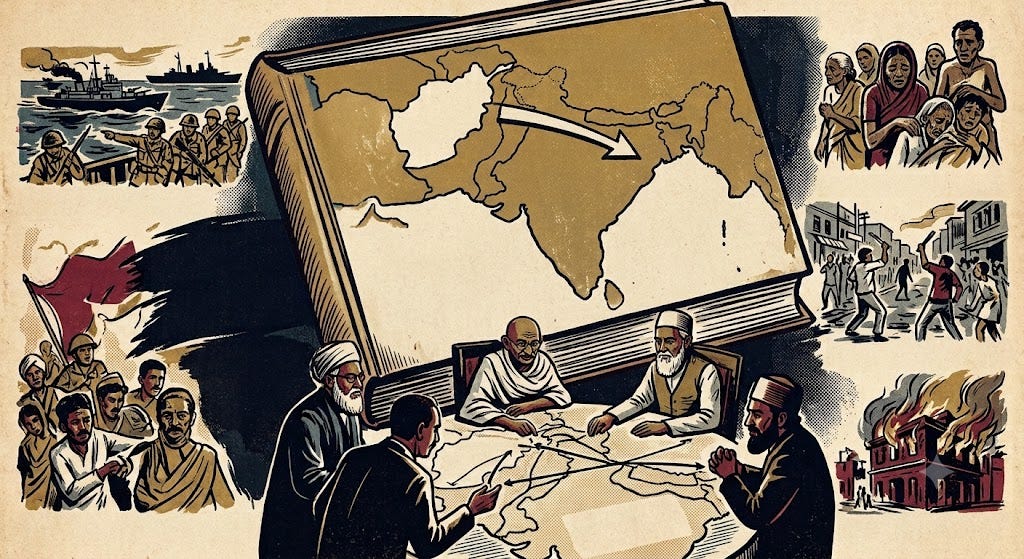
Partition and the rupture of the jute economy. The Partition of India in 1947 was the first major structural blow. Bengal’s jute economy depended on an integrated geography: raw jute cultivation in the fertile eastern districts and industrial processing in mills located largely in and around present-day West Bengal. Partition separated these two functions overnight. West Bengal retained most of the mills, including many in Howrah, Hooghly, and 24 Parganas, while East Bengal, later East Pakistan and then Bangladesh, retained most of the land producing raw jute.
The economic consequences were immediate. Mills that had once drawn raw material through established commercial channels suddenly faced border, currency, transport, and political uncertainties. The source article notes that by October 1947, jute arrivals into Calcutta had fallen sharply below normal levels, and several mills closed within a year of Partition. This was not merely an industrial statistic. For families dependent on mill wages, clerical posts, river transport, brokerage, warehousing, and small urban services, Partition entered daily life through unemployment, shortages, displacement, and insecurity.
Partition also brought a vast refugee burden to West Bengal. Unlike some other regions where refugee rehabilitation was eventually connected with large land settlement or industrial absorption, Bengal had to manage severe population pressure on limited urban and peri-urban land. Refugee colonies became sites of resilience, entrepreneurship, political mobilisation, and cultural survival, but they also reflected the state’s stretched administrative capacity. Economic reconstruction required capital, housing, sanitation, schools, jobs, and transport; the demand arrived faster than the institutional response.
The policy problem after independence. Post-independence economic policy did not adequately compensate eastern India for the loss of its historical advantages. Freight equalisation, central licensing, public sector location decisions, and controlled industrial permissions reduced the natural benefit that mineral-rich and port-connected regions should have enjoyed. When coal, iron ore, steel, and freight advantages were administratively flattened, regions such as West Bengal, Bihar, Odisha, and parts of central India lost a major reason for private capital to remain close to raw material sources.
For West Bengal, this mattered deeply. The state’s industrial ecology had depended on proximity: coal from Raniganj and nearby belts, steel and engineering linkages, port access, and a skilled labour pool. Once licensing decisions and freight policy weakened these locational benefits, investment could move elsewhere. Western India and parts of southern India built new industrial clusters around more flexible governance, entrepreneurial networks, and later better adaptation to petrochemicals, automobiles, pharmaceuticals, information technology, and services. Bengal retained talent but gradually lost industrial momentum.
The Dr BC Roy phase and the challenge of state-led modernisation. The early decades after independence still carried ambition. Dr BC Roy’s tenure is remembered for planning, urban expansion, medical and educational institutions, and industrial thinking around Durgapur, Kalyani, Haldia, and related infrastructure. Burnpur and the wider Asansol-Durgapur belt symbolised the older iron and steel base, while Durgapur became one of the major public sector steel townships of planned India. These efforts show that decline was not predetermined; Bengal still possessed leadership, technical talent, and a viable industrial imagination.
Yet planned industrialisation required continuous execution. Power, land, transport, port depth, labour peace, and administrative predictability had to move together. When these systems failed to reinforce one another, factories became islands rather than engines of wider growth. A steel plant without reliable downstream manufacturing, a port without modern logistics, a railway network without efficient freight integration, and a trained workforce without expanding private enterprise cannot produce durable prosperity.
Labour politics, capital flight, and institutional distrust. Bengal’s later industrial history cannot be discussed honestly without examining labour militancy and political violence. Trade unions arose from real grievances: harsh mill conditions, low wages, insecure work, and unequal bargaining power. However, when industrial relations hardened into permanent confrontation, both workers and investors suffered. Lockouts, strikes, political intimidation, slow dispute resolution, and deteriorating management confidence weakened the very employment base that labour politics sought to protect.
The human cost of this breakdown was profound. Many middle-class families in Kolkata, Howrah, Hooghly, Durgapur, Asansol, and smaller industrial towns still carry memories of a father waiting for a factory to reopen, a brother leaving for another state, or a student preparing for government examinations because private industry no longer seemed dependable. Industrial decline is often narrated through charts, but it is lived through delayed marriages, abandoned apprenticeships, closed workshops, shrinking neighbourhood markets, and the quiet migration of ambition.
The Communist era and its mixed legacy. The Left Front period brought land reforms, panchayat mobilisation, and political stability of a certain kind, especially in the rural sphere. Operation Barga is often discussed as a landmark in tenancy reform, and rural political participation did expand. But industrial policy suffered from an ideological suspicion of capital, excessive politicisation of unions, and a slow response to India’s changing economic environment. When the national economy began liberalising in 1991, West Bengal had to compete with states that had already built stronger investor confidence.
The problem was not that social justice and industrial growth are incompatible. A Dharmic and civilisational understanding of society would reject such a false opposition. Dharma requires fairness, dignity of labour, stewardship of resources, and prosperity that sustains families and communities. The failure lay in treating wealth creation and worker welfare as enemies rather than mutually reinforcing duties. A state that cannot create productive employment cannot protect labour in the long run.
The post-liberalisation gap. After 1991, India’s growth story shifted toward services, technology, automobiles, pharmaceuticals, telecom, ports, highways, and global supply chains. West Bengal had the human capital to participate but lacked the policy speed and institutional trust required to lead. Bengaluru, Hyderabad, Pune, Chennai, Gurugram, Ahmedabad, and Noida captured investment that Kolkata could have competed for. Bengal’s educated youth continued to succeed individually across India and abroad, but the state did not convert that talent into enough local employment clusters.
Information technology and services did develop in parts of Kolkata and adjoining areas, but not at the scale required to reverse decades of industrial stagnation. Manufacturing remained constrained by land politics, infrastructure gaps, regulatory uncertainty, and the legacy of investor hesitation. Small and medium enterprises continued to show resilience, especially in leather, garments, food processing, engineering, tea, handicrafts, and informal services, yet they often operated below potential because credit, logistics, technology adoption, and market access were uneven.
Kolkata port, Haldia, and the logistics question. Rebuilding Sonar Bangla requires a technical understanding of logistics. Ports are not only waterfront assets; they are nodes in a chain that includes dredging, warehousing, customs efficiency, rail connectivity, inland waterways, container handling, cold chains, industrial parks, and last-mile roads. Kolkata’s riverine port has historical depth but also navigational constraints. Haldia added capacity, yet the region needs integrated modernisation linking the Kolkata-Haldia system with inland waterways, eastern freight corridors, Bangladesh connectivity, and the Northeast.
West Bengal’s geography is still strategic. It borders Bangladesh, touches the corridor to the Northeast, connects with Nepal and Bhutan through northern Bengal, and faces the Bay of Bengal. In an era of Act East policy, BIMSTEC cooperation, India-Bangladesh trade, energy links, multimodal transport, and resilient supply chains, Bengal can again become India’s eastern gateway. This requires moving beyond nostalgia for Calcutta’s old commercial greatness and building contemporary capacity in ports, logistics technology, customs processes, export clusters, and border infrastructure.
The Bangladesh factor. Bangladesh is not merely a neighbour in Bengal’s economic story; it is part of the same historical deltaic economy divided by political borders. Trade with Bangladesh, transit to the Northeast, river connectivity, power cooperation, textiles, food processing, health services, education, and cultural exchange can all contribute to regional prosperity. At the same time, border management, illegal migration, security, demographic pressure, and local employment anxieties require firm, lawful, and humane governance. Economic integration cannot succeed without administrative clarity and social trust.
A mature Bengal policy must therefore hold two principles together: cultural and civilisational kinship across the region, and the sovereign responsibilities of the Indian state. Such a position avoids both sentimental borderlessness and harsh social fragmentation. It recognises that secure borders, documented movement, lawful trade, and minority protection are not contradictory goals. They are the minimum conditions for durable peace and prosperity in eastern South Asia.
A Dharmic lens on reconstruction. The phrase Sonar Bangla carries emotional power because it evokes beauty, abundance, music, language, devotion, and collective memory. But reconstruction cannot be built on exclusion. Bengal’s strength has long come from layered traditions: Hindu temple and matha networks, Buddhist legacies from the Pala age, Jain commercial and ethical traditions, Sikh institutions of service, and numerous local practices of worship, learning, music, and community life. Unity among Dharmic traditions is not a decorative ideal; it is a practical foundation for social cohesion.
In policy terms, this means cultural heritage must be linked with development. Pilgrimage circuits, historic temples, monasteries, archives, Sanskrit and Bengali learning, folk arts, Vaishnava and Shakta traditions, Buddhist sites, Jain memories, Sikh gurdwaras, museums, and riverfront restoration can create tourism, scholarship, local employment, and pride. Heritage should not be treated as a museum object separated from livelihood. It can support hospitality, crafts, publishing, education, conservation, and urban renewal when managed with professionalism.
The governance agenda. Any serious programme for rebuilding West Bengal must begin with rule of law. Investors, workers, teachers, shopkeepers, farmers, and families need predictable institutions. Contract enforcement, police neutrality, time-bound permissions, transparent land records, municipal capacity, tax clarity, and corruption control are not abstract reforms. They determine whether a small manufacturer expands a workshop, whether a logistics firm builds a warehouse, whether a family keeps its children in the state, and whether a migrant worker returns with savings to start an enterprise.
Industrial revival should focus on sectors aligned with Bengal’s comparative strengths: river and port logistics, engineering, foundry modernisation, tea value addition, jute diversification, textiles, leather with environmental compliance, food processing, fisheries, healthcare, education, data services, cultural tourism, and green manufacturing. Jute, in particular, should not be viewed only through the lens of old mills. With global interest in biodegradable packaging and sustainable fibres, Bengal can reposition jute through design, composites, technical textiles, branding, and export-oriented innovation.
Energy reliability is equally critical. No industrial state can succeed without stable power, grid modernisation, rational tariffs, renewable integration, and efficient distribution. Industrial parks require plug-and-play infrastructure, waste treatment, digital approvals, water management, worker housing, and training centres. Skills policy should connect universities, polytechnics, ITIs, apprenticeships, and industry associations. Bengal’s intellectual tradition is strong; the missing link is often institutional conversion of knowledge into production.
Agriculture and rural enterprise. Sonar Bangla cannot be rebuilt only through cities. The countryside remains central to Bengal’s future. Rice, vegetables, fisheries, mangoes, flowers, jute, tea, and dairy can support agro-processing clusters if cold chains, grading, storage, rural roads, and farmer-producer organisations are strengthened. Rural Bengal has entrepreneurial capacity, but fragmented landholding, limited processing, and weak market access reduce returns. The goal should be to move from raw output to value-added rural industry.
Such rural industrialisation would also reduce distress migration. When young people leave villages only because local opportunity is absent, the social fabric weakens. Families become dependent on remittances, elders are left behind, and cultural continuity becomes fragile. A balanced economy would allow migration by choice rather than compulsion. That balance requires rural credit, digital access, local storage, agro-logistics, and small-town manufacturing linked to larger markets.
Education, research, and the Bengali mind. Bengal’s intellectual reputation remains one of its greatest assets. The state produced reformers, scientists, revolutionaries, poets, jurists, monks, economists, artists, and political thinkers who shaped modern India. Yet reputation alone does not create jobs. Universities must become stronger centres of research, industry collaboration, classical learning, civilisational studies, science, engineering, medicine, public policy, and entrepreneurship. Political interference in education weakens both scholarship and employability.
A renewed Bengal would combine Rabindranath Tagore’s cultural breadth, Swami Vivekananda’s confidence, Sri Aurobindo’s civilisational depth, Subhas Chandra Bose’s disciplined nationalism, and the practical energy of countless unnamed artisans, traders, teachers, monks, farmers, workers, and refugees. This is not romanticism. Societies rebuild when their moral vocabulary and economic institutions begin speaking to each other again.
Politics and public accountability. The political debate around Bengal often becomes trapped in accusation. The Congress era, central policy, Partition, Left rule, and later regional governance all deserve scrutiny. But accountability should not become an excuse for paralysis. The relevant question is not only who caused decline; it is who can build institutions that prevent further decline. Bengal needs a political culture where law and order, industrial growth, cultural dignity, women’s safety, border security, and educational excellence are treated as non-negotiable public goods.
For voters, this requires moving beyond symbolic gestures. Roads, drainage, schools, hospitals, police stations, courts, land offices, industrial permissions, and municipal services must become measures of political seriousness. For parties, it requires accepting that welfare without growth becomes fiscally weak, and growth without social trust becomes socially unstable. Bengal’s future depends on integrating both.
The eastern gateway opportunity. India’s rise in the twenty-first century will be incomplete if eastern India remains underdeveloped. West Bengal, Odisha, Bihar, Jharkhand, Assam, and the Northeast together form a strategic arc of population, resources, rivers, ports, borders, and cultural depth. West Bengal’s location gives it a special role in connecting mainland India with Bangladesh, Nepal, Bhutan, the Northeast, and Southeast Asia. This is why the idea of Bengal as the gateway to the East remains geopolitically relevant.
To fulfil that role, Bengal must become a state where enterprise feels welcome, heritage feels protected, borders feel secure, institutions feel impartial, and youth feel that their future does not require permanent departure. The rebuilding of Sonar Bangla is therefore not a narrow regional project. It is a national project with implications for Indian ports, Indian infrastructure development, South Asian integration, Dharmic cultural preservation, and the balance of growth across Bharat.
The central lesson is clear: Bengal declined because geography, culture, and talent were not matched by consistent governance. It can rise again if those same assets are reorganised through law, infrastructure, education, industry, and civilisational confidence. The memory of old Calcutta’s port, the Hooghly’s mills, refugee resilience, rural abundance, and Bengal’s sacred cultural inheritance should not remain only a lament. Properly understood, it can become a disciplined blueprint for renewal.
Inspired by this post on Hindu Post.







Leave a Reply
You must be logged in to post a comment.