The most revealing measure of character emerges not in encounters with the powerful, but in the everyday treatment of those with little leverage: the poor, the employee at the bottom of a hierarchy, the laborer, the stranger, the animal, and the earth itself. This ethical asymmetry testhow one behaves when one could exploit without consequencestands at the heart of dharmic wisdom and provides a timeless, cross-cultural diagnostic for moral integrity.
Within the dharmic traditions, this principle is articulated as a practical and spiritual discipline. Dharma is not merely a rulebook; it is a relational ethic that preserves order, dignity, and mutual flourishing. The pivot is simple yet exacting: when power differentials widen, responsibility and restraint must deepen. Measured conduct in such settings is where Ahimsa (non-violence), Karuna (compassion), and Seva (selfless service) are testedand proven.
Hindu texts place this insight in clear relief. The Bhagavad Gita (5.18) describes the wise as those who behold with equal vision a learned and humble Brahmana, a cow, an elephant, a dog, and one who eats the dogan uncompromising statement that spiritual realization is evidenced by non-discriminatory regard. Vidura-niti in the Mahabharata repeatedly warns that the moral stature of a householder, official, or king rests upon kindness, justice, and restraint toward dependents and the vulnerable. The Ramayana elevates this ethic through Rama’s unfeigned respect for Shabari, signaling that purity of heart, not social rank, defines worth. Dharmasastra literature adds administrative teeth to this vision, insisting that leaders ensure due process, proportionality, and protection for those most likely to be wronged.
Classical statecraft reinforces the same measure. The Arthasastra insists that a ruler’s happiness lies in the happiness of the subjects, and that impartial justice is essential to legitimacy. These teachings prefigure modern governance benchmarks: transparency, accountability, procedural fairness, and the continuous evaluation of how policy outcomes affect those with the least power. In contemporary language, Dharma demands “dignity-first design.”
Other dharmic paths converge on this yardstick. Buddhism places Metta (loving-kindness) and Karuna (compassion) at the center of practice, building communities where rank recedes before mindfulness and empathy. The early Sangha’s discipline aimed to flatten social hierarchies through shared rules and mutual respect, protecting novices and outcastes with the same care as the learned. This was not sentimentality but a methodical training in non-harm and perspective-taking.
Jain philosophy makes the measure even more stringent: Ahimsa paramo dharmah. By extending moral concern to every living being, Jain ethics institutionalizes restraint in thought, speech, and action. The anuvratas (small vows) operationalize compassionlimiting possession, curbing harsh speech, and checking careless actions that cascade harm downward. In practice, this means treating the voiceless and invisiblethe insect, the soil, the unseen laborerwith reverent caution.
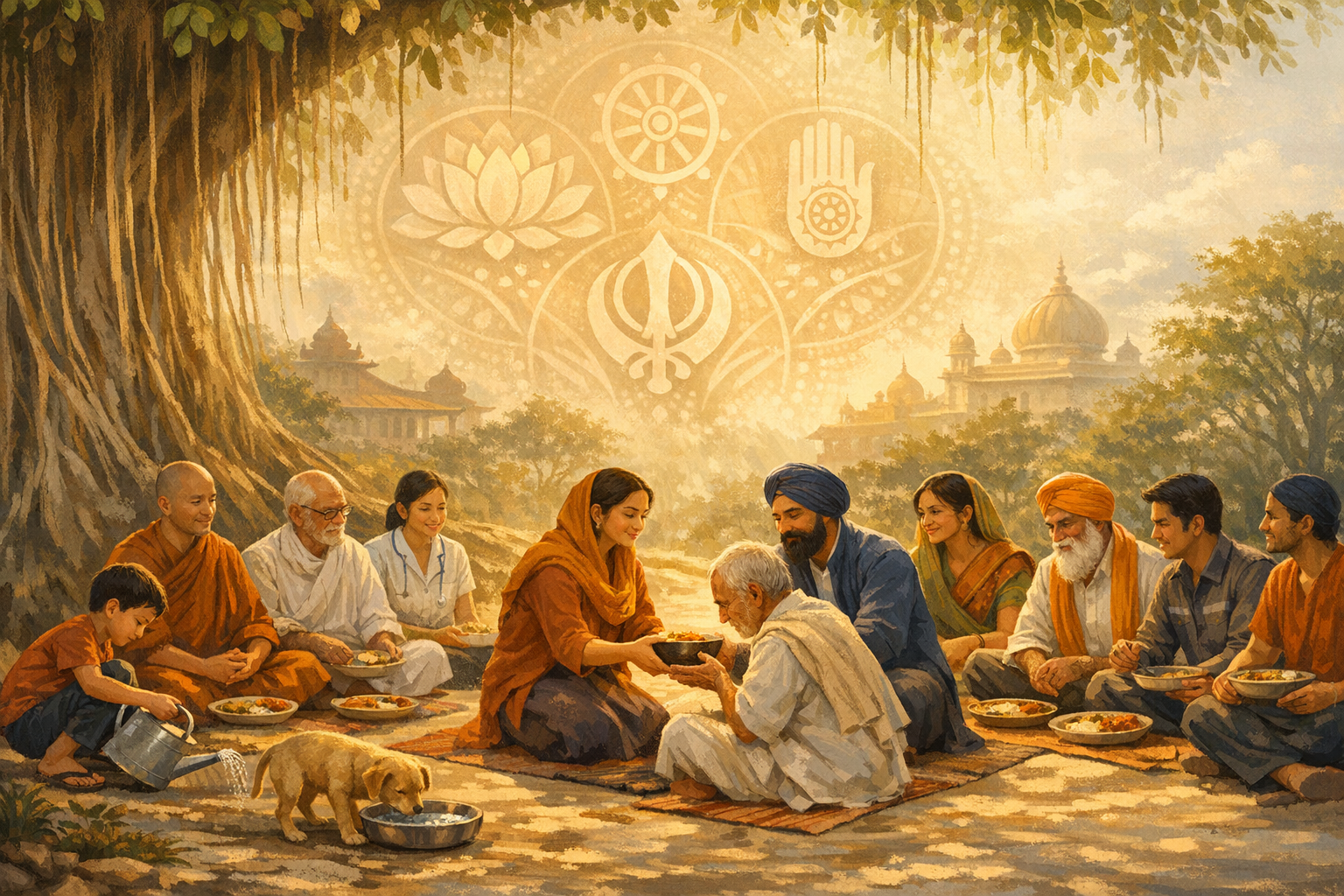
Sikh tradition transforms this ethic into daily, public practice. Seva, langar, and the invocation sarbat da bhala weave equality into the fabric of worship: all sit together, all are fed together, all are honored together. Humility in service becomes the antidote to status-seeking, and dignity becomes a shared, non-negotiable baseline. In institutional terms, Sikh praxis models how ethical hospitality can neutralize hierarchy.
Taken together, Hinduism, Buddhism, Jainism, and Sikhism converge on a single proposition: character is revealed by conduct toward those who cannot repay, promote, or protect. This ethos is neither abstraction nor mere piety; it is an applied science of human flourishing. The shared threadVasudhaiva Kutumbakamframes the world as one family and power as stewardship.
Contemporary behavioral research corroborates these insights. Studies on the approach/inhibition effects of power show that increased power can reduce perspective-taking and increase impulsivity unless intentionally checked by empathy and norms. Organizational literature on psychological safety demonstrates that cultures which dignify the least powerful (junior staff, contractors, service workers) outperform those that tolerate subtle disrespect. The dharmic remedytraining attention, curbing egoistic speech, and ritualizing compassionmaps cleanly onto evidence-based practices.
These traditions also offer a practical, threefold operationalization for individualsperception, speech, action. Perception: pause to consciously recognize the person before the role and to notice one’s own status advantages. Speech: prefer clarity without cruelty; eliminate sarcasm, contempt, and performative anger. Action: default to fair processexplain decisions, offer appeal paths, and share credit downward. Small disciplines compound into ethical reliability.
At the level of institutions, a dignity-first architecture turns ideals into systems. Examples include transparent grievance procedures that protect the least powerful; audits that track outcomes for the bottom quartile of stakeholders; mandatory “queue fairness” protocols in public services; and procurement standards that avoid exploitative supply chains. In temples, gurdwaras, and monasteries, this translates into universal access, inclusive seating and serving practices, and service schedules that prioritize the elderly, the disabled, and children.
Public leadership benefits from codifying these measures. Borrowing from Arthasastra’s clarity and Dharmasastra’s proportionality, administrators can design service charters with time-bound remedies, publish disaggregated performance data, and embed ombuds mechanisms at the last mile. The litmus test remains constant: do the least powerful experience equal respect, timely redress, and visible inclusion?
Concrete vignettes illustrate the point. In a crowded pilgrimage center, implementing a rotating “priority window” for the elderly and persons with disabilities changes more than throughput; it signals moral seriousness. In a corporate cafeteria, management eating after staffnot beforeinstantiates Seva more persuasively than posters on values. In classrooms, adopting blind grading where feasible removes the silent penalties borne by the underconfident. Each redesign translates Dharma into felt dignity.
Daily micro-practices sustain this ethic. A five-breath pause before difficult conversations curbs harshness. A “last-mile check” asks before finalizing any decision: who bears hidden costs, and how might those be mitigated? A weekly Seva hour reorients attention outward. A commitment to non-derogatory humor decontaminates team culture. Jain anuvratas inspire modest consumption pledges; Buddhist Metta formalizes goodwill; Sikh Seva routinizes humility; Hindu dana and atithi-devo-bhava ritualize generous hospitality.
Measurement helps maintain fidelity. A simple Net Dignity Index can be built by surveying the bottom quartile of stakeholders for four items: felt respect, voice in decisions, fairness of process, and timeliness of remedy. Tie leadership evaluations to these bottom-quartile scores and publish them. What gets measured gets protectedespecially when those measured have traditionally lacked voice.
Edge cases demand nuance. Compassion does not preclude accountability. Dharma-Yuddha, rightly understood, balances non-violence with the duty to protect the innocent and uphold order. In practice, this means coupling firm boundaries with humane processes: clear rules, proportionate consequences, and restorative opportunities. The aim is not lenience for its own sake but justice that never forgets the person behind the error.
The dharmic insight is therefore both simple and transformative: when status, speed, or scarcity tempt corner-cutting, character shows in whether dignity remains non-negotiable. The quiet virtue of fair treatment radiates outwardstabilizing families, elevating workplaces, reforming institutions, and humanizing public life. Across Hinduism, Buddhism, Jainism, and Sikhism, the same teaching endures: the measure of a life is the kindness of its asymmetries.
To live by this measure each day is to participate in a civilizational inheritance that is at once rigorous and tender. Practiced consistently, it turns power into service, policy into protection, and difference into solidarity. Practiced collectively, it brings the world a little closer to Vasudhaiva Kutumbakam.
Inspired by this post on Hindu Blog.