Bhadrakali Ammanrevered across South Asia as the fierce yet benevolent Motherembodies the paradox of sacred ferocity that dispels inner and outer darkness. Drawing on philology, iconography, ritual, and comparative dharmic perspectives, the following analysis explains how Bhadrakali integrates fearlessness with compassion, time with eternity, and protection with awakening, offering a unifying vision for Hindu, Buddhist, Jain, and Sikh seekers committed to a harmonious spiritual ethos.
The name Bhadrakali is a compound of two Sanskrit words. Bhadra means auspicious, benevolent, and blessed, while Kali derives from the root Kala, meaning time, the great devourer of all things. Together, Bhadrakali signifies the goddess who is at once terrifying and supremely auspicious the fierce mother whose presence is protective because it reveals the truth of impermanence, liberating devotees from fear.
In Tamil usage, the epithet Amman denotes the intimate experience of the Goddess as Motherproximal, protective, and relational. As Bhadrakali Amman, the deity is perceived not only as a cosmic force but as a close guardian of families, neighborhoods, and villages, reflecting a living tradition in which the transcendent is accessible in everyday life.
Within Śākta philosophy, Bhadrakali is a radiant expression of Mahāśakti, the dynamic power of ultimate reality. She coexists with and complements other Devi forms such as Durga, Kālī, Tripura Sundarī, and Cāmuṇḍā, revealing that auspiciousness (bhadra) and fierce compassion (raudra) are not opposites but two faces of one liberating intelligence. In this theological frame, time (kāla) is not merely destructive; it is educative, cutting away ignorance to unveil clarity.
Classical and regional texts support this vision. The Devi Mahatmya describes the fierce manifestations of the Goddess who restore dharma; the Kalika Purana and various sthala-purāṇas of Kerala and Tamil Nadu narrate the rise of Bhadrakali as a protector against adharma. These sources underscore a consistent message: the Goddess as time-consciousness dissolves what is stale and life-denying, while blessing what nurtures truth and compassion.
Regional narratives, especially in Kerala, recount the slaying of the asura Darika (also styled Darukan) by Bhadrakali, who is born from Shiva’s righteous wrath to establish moral balance. Elsewhere, motifs from the Raktabīja episode in the Devi Mahatmya inform the visual language of Bhadrakali, associating her with the power to subdue proliferating negativity. The common ethical core is clear: fierce grace becomes a medicine against cruelty, delusion, and fear.
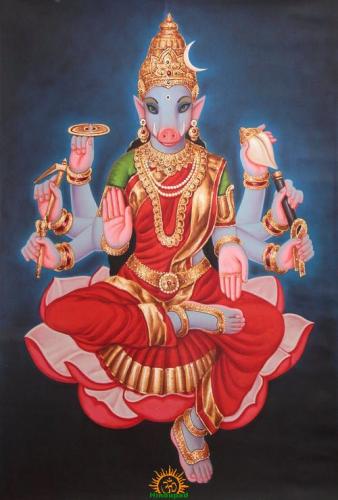
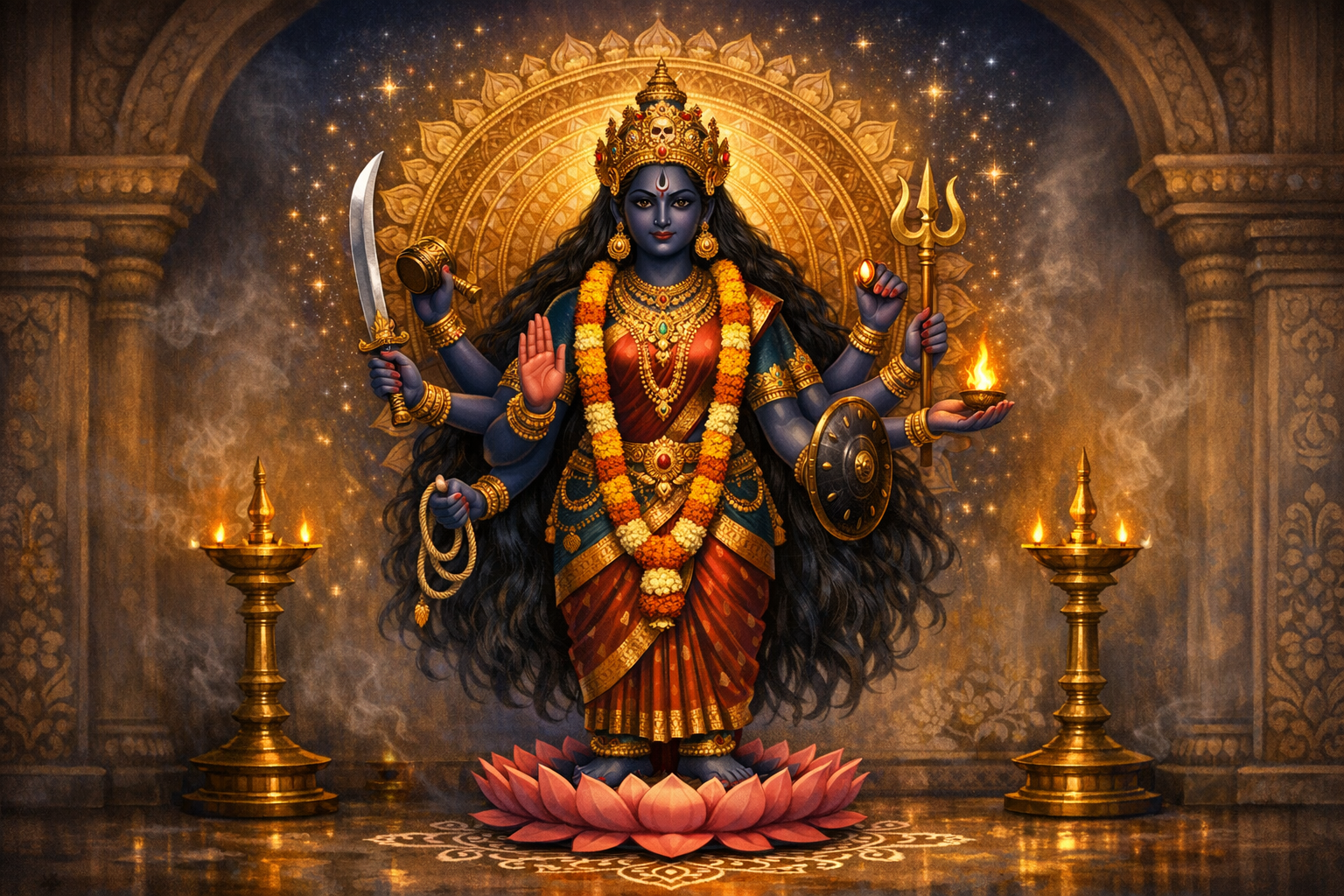
Iconographically, Bhadrakali appears with a luminous, often dark or deep-hued complexion, three eyes signifying omniscient awareness, and multiple arms bearing weapons and emblems of wisdom. Typical attributes include the sword (discriminative knowledge), trident (transcendence of the three guṇas and threefold time), skull or kapāla (impermanence), noose (constraint of harmful impulses), damaru (the pulse of creation), shield (protection), and fire (transformative energy). The visage can be majestic and serene or awe-inspiring and fierce, communicating her twofold promise of protection and awakening.
Semiotically, each element functions as a teaching tool. The sword severs ignorance (avidyā), the trident integrates past, present, and future, and the kapāla invites contemplations on mortality that deepen compassion. The disheveled hair common to fierce forms signals unbounded freedom, while garlands of skulls (mundamālā) and girdles of severed hands, when present in folk idioms, symbolize the cutting of ego-bound actions. Mudrās such as abhaya (fearlessness) and varada (boon-bestowing) ground the icon in ethical assurance: courage is granted, and compassionate results follow right intention.
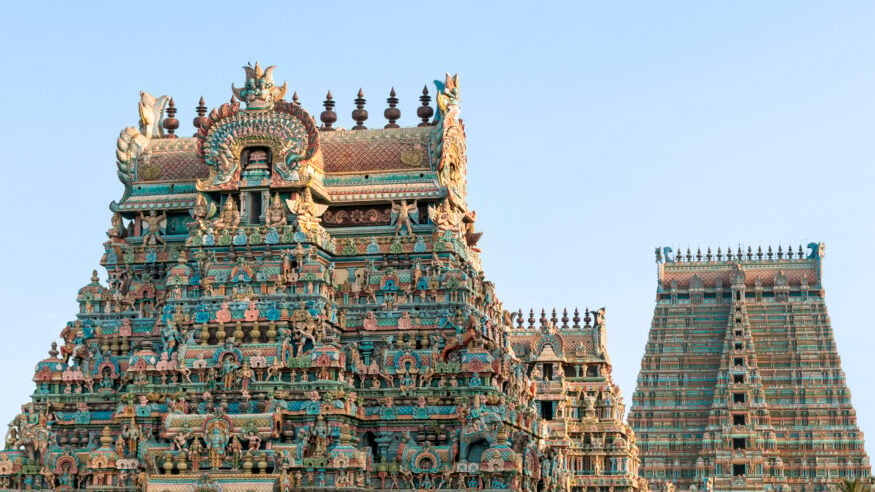
As Amman, Bhadrakali’s temple forms stretch from Tamil Nadu through Kerala and into Sri Lanka’s Tamil regions, with many shrines pairing fierce iconography with deeply nurturing rituals. In Tamil contexts, the proximity of the sanctum, frequent darśana, and regular community offerings strengthen a living bond, while in Kerala the fusion of temple worship with performative traditions further animates the Goddess’s protective presence in public life.
Ritual practice reflects this union of power and care. Daily worship commonly includes abhishekam (ritual bathing), alankāra (adornment), kumkuma archana (red turmeric offerings), and deepa ārati (lamp offerings). In many Śākta temples, homas dedicated to the Goddesssuch as Chandi homa and Bhadrakali homaare performed to invoke collective well-being, ethical clarity, and fearlessness in the face of adversity.
Kerala hosts luminous public observances that highlight Bhadrakali’s inclusive social dimension. The Attukal Pongalalinked with Attukal Bhagavathy, widely revered as Bhadrakaliis among the world’s largest gatherings of women devotees. The act of cooking sweet offerings in community fosters solidarity, agency, and shared prayer for family and social harmony, translating metaphysical devotion into tangible communal care.
Kodungallur Bharaniassociated with Kodungallur Bhagavathyforegrounds fierce compassion as a principle of renewal. While regional practices are diverse, contemporary emphasis across dharmic communities increasingly highlights non-violence (ahimsa), ecological awareness, and service (seva), showing how ancient rites adapt to modern ethical expectations without sacrificing spiritual intensity.
Performative traditions such as Theyyam and Kaliyattam embody Bhadrakali’s presence in lived culture. Through music, dance, and intricate costuming, performers and audiences engage a pedagogy of the sacred: fear is ritually confronted and transformed, social bonds are reaffirmed, and virtues like courage, compassion, and truthfulness are internalized through embodied art.
Mantra and meditation practices personalize this relationship with the Goddess. Devotees frequently employ seed syllables (bīja) associated with Kalisuch as “Krīm”and salutations including “Om Bhadrakalyai Namah,” integrating japa with breath awareness and ethical disciplines (yama-niyama). Guidance from a qualified guru and observance of ahimsa-centered dietary and behavioral vows support safe and meaningful practice, ensuring that fervor aligns with discernment.
Within the ritual calendar, Navaratri offers a contemplative arc for Bhadrakali worship. The progression from auspicious invocation to the celebration of victory over inner negativity mirrors the philosophical journey from tamas (inertia) to sattva (clarity). Recitations of the Devi Mahatmya during this period render fierce myths as living meditations on resilience, humility, and ethical renewal.
Philosophically, Bhadrakali discloses a precise vision of time. As Kali from Kala, she does not merely end things; she reveals their changing nature, turning the fear of endings into a gateway to wisdom. This reframing cultivates non-attachment, gratitude, and fearless compassionqualities urgently needed in an age of rapid change, technological acceleration, and social polarization.
In psychological terms, Bhadrakali functions as a sovereign archetype for transforming anger, anxiety, and grief into moral courage. Devotees often describe feeling “held and challenged” at once: held by maternal assurance, challenged by the sword of insight. The result is not aggression but clear-sighted steadinessan inner bhadra that tempers power with responsibility.
Across dharmic traditions, Bhadrakali’s symbolism finds resonances that strengthen interfaith unity. Vajrayana Buddhism venerates fierce protectors and wisdom dākinīs whose compassionate wrath subdues obstacles; Sikh tradition reveres the martial feminine in compositions such as Chandi di Var; Jain practice honors protective yakṣīs like Ambika and Padmavati, emphasizing ethical vigilance. These convergences affirm a shared insight: fierce compassion is a universal antidote to injustice when guided by ahimsa and wisdom.
Temple communities increasingly foreground ecological responsibility in Bhadrakali worship. Environmentally sensitive offerings, reduced waste during festivals, and community kitchens that minimize resource use exemplify dharmic stewardship. Such initiatives reinterpret the Goddess’s guardianship as protection not only of devotees but also of the living earth.
Socially, Bhadrakali’s cult sustains women’s leadership in ritual and community organization, especially visible at Attukal Pongala and in Amman temples throughout Tamil Nadu. While open to all, these spaces uplift women’s voices and agency, translating sacred symbolism into everyday confidence, civic participation, and compassionate service.
Art-historically, Bhadrakali’s imagery has evolved through dialog with local crafts, performing arts, and regional aesthetics. From the vigorous lines of Kerala murals to the jewel-toned ornamentation of Tamil Amman shrines, visual idioms remain faithful to core semiotics while inviting new generations to encounter the sacred through contemporary eyes.
For practitioners seeking a structured approach, a balanced sādhanā includes daily remembrance (smaraṇa), selective mantra-japa, occasional homa under guidance, ethical disciplines, and acts of seva. This integrated pathway honors the Goddess’s fierce compassion without excess, cultivating fearlessness that benefits families, communities, and society at large.
Taken together, the philological root in Kala, the ritual density of Amman worship, the iconographic precision of weapons and mudrās, and the shared dharmic appreciation of fierce compassion present Bhadrakali as a unifying force. In this light, the “Destroyer of Darkness” is not a threat to plurality but its guardianprotecting the freedom to practice, think, and serve within the vast tapestry of Bharat’s dharmic traditions.
Viewed through this comprehensive lens, Bhadrakali Amman stands as fierce grace: the auspicious light that wields time to remove fear, the maternal presence that steadies the heart, and the philosophical clarity that converts endings into beginnings. The result is a practical spiritualityrooted in ritual, refined by wisdom, and radiant with compassionthat strengthens unity among Hinduism, Buddhism, Jainism, and Sikhism.
Inspired by this post on Hindu Blog.