The statement, “Knowledge of Brahman is impossible with the idea of male and female,” articulates a central insight of Hindu philosophy: Brahman, the ultimate reality, transcends all dualities. In Advaita Vedanta and the Upanishads, Brahman is described as beyond name and form (nāma-rūpa), beyond attributes (nirguṇa), and thus beyond any gendered conception. Holding tightly to categories such as “male” and “female” confines the mind to relative distinctions; realization of Brahman requires a vision where such distinctions dissolve.
Upanishadic teachings like neti neti (Bṛhadāraṇyaka Upaniṣad) negate every limiting idea, not out of rejection of the world but to point to a reality deeper than conceptual boundaries. In this light, gender is not denied in practical life; rather, it is recognized as a functional, worldly category that cannot define the absolute. When contemplation matures, the witness-consciousness is recognized as prior to all pairs of oppositesmale and female, subject and object, sacred and secular. This is the non-dual insight at the heart of moksha.
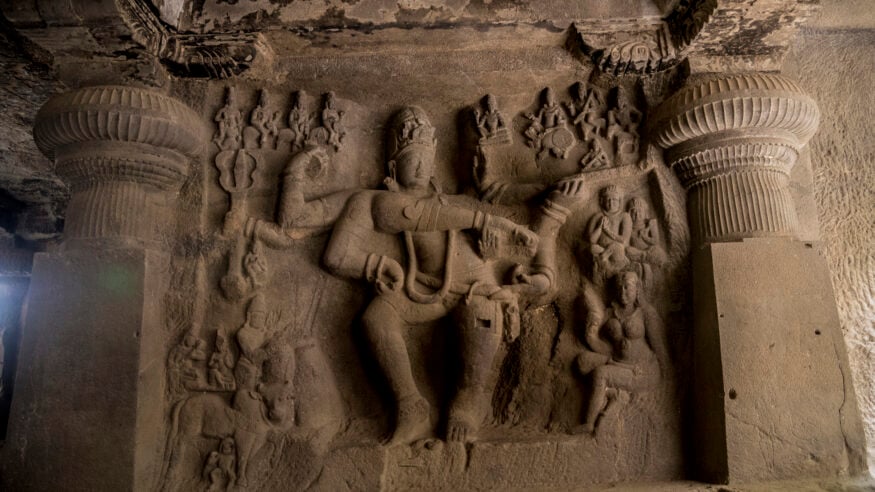
Hindu symbolism reinforces this teaching with remarkable subtlety. The image of Ardhanārīśvara, half Śiva and half Śakti, communicates that the apparent polarities of masculine and feminine are complementary expressions of one indivisible reality. Similarly, the Purusha–Prakṛti framework points to the interplay of consciousness and nature while affirming their ultimate non-separation. Such symbols do not freeze divinity into gendered categories; they educate perception to see the One refracted as many.
This insight resonates across the dharmic traditions. In Buddhism, the realization of śūnyatā (emptiness) loosens all conceptual extremes, while in Jainism, Anekāntavāda teaches the many-sidedness of truth that cannot be captured by a single viewpoint. Sikh teachings proclaim Ek OnkarOne Realitybeyond form. Read together, these traditions offer a shared orientation: truth is broader than any conceptual binary, and spiritual maturity is the art of seeing unity without erasing diversity.
In lived experience, many seekers report that during deep meditation (dhyāna) or heartfelt devotion (bhakti), the boundaries that once felt rigid begin to soften. The mind’s habit of dividing realityself and other, male and femalegives way to a spacious awareness. What remains is a quiet recognition that identity grounded in the Self (ātman) is not confined by bodily attributes or social roles. This recognition naturally fosters reverence for every being.
Practically, this vision supports dignity and equality in society. If consciousness is fundamental and universal, then respect cannot be contingent upon gender. In recognizing the sacred in all, communities can uphold justice, compassion, and inclusion. This is not an abstract metaphysical claim alone; it is an ethical imperative derived from the Upanishadic realization that “Tat Tvam Asi”the same light of Brahman shines in all.
For modern life, the teaching encourages moving from identity-based rivalry to shared spiritual purpose. It invites families, communities, and institutions to hold diversity with humility, remembering that ultimate truth is larger than any label. Such humility aligns with the dharmic ethos of unity in spiritual diversity, supporting dialogue among Hinduism, Buddhism, Jainism, and Sikhism without collapsing their distinct paths.
Several pathways help cultivate this non-dual clarity. Contemplation on neti neti gradually loosens attachment to limiting identifications. Bhakti reframes the relationship with the Divine from a fixed form to a boundless presence, whether approached as Śiva, Viṣṇu, Devī, or as formless Brahman. Seva (selfless service) trains the mind to see the same Self in all, and pranayama steadies attention to rest in awareness itself. Taken together, these practices harmonize insight and action.
Importantly, acknowledging that Brahman is beyond male and female does not deny the value of gendered experiences; it places them within a wider horizon. Cultural forms, ritual languages, and devotional images can be cherished as upāyas (skillful means) that guide attention toward the Real, provided they are not mistaken for the Real itself. The result is a spirituality that is both rooted and free: rooted in tradition, free from constriction.
In summary, the statement points to a transformative philosophical and practical truth. Advaita Vedanta clarifies that the ultimate is beyond gender; Hindu symbolism reveals unity within polarity; and the wider dharmic family affirms the One through varied lenses. When this understanding informs meditation, ethics, and community life, it nurtures compassion, clarity, and a resilient sense of shared belongingan enduring path to inner freedom in a complex world.
Inspired by this post on Hindu Blog.