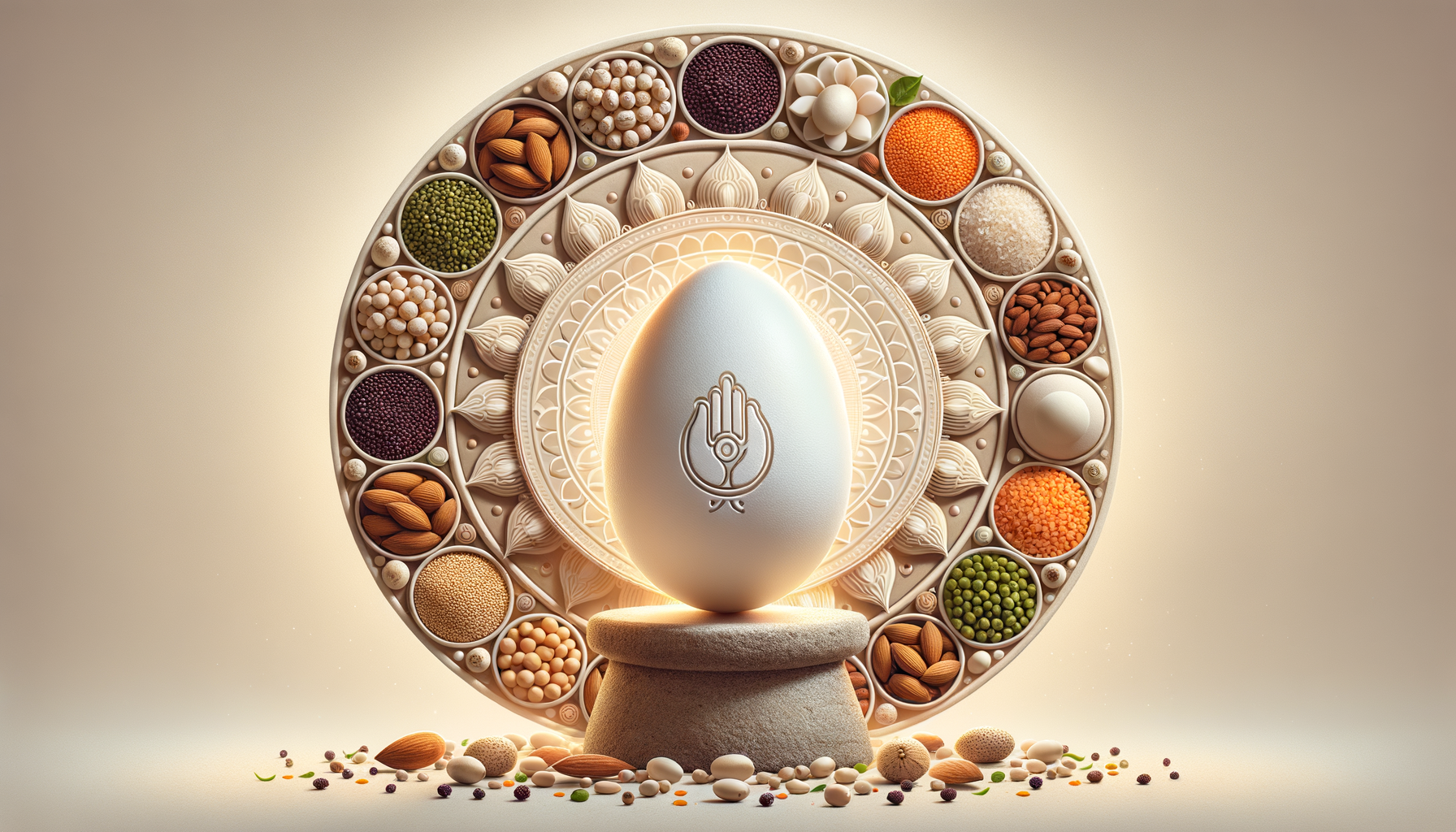
Egg consumption often raises a simple but significant question: if most commercial eggs are unfertilized, why are they not considered vegetarian, and why do Jains refrain from eating them? This analysis clarifies the biological facts about eggs, examines Jain ethical reasoning rooted in ahimsa, and situates the discussion within a broader dharmic ethos of compassion and non-violence.
From a biological standpoint, hens ovulate irrespective of mating, meaning the majority of retail eggsespecially those from standard layer farmsare unfertilized and contain no developing embryo. Fertilized eggs do exist, primarily in breeder settings; when incubated under proper conditions, a chick can develop. Thus, the term “unfertilized egg” is broadly accurate for supermarket eggs, whereas “fertilized egg” denotes the presence of a potential embryo under incubation. Both, however, are animal-origin foods.
Within Indian dietary classifications, eggs are widely categorized as non-vegetarian because they are products of an animal body and are intimately connected with animal reproductive processes. Jain dietary practice goes further: it applies the principle of ahimsa to avoid direct and indirect harm to sentient beings, and to minimize participation in systems that perpetuate violence. Consequently, eggsfertilized or notare excluded.
The Jain commitment to ahimsa is supported by the Principle of Minimum Violence for Human’s Survival. Beyond the egg itself, the modern egg industry typically involves practices that Jains identify as himsa: beak-trimming, intense confinement, the culling of male chicks (often by maceration or gas), and the slaughter of “spent” hens. Even where such practices are regulated or reduced, the structural link to harm remains, guiding conscientious abstention from eggs.
Some argue that unfertilized or “backyard” eggs may be ethically distinct. While small-scale or sanctuary settings can mitigate industrial cruelty, the Jain framework still regards eggs as animal products and encourages disengagement from consumption patterns that normalize harm. The focus is not only on the presence or absence of an embryo, but on alignment with vows of restraint, compassion, and careful awareness of consequences.
Jainism’s meticulous sensitivity to life also informs related dietary choices, such as avoiding certain root vegetables that disturb numerous micro-organisms. This approach emphasizes full awareness and the intentional reduction of harm wherever possible. It dovetails with broader dharmic values shared across Hinduism, Buddhism, and Sikhismtraditions that likewise uplift compassion, satya, and mindful consumption. For instance, Hindu lacto-vegetarian customs, Buddhist compassion for all sentient beings, and the Sikh langar tradition (which excludes eggs and meat) all resonate with a common ethic of care.
Factually, then, eggs are often unfertilized; ethically, they are still avoided in Jain practice due to their animal origin and the systemic harms bound to production. This distinction helps reconcile scientific clarity with spiritual integrity: one may acknowledge biological facts while choosing non-violence as the guiding criterion for diet.
For practitioners seeking practical alignment, several steps are effective: prioritizing plant-based proteins (pulses, dals, soy products, nuts, and seeds), adopting fortified foods for vitamin B12 and D, and verifying labels to avoid hidden egg derivatives in baked goods and processed items. Such choices honor ahimsa while ensuring robust nutrition, demonstrating that a compassionate diet can also be complete and sustainable.
In summary, the Jain view on eggs is not a misunderstanding of biology but a deliberate ethical stance. By distinguishing fertilization status from ahimsa-centered decision-making, this perspective integrates accuracy, empathy, and responsibility. It also affirms a unifying dharmic insight: reducing harm in everyday choices is a shared pathway to personal integrity and collective well-being.
Inspired by this post on Jainism Says.