Srila Prabhupada (A. C. Bhaktivedanta Swami, 1896–1977), founder of ISKCON (International Society for Krishna Consciousness), consistently inspired profound respect across diverse audiences. Observers noted not only the persuasive clarity of his exposition of Gaudiya Vaishnavism but also the conspicuous integrity with which he lived it in public and private.
Accounts from those who served or traveled with him converge on a single point: he did not accept comforts for himself, and any facilities provided by disciples were treated strictly as instruments for seva. In practice this meant modest personal quarters even in major temples, a simple vegetarian diet, and a pattern of travel and engagement calibrated to maximize outreach rather than ease.
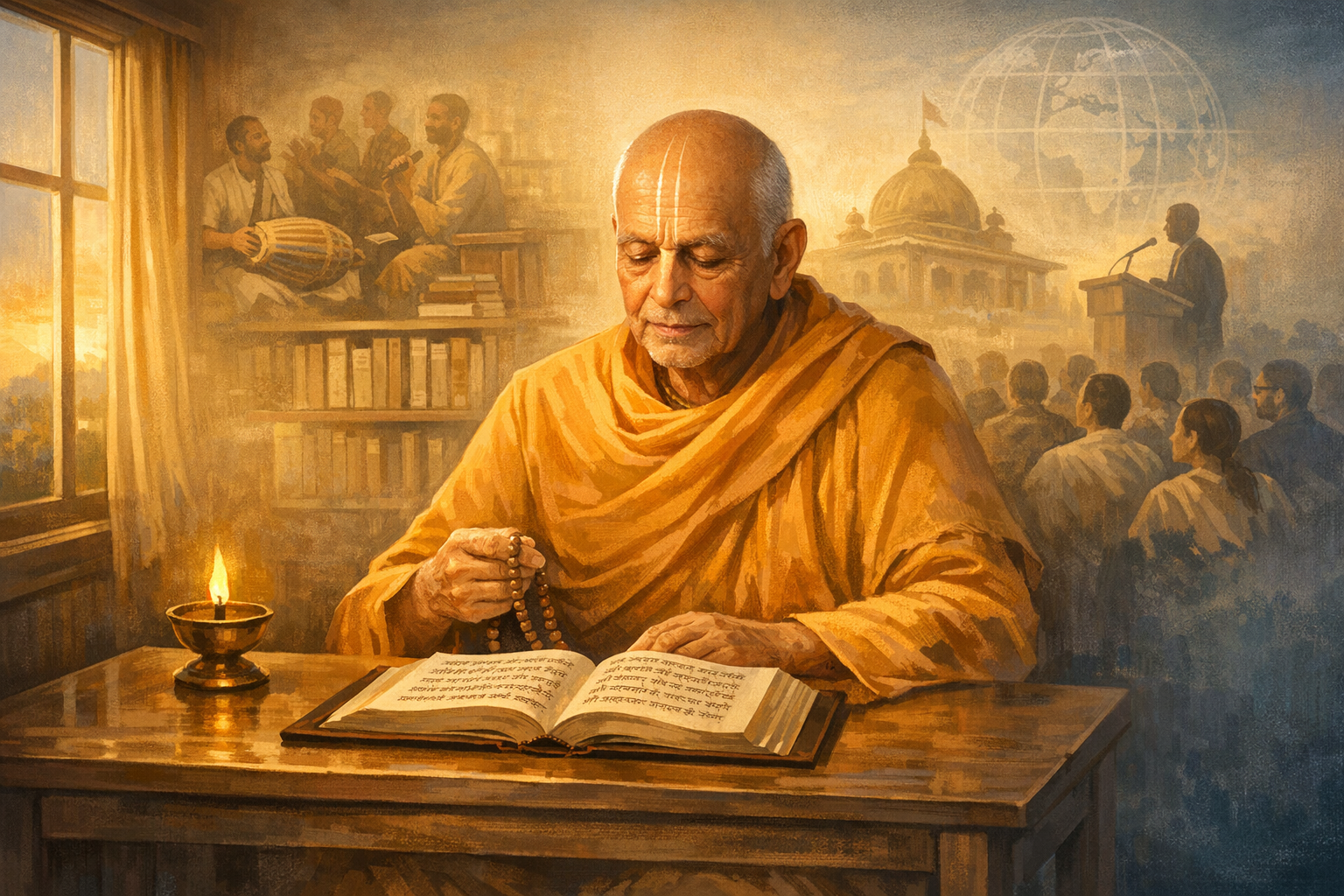
In the idiom of his close followers, he was ‘cent percent engaged’ in Krishna’s service, effectively around the clock. He routinely slept very little, rising before dawn to translate and comment on Sanskrit texts such as the Srimad-Bhagavatam, followed by japa, kirtan, lectures, meetings, and correspondence that advanced ISKCON’s educational and devotional programs.
Such visible alignment between teaching and conduct explains why respect often came even from those who did not share his theology. The credibility generated by renunciation (vairagya) combined with tireless service (seva) created a form of spiritual leadership readily legible across cultures: disciplined, transparent, and purpose-driven.
In contemporary leadership theory, this synthesis maps onto servant leadership, wherein authority is earned by serving a cause beyond the self. In the Guru–Shishya Tradition of the Bhakti Tradition, it additionally corresponds to the role of the acharya, who teaches principally by example, transmitting knowledge through lived practice as much as through formal instruction.
Poet Allen Ginsberg captured this cross-ideological appeal succinctly: “The main thing, above and beyond all our differences, was an aroma of sweetness that he had, a personal selfless sweetness like total devotion. And that was what always conquered me, whatever intellectual questions or doubts I had, or even cynical views of ego. In his presence there was a kind of personal charm, coming from dedication, that conquered all our conflicts.”
That testimony sits alongside numerous public interactions with artists, scholars, and community leaders who, while differing on questions of doctrine, recognized in him an uncommon steadiness and civility. The result was a widening circle of goodwill that opened doors for kirtan, interfaith dialogue, and university forums at a time when Eastern spiritual ideas were often treated skeptically.
From a technical standpoint of Gaudiya Vaishnava theology, this comportment flows from achintya-bheda-abheda, the doctrine of inconceivable simultaneous oneness and difference between the Divine and the individual self. To the extent the practitioner internalizes the identity of dasa (servant) of Krishna, personal aggrandizement becomes incoherent; resources and time are naturally redirected toward teaching, publication, and community building.
Operational decisions within ISKCON under his guidance reflected that ethos: prioritizing translation and distribution of foundational texts such as Bhagavad-gita As It Is and the Srimad-Bhagavatam; establishing temples as centers of study, kirtan, and prasadam distribution; and instituting daily sadhana that scaffolded personal transformation alongside communal service.
These qualities resonate far beyond a single lineage. Humility, disciplined practice, compassion, and service are shared ethical touchstones across the dharmic traditions of Hinduism, Buddhism, Jainism, and Sikhism. In each, the minimization of ego and commitment to the welfare of othersvariously articulated as seva, karuna, dayā, and sarbat da bhalaform the basis for unity in diversity.
For contemporary seekers and community leaders alike, the lesson is clear: discourse gains persuasive power when matched by demonstrable austerity, transparent stewardship of resources, and a consistent daily discipline. When spiritual speech and conduct converge, trust followseven across philosophical boundaries.
Srila Prabhupada’s enduring appeal, therefore, rests less on rhetorical flourish and more on a rigorously embodied practice that observers could verify in real time. That verifiable integrity continues to be the basis of the deep respect he commanded and still commands within ISKCON and among broader spiritual communities.
Inspired by this post on Dandavats.