Lilasukawidely identified with Bilvamangala (often styled Bilvamangala Thakura)occupies a singular place in Hindu devotional literature. Known above all for the Krishna Karnamrita (also rendered as Krishna Karnamrutham), he is celebrated as a Vaishnava saint whose intensely lyrical verses have nourished bhakti for centuries. Although historical details remain elusive, the work’s poetic sophistication, theological depth, and lasting influence are indisputable. The poem’s very title“nectar for the ears” of Krishnaannounces its aesthetic ambition: to flood the listener’s inner world with rasa, devotion, and remembrance of Sri Krishna’s divine sport (lila).
The historical person behind the name Lilasuka is intentionally veiled. Traditions locate him variously in Kerala and elsewhere, offer differing chronologies between roughly the 11th and 13th centuries, and preserve multiple hagiographic strands. What all strands share, however, is an image of a kavi-yogi: a poet whose disciplined devotion attains the intensity of direct vision, and a yogi whose insights pour out in perfected Sanskrit form. That dual identitypoet and saintexplains the honorific “Lilasuka” (the swan-poet of Krishna’s lila) commonly coupled with Bilvamangala’s name in both scholastic and devotional memory.
Accounts of spiritual transformation recur across sources. One famous narrative describes a sensual youth jolted into renunciation by the admonition of a courtesan named Cintamani; awakened to life’s higher purpose, he leaves behind worldly entanglements and sets out on pilgrimage, eventually arriving in Vrindavan. In the devotional tradition, Lilasuka’s humility before his guru is often remembered through a celebrated line of praise to Somagiri, enshrining the primacy of disciplic guidance. While the verifiable chronology of these episodes resists firm dating, the thematic arcfall, awakening, surrender, and abiding love of Krishnaaligns closely with the poem’s interior psychology.
Krishna Karnamrita (Krishna Karnamrutham) is a compact yet profound masterpiece of Sanskrit poetry. Manuscripts and printed editions exhibit variation in organization and verse counts; many recensions present three śatakas (centuries) of verses, while others transmit around 250–330 verses across three parts. The compositional palette is rich: along with the prevalent anuṣṭubh, Lilasuka deploys classical meters such as mandākrāntā, śārdūlavikrīḍita, and sragdharā, among others. His language gleams with alaṅkāra (ornamental figures), śleṣa (ingenious double meanings), and carefully paced sound patterns that make the verses memorable to the ear and meditative to the mindfully justifying the work’s sonic epithet “karṇāmṛta.”
Theologically and aesthetically, the poem is anchored in mādhurya-bhakti, the sweet mode of devotion extolled by the Bhagavata Purana’s Tenth Skandha. Krishna appears as the cowherd of Vrindavan, the enchanting flautist whose smile disarms the senses and whose play discloses the Absolute in childlike immediacy. Yet the sweetness never descends into mere sentiment. The poem balances intensity of longing (viraha) and intimacy of presence, devotion’s vulnerability and its triumph. In a handful of measures, it articulates the paradox at the heart of Vedantic devotion: the Beloved is both the innermost Self and the supremely other, so that union is tasted through loving distinction. Later Gaudiya articulation as acintya-bhedābheda (inconceivable oneness and difference) finds a luminous anticipatory resonance in these verses.
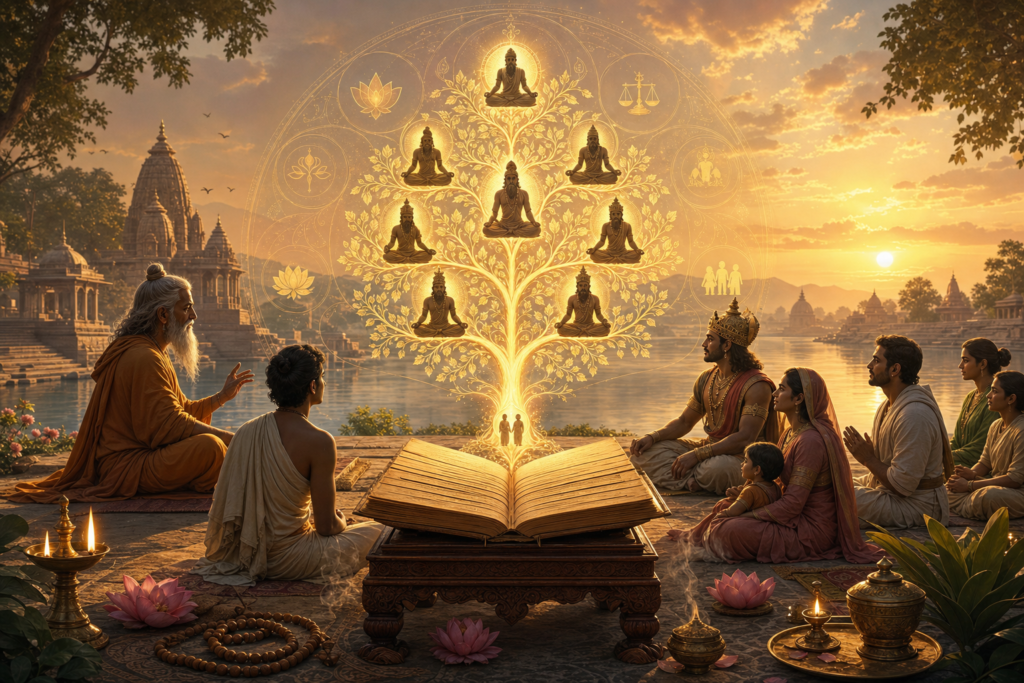
Intertextual threads with the Bhagavata Purana are unmistakable. Krishna Karnamrita frequently refracts canonical episodesKrishna’s flute, rasalila, playful quarrels with the gopas and gopisinto compact lyrical vignettes. This selective reimagining amplifies sentiment rather than retelling plot. Where the Purana establishes a grand theological and narrative canvas, Lilasuka condenses experience into a few perfectly weighted sounds and images, a method that made the poem ideal for memorization, oral recital, and contemplative repetition (japa of meaning as much as of syllables).
The poem’s reception history is equally remarkable. Gaudiya Vaishnava tradition remembers Sri Chaitanya Mahaprabhu encountering Krishna Karnamrita in South India and treasuring it thereafter. Verses from the work became cherished touchstones in the devotional culture of Bengal, Odisha, and beyond, entering the living stream of kirtan, commentary, and daily recitation. Modern vernacular translationsBengali, Malayalam, Hindias well as English renderings have widened its reach without diminishing the original’s cadence and color. In many Vaishnava homes and monasteries, select verses remain part of the liturgical or personal repertoire, linking study, song, and meditation.
From the standpoint of alaṅkāra-śāstra (classical poetics), Krishna Karnamrita offers a compact laboratory of aesthetic theory in practice. The management of rasaparticularly śṛṅgāra in its divine modeis exemplary; images pivot gracefully between the concrete (dust of Vrindavan, the curve of the flute, the brightness of peacock feathers) and the metaphysical (Krishna as the taste within taste, the sound within sound). Carefully placed alliterations and internal rhymes distribute delight across the line, while the rhythm of pausescaesura used like a painter’s negative spaceallows each image to reverberate inward. For students of Sanskrit literature, Lilasuka’s facility in merging brevity with depth makes the text a compelling case study of how spiritual phenomenology can be carried by classical form.
Philologically, the text’s manuscript ecology spans multiple regions, pointing to early and sustained popularity. South Indian palm-leaf traditions preserve one profile of readings, while Eastern manuscripts sometimes transmit alternative enumerations and occasional variant readings or added verses. Twentieth-century printed editions standardized the poem for broader study while recording notable variants. This manuscript plurality is not a defect but a testimony to a living text, sung and copied in different devotional communities over centuries.
Beyond its literary excellence, the poem’s devotional psychology has abiding relevance. Many verses describe the disciplined cultivation of remembrance (smaraṇa) that matures into spontaneous vision (sākṣātkāra). Others teach the art of transmuting sensory impressionssound, color, fragranceinto vehicles of contemplation, a technique that aligns with broader Dharmic contemplative sciences. In that respect, Krishna Karnamrita speaks not only to Vaishnavas but to seekers across the Dharmic spectrum who value attention, compassion, and inner transformation as shared goods.
Interreligious resonance within the Dharmic family is particularly striking. While the poem is firmly Vaishnava in focus, its ethos of love-informed discipline finds counterparts in Buddhist chanting and mindfulness, Jain stavan traditions of exalted praise, and Sikh kirtan grounded in remembrance of the Divine Name. Each path honors the refinement of perception, the dignifying of everyday life through sacred attention, and the conviction that truth, beauty, and goodness are not mutually exclusive but mutually illuminating. Approached with this spirit, Krishna Karnamrita becomes a bridge text: a work that deepens one’s own tradition while enhancing empathy for neighboring paths.
Lilasuka’s epithet itself encodes a theology of creativity. The “swan” (hamsa) symbolizes discernmentthe capacity to separate milk from wateran ancient image of the contemplative mind. As Lilasuka, Bilvamangala becomes the “swan of lilas,” moving effortlessly across the mirrored lakes of Krishna’s play, filtering experience until only the essence remains. This emblem suggests why the poem remains evergreen: it models how rigorous intellect and childlike wonder can coexist, how a disciplined art can carry the heart beyond itself without abandoning clarity or craft.
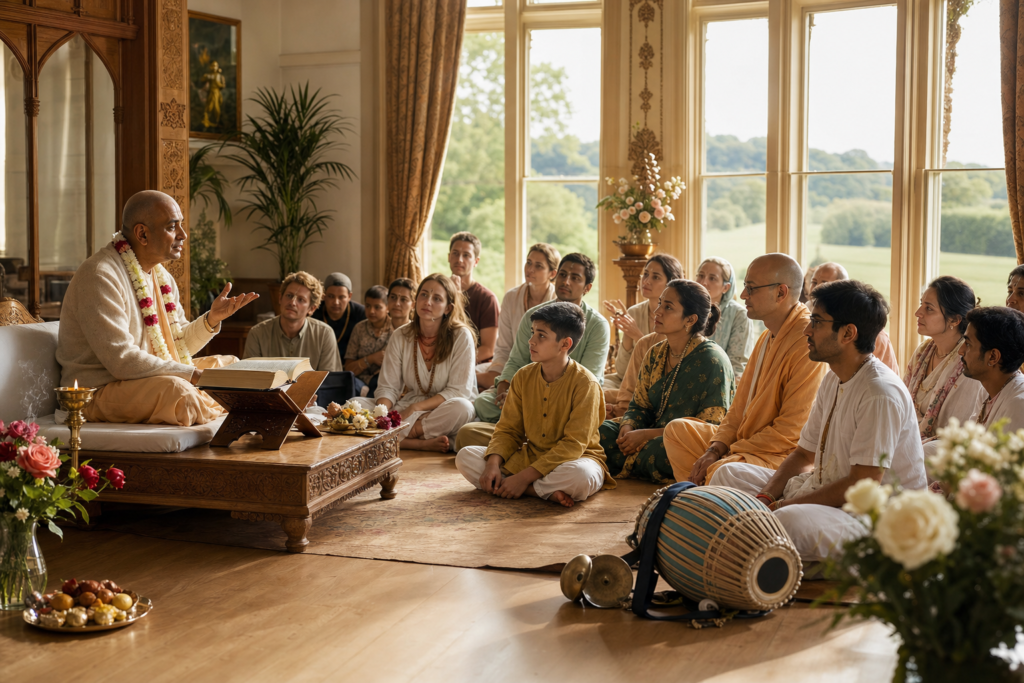
Key themes recur with instructive symmetry: the ear as the gateway to the heart; the eye purified by beholding; speech transformed into prayer; breath synchronized with remembrance. In many households, verses are recited at dawn or dusk, when transitions sharpen awareness. Teachers sometimes recommend meditating on a single verse for days, allowing meaning to unfold through repetition. Such practices demonstrate how a slender lyric corpus sustains a full devotional lifethe mark of a classic.
Dating the historical Bilvamangala continues to invite debate. Internal allusions align the poem with a post–Bhagavata Purana world of aesthetics and devotion; stylistic features suggest composition no earlier than the late first millennium. Conservative estimates place him between the 11th and 13th centuries; Gaudiya memory associates the text’s transmission with the early 16th century through Sri Chaitanya’s South India pilgrimage. Rather than a problem, this layered chronology should be seen as evidence of the work’s wide and early diffusion, with local communities curating and transmitting their beloved verses within resilient oral and manuscript cultures.
For students of Hindu philosophy, the poem’s soteriology is strikingly practical. Liberation (mokṣa) is not treated as distant abstraction but as a transformation of perception in the midst of life. The senses, often suspected in ascetic discourse, are here re-educated: the ear delights in Krishna’s names, the tongue is sanctified by praise, the mind quiets in sweet remembrance. This pedagogy harmonizes with broader Indian contemplative traditions that reframe rather than repress human faculties, guiding them toward their noblest object.
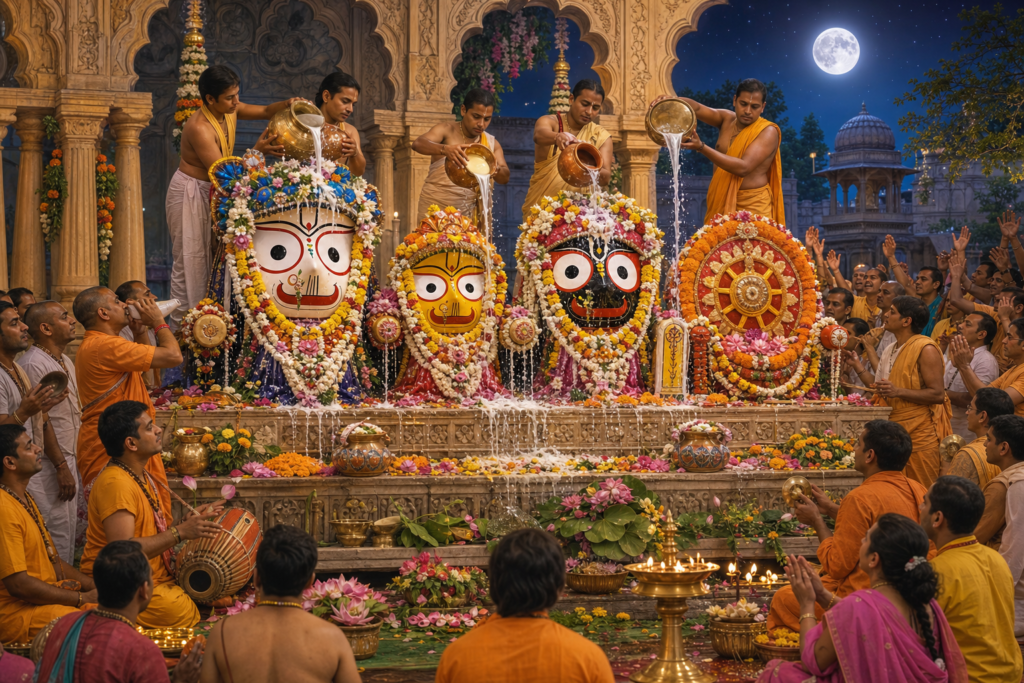
Krishna Karnamrita’s influence in Gaudiya Vaishnavism is particularly visible in devotional rhetoric and imagery: the child Krishna’s mischief as theological disclosure, the flute as both instrument and irresistible summons, the dust of Vrindavan as sacramental presence. These motifs, carried into song, dance, and visual arts, have in turn shaped the public imagination of Krishna across India and the global diaspora. Contemporary kirtan movements, including the Hare Krishna tradition, continue to cherish and circulate verses that owe much to Lilasuka’s aesthetic horizon.
As scholarship on Sanskrit literature expands, Krishna Karnamrita increasingly serves as a nexus for interdisciplinary study. It provides material for comparative poetics (how rasa theory maps onto devotional experience), for manuscript studies (how textual communities curate and authorize variants), and for religious studies (how intimacy with the Divine reshapes ethical life). In each arena, Lilasuka’s poetry refuses narrow categorization: it is scripture-adjacent without being canonical, yearning yet measured, personal while universally intelligible.
Despite the legends surrounding his biography, Lilasuka’s legacy is not a mystery. It is audible. The poem’s enduring power lies in how it trains perception: to hear the world as invitation, to see play as revelation, to welcome devotion as clarity rather than escape. In doing so, it strengthens the bonds of a shared Dharmic heritage, reminding diverse communitiesHindu, Buddhist, Jain, and Sikhthat love, discipline, and contemplative artistry are common ground worth tending together.
In sum, Lilasuka’s Krishna Karnamrita is not merely a relic of India’s literary past; it is a living guide to spiritual and aesthetic practice. It unites exquisite Sanskrit craftsmanship with a theology of sweetness, invites rigorous reading alongside heartfelt song, and demonstrates how a few hundred verses can carry lifetimes of contemplation. For those seeking depth in Hindu devotional literature and for those cultivating unity among Dharmic traditions, this nectar for the ears remains, in every sense, a timeless gift.
Inspired by this post on Hindu Blog.