
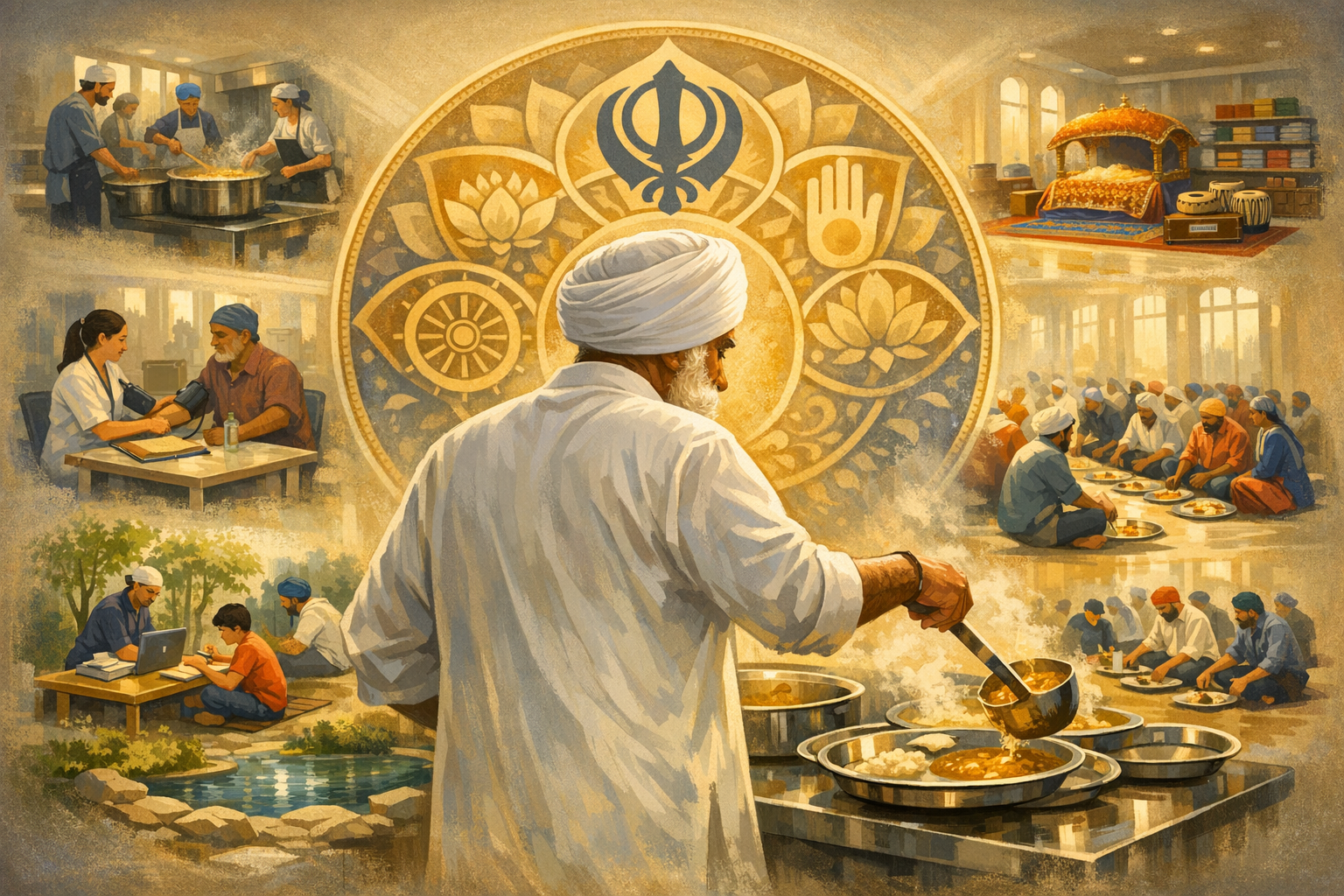
Baba Balwinder Singh Dhaliwal (1958–2026) is remembered within the Sikh community and the broader Dharmic family for an unwavering commitment to seva, a lived embodiment of Ik Onkar, and a practical dedication to sarbat da bhala. His name invokes the quiet authority of a community elder whose guidance flowed not from institutional power but from disciplined practice, compassion, and an ethic of universal uplift. In commemorating his life, the most meaningful tribute is an examination of the principles and operational disciplines that defined his public service and spiritual presence.
Publicly available particulars about his early biography remain limited; however, the ethical imprint associated with the title “Baba” points to a life patterned by daily discipline, humility (nimrata), and consistent service. Rather than foregrounding unverified details, a responsible profile of his legacy situates his memory in the well-documented frameworks of Sikh praxis—Naam Japna, Kirat Karni, Vand Chakna—and in the Gurmat vision that community welfare is a sacred charge. In this sense, his remembrance is not merely hagiography but a study in how Sikh spiritual commitments may be translated into enduring institutions of care.
At the doctrinal core of Sikhism, the primacy of Guru Granth Sahib and the Rehat Maryada sets the cadence of spiritual life through Nitnem, Simran, and Kirtan. Figures revered as “Baba” typically exemplify these rhythms by embodying a culture of remembrance (Simran), truthful living (Kirat Karni), and sharing (Vand Chakna). This triad ensures that devotion, labor, and generosity are inseparable—and that personal attainment is validated only insofar as it nourishes the sangat and the wider world.
In practice, this ethic is often most visible in the gurdwara’s langar, where universal access, vegetarian meals, and egalitarian seating operationalize equality and dignity. The technical excellence of a mature langar system rests on predictable procurement, hygienic food handling, balanced menus that meet nutritional needs, and transparent accounting. Volunteer rosters, shift-based tasking, and a culture of safety (including attention to fire controls and first-aid readiness) convert goodwill into reliable throughput. Such attention to detail honors the spiritual injunction that compassion must be rigorous to be effective.
Sound governance deepens impact. Community committees that plan seva initiatives benefit from clear roles, published budgets, and independent audits that sustain trust. Cashless contributions, traceable procurement, vendor due diligence, and periodic disclosures align the spiritual imperative of integrity with contemporary expectations of public accountability. In this way, a gurdwara becomes both a sanctuary and a benchmark institution for ethical administration.
Education-focused seva offers another durable pathway to uplift. Scholarship support, tutoring circles, and skill-building workshops for youth create intergenerational bridges that preserve heritage while expanding opportunity. Programs that teach Punjabi and Gurbani recitation alongside STEM mentoring, digital literacy, and ethics in technology help young people integrate identity with vocation. In many communities, such programming emerges when elders model patient mentorship and insist on the unity of learning and character.
Public health seva—including medical check-ups, chronic-disease screening, and health-literacy sessions—translates compassion into measurable outcomes. Within a Sikh framework, care for the body is inseparable from care for the spirit; addressing nutrition, preventive health, and dignified elder care extends the langar ethos beyond the kitchen into the rhythms of daily life. Trauma-informed listening circles and referral networks to qualified professionals reflect an inclusive, humane approach to mental well-being.
Sikh doctrine affirms gender equality, and robust seva ecosystems make that doctrine concrete. Inclusive leadership pathways, women-led Kirtan, and training that counters implicit bias ensure that participation is not symbolic but substantive. Institutionalizing safety policies, redressal mechanisms, and equal access to resources are not mere procedural steps; they are spiritual commitments to justice, reflected in organizational design.
Interfaith engagement grounded in Dharmic ethics was a hallmark of the values associated with Baba Balwinder Singh Dhaliwal’s remembrance. Within the Dharmic family—Hinduism, Buddhism, Jainism, and Sikhism—there is profound convergence on compassion (daya/karuna), non-harm (ahimsa), truthfulness (satya), self-restraint (aparigraha), and service (seva/dana). While metaphysical articulations differ—Sikhism’s monotheistic affirmation of Ik Onkar, Hinduism’s plurality of sadhanas and Ishta, Buddhism’s path of insight and compassion, and Jainism’s anekantavada—the ethical horizons are shared. This common ground is fertile soil for joint seva that puts people before polemic.
Respectful dialogue across traditions preserves the integrity of each path while celebrating unity in spiritual diversity. A Sikh gurdwara’s aniconic devotion and sung shabad can stand alongside a Hindu mandir’s murti-seva, a Buddhist vihara’s meditation discipline, and a Jain derasar’s vrata with mutual regard. The unifying crux is not liturgical conformity but ethical kinship and a shared willingness to labor for the vulnerable.
Conflict transformation in community life benefits from pastoral wisdom and procedural clarity. Mediation circles facilitated by trusted elders, time-bound action items, and follow-up reviews create a restorative justice pathway that prioritizes truth, dignity, and reconciliation. When supported by clear bylaws and transparent minutes, these processes nurture social cohesion without suppressing dissent.
Environmental seva, increasingly central to community ethics, reflects the Sikh insight that creation is divine expression. Tree-planting drives, sarovar cleaning, water-conservation workshops, and single-use-plastic reduction link spiritual aspiration to ecological stewardship. The affirmation—“Nanak Naam chardi kala, tere bhane sarbat da bhala”—extends naturally to planetary well-being.
In an era of digital connectivity, technology can amplify seva when deployed with prudence. Secure donation portals, volunteer-management platforms, multilingual outreach, and privacy-conscious data practices widen participation while safeguarding trust. Digital Kirtan and educational content can serve the housebound, the diaspora, and seekers beyond geographic boundaries—provided curation remains accountable and grounded in Gurmat.
Measuring impact does not diminish devotion; it makes devotion durable. Balanced scorecards that track meals served, learners mentored, clinical screenings completed, trees planted, and volunteer hours logged help organizations learn and adapt. Qualitative narratives—carefully collected with consent—add the human texture that numbers alone cannot capture. Together, evidence and empathy keep institutions responsive.
Ethical leadership in the Sikh lexicon is a synthesis of virtues: daya (compassion), dharam (righteous conduct), nimrata (humility), santokh (contentment), and sharda (devotional resolve). When these qualities are organized into systems—policies, committees, budgets, rotas—they become replicable culture rather than transient mood. Such leadership is less a charisma than a consistency, less a performance than a practice.
The enduring legacy linked with the memory of Baba Balwinder Singh Dhaliwal rests, therefore, not on monuments but on methods: disciplined worship, honest labor, shared bread, transparent institutions, and interfaith collaboration. By insisting that spirituality be as exacting as any craft, that compassion be as organized as any enterprise, and that unity be as intentional as any policy, this legacy invites communities to grow both tender and strong.
As a historical note, the present profile privileges principles over anecdote where verifiable archival detail is scarce. This approach aligns with academic rigor and with the Dharmic commitment to truthfulness: it honors the person by elevating the practices that outlive personality. In doing so, it recognizes that a life of seva writes its biography most clearly in the hearts it elevates and the institutions it steadying builds.
Inspired by this post on SikhNet – News.










Leave a Reply
You must be logged in to post a comment.