
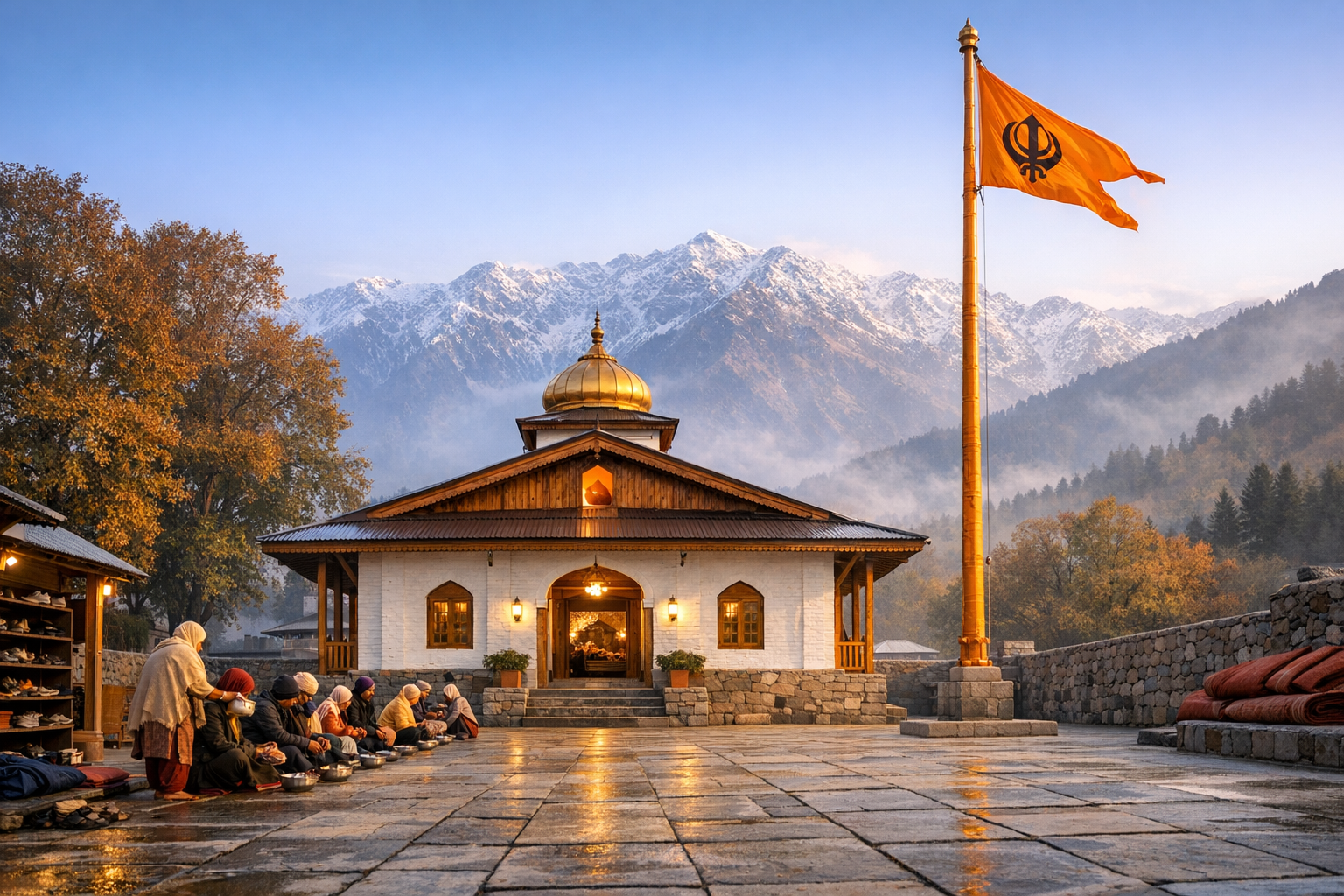
Gurdwara Tapiana Sahib in Shalkote, set within the quiet expanse of the Kashmir Valley in Jammu and Kashmir, is venerated as the Tap Asthan—seat of tapasya—of Sant Bhai Rocha Singh Ji. The site is cherished by the local sangat and visiting pilgrims alike as a locus of disciplined contemplation, service, and remembrance. Its spiritual identity is anchored in the Sikh synthesis of simran (meditative remembrance), seva (selfless service), and gurmat (the Guru’s wisdom), while remaining open and welcoming to all who seek solace and insight. As a living heritage space, it exemplifies how Sikh institutions safeguard sacred memory and transmit ethical practice across generations in a region known for its layered civilizational history.
Situated in North Kashmir’s highland landscape, Shalkote’s natural calm shapes the devotional atmosphere of the gurdwara complex. The daily cadence of kirtan, Ardas, and langar stretches beyond ritual form into embodied compassion, fostering community cohesion in a place where mountain quietude deepens the quality of inner reflection. Pilgrims routinely observe that the environment—crisp air, soft light, and seasonal shifts—amplifies awareness in ways that complement the contemplative character of a Tap Asthan. This union of geography and practice helps explain why Gurdwara Tapiana Sahib continues to draw visitors who seek both rootedness and renewal.
In a broader dharmic frame, Tap Asthan denotes a site consecrated by tapas—disciplined austerity and transformative inner work—a principle that resonates across Hinduism, Buddhism, Jainism, and Sikhism. In Sikh thought, external austerity yields to the primacy of inward alignment with hukam (the cosmic order) through naam-simran and an ethical life grounded in seva. Gurdwara Tapiana Sahib, therefore, represents a distinctly Sikh articulation of a shared civilizational ideal: spiritual strength expressed through compassionate action. This shared grammar of discipline and service makes the shrine a natural bridge among dharmic traditions, where visitors of diverse paths can recognize familiar virtues without erasing doctrinal distinctiveness.
Local oral tradition venerates Sant Bhai Rocha Singh Ji as a sant whose resolute practice and moral clarity nurtured the spiritual ethos of Shalkote. The memory of such sants typically endures through song, story, and institutional habits—daily maryada, communal langar, and the quiet counsel offered to those in distress. At Gurdwara Tapiana Sahib, this remembrance is not preserved as museum-like stasis; rather, it is expressed as living continuity in the sangat’s care for guests and neighbors. The Tap Asthan designation thus signals both historical sanctity and a present-tense commitment to the saint’s values.
The liturgical life of the gurdwara follows established Sikh maryada. The Guru Granth Sahib is enthroned on a raised palki within the prayer hall; the sanctum’s dignity, maintained through cleanliness and decorum, directs attention to shabad as the sovereign guide. Kirtan unfolds as contemplative exposition, followed by Ardas and the sharing of karah prasad, reaffirming equality before the Guru. In the langar, volunteers prepare and serve simple, nourishing food without distinction of background, a practice that embodies the core Sikh ethic of human dignity and social harmony. Regular Gurpurabs—especially Guru Nanak Jayanti and Vaisakhi—animate the annual calendar, drawing wider participation and reinforcing bonds among neighboring communities.
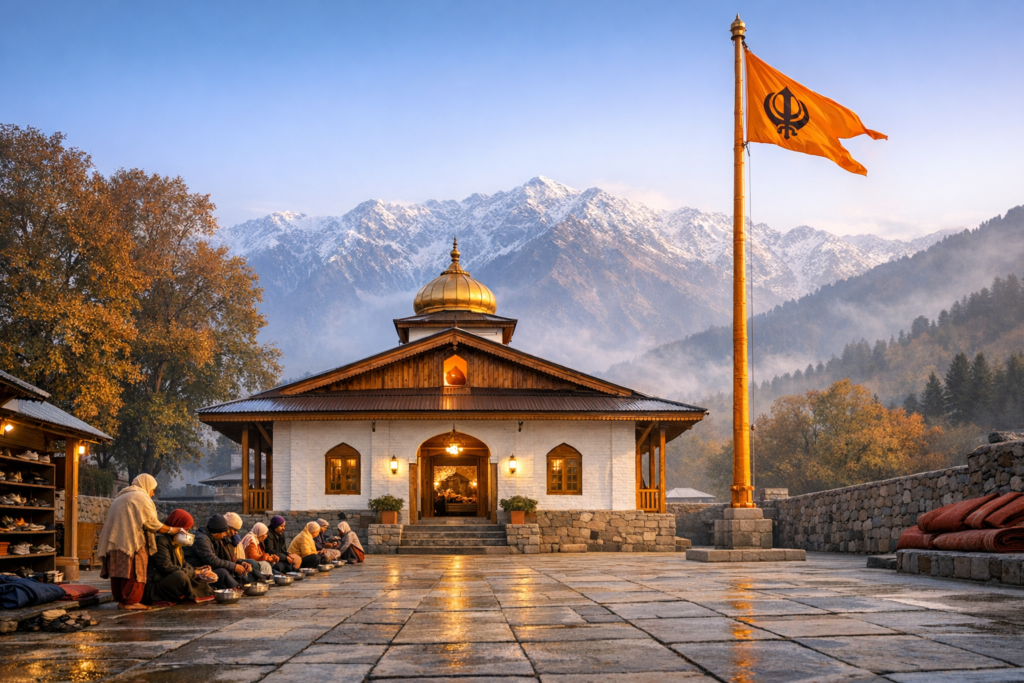
Architecturally, Gurdwara Tapiana Sahib aligns with functional clarity characteristic of gurdwaras: a congregational hall oriented toward unhindered singing of shabad, a prominent Nishan Sahib that marks the presence of the Guru’s house, and dedicated spaces for langar and community care. While the exact building materials vary with local availability, the emphasis on warmth, light, and accessible circulation responds to the Valley’s climate and the community’s needs. The simplicity of the complex underscores a Sikh aesthetic that privileges the radiance of sabad over monumental display, inviting quiet recollection rather than spectacle.
Commemorative observances at the Tap Asthan focus on ethical remembrance rather than ceremonial excess. Local sangat often marks the sant’s legacy through kirtan diwan, reflective discourses, and extended seva in langar, hospitals, schools, or neighborhood clean-ups. Such programming weaves spiritual aspiration to civic responsibility, reminding participants that inner discipline and public compassion sustain one another. Visitors commonly report that the feeling of stillness at the site lingers well beyond the formal program, as if the disciplines of the Tap Asthan continue to work gently within.
Historically, Sikh presence in the Kashmir Valley is documented through travel traditions linked to Guru Nanak’s udasis and later through evolving community networks, trade routes, and administrative linkages in the early modern period. Over centuries, Sikh households and institutions contributed to the Valley’s intricate mosaic of cultures, languages, and devotional practices. In that continuum, Gurdwara Tapiana Sahib stands as both a devotional anchor and a cultural archive, safeguarding stories, hymns, and service traditions that define Sikh heritage in Kashmir. Even in times of difficulty, the routine of kirtan and langar has offered stability, mutual aid, and a sense of shared destiny.
The Tap Asthan’s message also resonates beyond confessional boundaries. Visitors from Hindu, Buddhist, Jain, and other backgrounds frequently recognize in its disciplines the familiar dharmic motifs of tapas, ahimsa, dana, maitri, and shraddha. The gurdwara’s open doors and the equal seating of langar operationalize religious pluralism not as abstraction but as daily practice. This lived hospitality affirms that unity in spiritual diversity can be cultivated through small, consistent acts of care that honor difference while building common life.
As a heritage site, Gurdwara Tapiana Sahib benefits from careful documentation and preservation strategies. Intangible heritage—kirtan repertoires, oral histories of Sant Bhai Rocha Singh Ji, local narratives of seva, and seasonal observances—deserves systematic recording alongside the conservation of built structures. Community-led archives, multilingual transcription of oral accounts, and sensitive repairs respecting local craft practices can together ensure that continuity is preserved without erasing historical texture. Such measures complement broader heritage-preservation goals in Jammu and Kashmir, where custodianship of sacred spaces is closely tied to social well-being.
Visitor etiquette reflects the gurdwara’s emphasis on respect and inclusivity. Head covering, removal of shoes, and modest attire express humility; sitting together for langar enacts equality; refraining from disruptive behavior preserves the contemplative tone appropriate to a Tap Asthan. Those encountering Sikh practice for the first time often find that stewards and volunteers provide gentle guidance, making the experience both accessible and meaningful. In this way, the site functions as a classroom of lived ethics as much as a house of prayer.
Sustainability practices are increasingly aligned with seva at Gurdwara Tapiana Sahib. Waste reduction in langar, responsible sourcing of staples, and attention to local environmental conditions reflect an ethic that recognizes nature as a shared trust. This ecological attentiveness is congruent with the dharmic understanding that spiritual maturity includes restraint, gratitude, and stewardship—virtues that protect both community health and the sanctity of place.
For researchers and heritage practitioners, the gurdwara offers a fertile setting for interdisciplinary study—combining religious history, ethnography, musicology, and heritage conservation. Comparative inquiry can illuminate how Sikh Tap Asthans relate to tapas traditions across Hinduism, Buddhism, and Jainism, and how these shared ideals shape practices of compassion and hospitality. Insights gleaned here can inform wider efforts in cultural preservation and interfaith understanding, demonstrating that rigorous scholarship and community care can be mutually reinforcing.
Ultimately, Gurdwara Tapiana Sahib, Shalkote, stands as a living testament to Sant Bhai Rocha Singh Ji’s spiritual clarity and to the Sikh conviction that disciplined remembrance must be inseparable from service. In the quiet of the Kashmir Valley, the Tap Asthan’s daily rhythms invite introspection while extending unmistakable warmth to all who enter. By uniting tapas with seva, and devotion with equality, the shrine offers a luminous example of how dharmic traditions can converge in shared purpose—honoring the past, strengthening the present, and nurturing hope for a more harmonious future.
Inspired by this post on SikhNet – News.








Leave a Reply
You must be logged in to post a comment.