
This article was originally posted on the Chanakya Forum.
Pakistan’s recurring political crises can be traced back to its inability to fortify democratic institutions and build a robust state-society relationship since its independence. The present political conundrum is the latest outburst of this crisis that commenced in 2022. The opposition parties banded together to present a no-confidence motion against Imran Khan’s government in the National Assembly.
This action had political ramifications throughout the nation, leading to a chain of crises that impacted governance at both the national and provincial levels. The crises did not stop in Islamabad; the resignation of Punjab Chief Minister Usman Buzdar on the imperative of Prime Minister Imran Khan in favor of PTI’s ally Pervaiz Elahi supplemented the apprehension that political chaos is not far from exacerbation. Soon, the Chief Minister of Khyber Pakhtunkhwa, Mahmood Khan, faced a no-confidence motion from the opposition parties in the provincial assembly. Similarly, the Pakistan Tehreek-e-Insaf (PTI) submitted a motion of no-confidence against their own Administered Kashmir prime minister adding another leaf to the complexity.
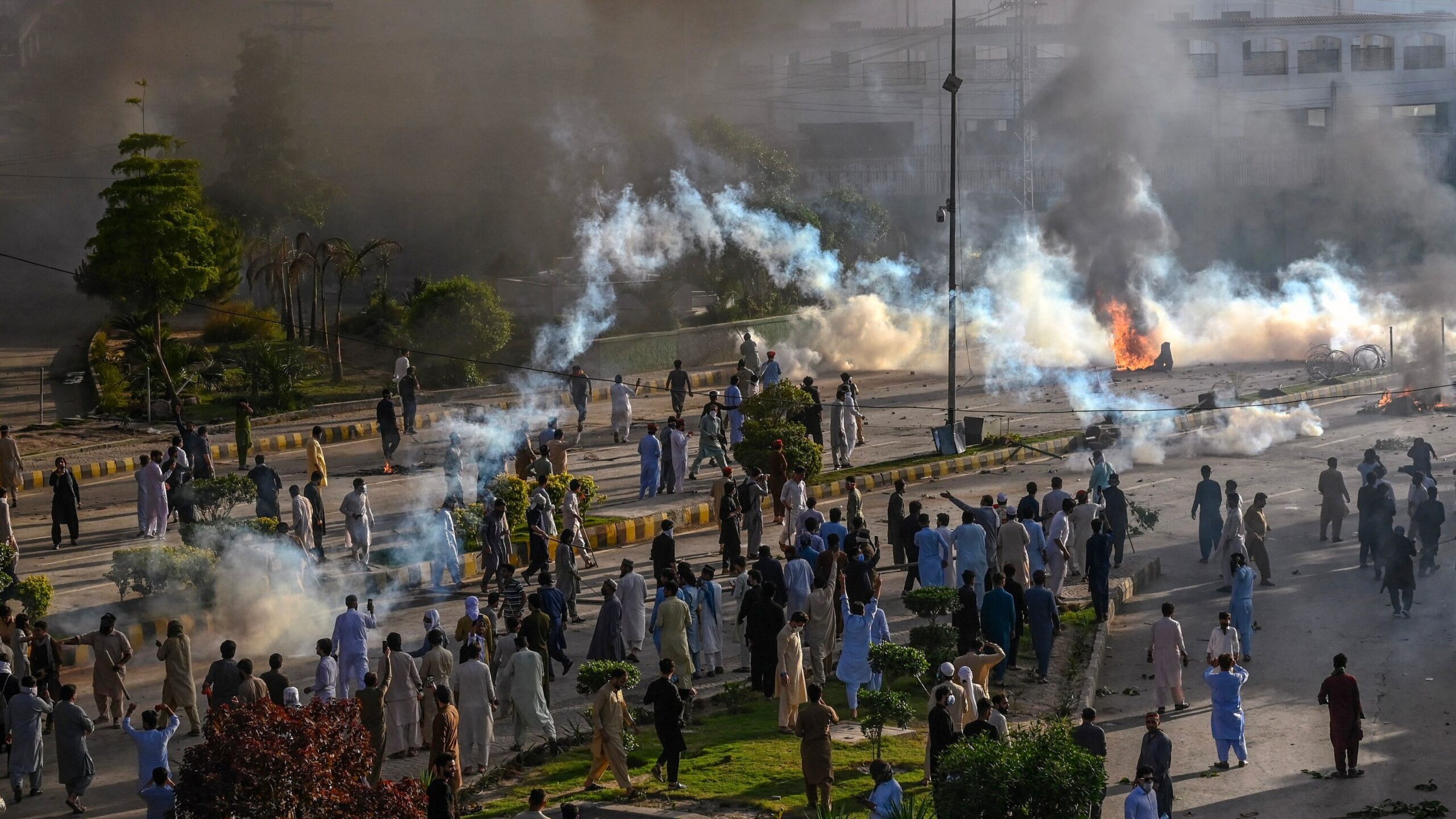
On May 9, 2023, Imran Khan was taken into custody by the police at the Islamabad High Court. The arrest of Imran resulted in a widespread demonstration by his followers across the country. According to reports, supporters of the PTI engaged in violent behavior as a means of protesting against the arrest. The country has implemented a ban on various social media platforms, such as Twitter, Facebook, and Instagram. Khan’s arrest was carried out by NAB officials, specifically acting upon the Al-Qadir Trust case. Since being removed from office in April of last year, Khan has been confronted with a series of legal challenges and is currently dealing with a significant number of legal cases, totaling over 140, which are related to various serious offenses such as terrorism, blasphemy, murder, violence, and incitement to violence.
Interconnected Challenge of Economic Collapse and Extremism
The current impasse has associated causes, which makes it imperative to address those in the first place and then move on to correct the constitutional crises. These associated factors are economic collapse, internal security, and extremism. The economic crisis that Pakistan is currently facing arises due to a pattern of factors ranging from financial mismanagement, political instability, crony capitalism, corrupt political practices, and the severe floods that occurred in 2022. These factors have collectively contributed to the country’s economic instability and brought it to the brink of collapse. The reliance on IMF bailouts and debt concessions from partners like China, Saudi Arabia, and the UAE only aggravates and hurts its economic growth, which is highly dependent on internal stability. For internal stability, Pakistan needs to teach its people civic sense, and as long as the military establishment controls the political order, it is impossible to achieve this goal.
An unstable Pakistan is a grave concern for regional stability given the sense of alienation in the regions of Khyber Pakhtun and Balochistan, which has given rise to separatism and extremism, making Pakistan a breeding ground for transnational extremism. Therefore, a democratic Pakistan would have been a win-win situation for South Asia and India in particular. A democratic Pakistan would not have let its soil be used to fetch cross-border extremism and separatism. It would have respect for human rights, procedural justice, and integrity, which indicates that there are legitimacy crises deeply entrenched in the military establishment as well as mannequin political leadership. The reliance on transnational extremism, particularly in Kashmir, has so far enabled the establishment to satisfy this deficiency. Therefore, it is high time for Kashmiris to realize the fault lines that lie beneath the surface and not rely on Pakistani rhetoric of freedom and separatism. A state that suffers from external political meddling cannot claim to be a beacon of freedom for others.
Pakistan should not be compared with republics, democracies, and sovereignties in the region and beyond, making it difficult to comprehend. In reality, Pakistani politics has a novel and straightforward format. It’s undeniable that the Army is the only strong institution that believes it can keep the nation together in the face of the gravest of difficulties, and that it’s more than just a political party in its own right. Its preeminence may be attributed to three main factors: keeping the corrupt political structure afloat, exploiting the Kashmir problem for legitimacy, and skillfully administering the project of social engineering in disturbed regions. In other words, it makes no difference how many people support Imran Khan or Shahbaz Sharif in the election, how many people show up to rallies for Khan or Sharif, or how many people vote. It has a powerful nuclear arsenal but a feeble economy, making it very reliant on external economic support from the United States and China.
Unstable Political Landscape – Threat to Regional Stability
When it comes to the necessity of maintaining good relations with the United States, the Army knows more than any political party or leader. Thus, Imran Khan committed political suicide when, on February 24, 2022, he a visited Moscow. According to IK, despite being the Army’s sweetheart in 2018, the United States wants to replace Khan as Prime Minister and has expressed this wish via a minor employee at the State Department named Donald Lu. His temper outbursts, bombastic speeches, and social media clout won’t help him regain power. There is a strong possibility of barring him from running in the National Assembly elections, and his party is also likely to lose several members through defection to the oppositionencouraged by the Army at the US’s behest. The fact that he publicly accused actual generals sealed his fate. If he avoids the destiny of leaders like ZA Bhutto, he may consider himself lucky. Amidst the ongoing political turmoil in Pakistan, it is important to note the role of Imran Khan and the extent to which he has gone to gain power. He has done everything by putting the country at stake and being willing to go to any extent to achieve his political ambitions. His actions and decisions have contributed to the current state of crisis in the nation. It’s uninformed and useless for Indian TV stations to debate whether PTI or PML-N has a better chance of regaining power.
To conclude, an unstable Pakistan is dangerous for India and the region. A stable Pakistan is a requirement for peace in the subcontinent. For India a peaceful, vibrant, and democratic neighbour which respects human dignity and having the understanding that in a peaceful environment lies prosperity and growth will always be the best scenario plausible
Please consider supporting Chanakya Forum and following their twitter account.