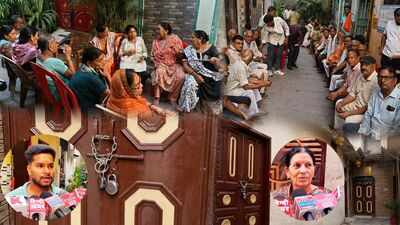
Tension gripped Kolkata’s Rajabazar on May 16, 2026, after a dispute reportedly arose over the temporary use of a public road for Jumma Namaz. The busy arterial zone saw heightened attention from residents, commuters, and local shopkeepers as police mobilized to maintain public order and reopen traffic in this high-density part of West Bengal’s capital.
Rajabazar’s urban formnarrow carriageways, dense footfall, and bustling marketsmakes it particularly sensitive to short-lived surges around Friday Namaz. Similar pressure points exist across Indian metros, where sacred time and urban time can collide, and where negotiated solutions remain both necessary and achievable.
The immediate issue at stake was not the act of worship itself but the allocation of limited public right-of-way during a peak window. When congregations exceed mosque capacity, spillover into adjoining streets can occur, giving rise to disputes with motorists, pedestrians, and traders who depend on continuous access. Managing this interface is fundamentally a question of urban governance rather than inter-community antagonism.
India’s constitutional architecture offers a clear compass. Article 25 guarantees freedom of religion subject to public order, morality, and health, while Article 19 protects freedom of movement and the right to carry on trade and profession. Urban authorities must therefore balance both sets of rights through reasonable, content-neutral regulations that uphold public order without discriminating among faiths.
Courts have repeatedly underscored that public ways cannot be occupied indefinitely and that assemblies in shared spaces require prior authorization and proportionate regulation. The Supreme Court’s jurisprudence on prolonged occupation of roads articulates a general principle equally applicable to religious, cultural, and political gatherings. High Courts, including the Calcutta High Court, have consistently emphasized permission-based use of public spaces to balance mobility with the freedom of assembly and worship.
In Kolkata, the administrative practice typically hinges on three pillars: advance permission, time-bound and demarcated use, and proactive traffic management. When these pillars are applied consistently, friction diminishes and the lived reality of pluralism becomes visible in the very choreography of the city’s streets.
The same parity must extend to all traditions that occasionally require public spaceDurga Puja pandals, Muharram processions, Nagar Kirtan during Gurpurab, Jain Paryushan processions, Vaishnava kirtans, and others. A single civic rulebook, applied evenly, sustains both devotion and daily life, strengthening communal harmony in Kolkata and across West Bengal.
Law enforcement response in Rajabazar focused on de-escalation, crowd guidance, and dialogue with community representatives. Such an approach aligns with best practice: protect the prayer, protect the passage, and protect the peacesimultaneously and without prejudice. Residents have often recalled how similarly structured approaches during large religious events kept neighborhoods calm and functional.
Crowd safety science provides additional clarity. Pedestrian flow remains safe when densities stay below critical thresholds; as crowding approaches four to five persons per square metre, mobility and situational awareness degrade, and risk rises. Pre-planned cordons, clear ingress and egress routes, and visible stewards can prevent hazardous compression and facilitate rapid dispersal after Friday Namaz.
Data-informed planning strengthens these safeguards. Mapping expected turnout for Jumma Namaz, overlaying it with carriageway widths and choke points, and aligning it with bus schedules and emergency corridors enable micro-diversions that are minimally disruptive yet maximally protective. Kolkata Police can leverage GIS layers and live footfall estimates to precision-time diversions and reopenings.
Equally important is a community stewardship model. Mosque committees, temple committees, gurdwara sewadars, and Jain sanghs can jointly nominate volunteer marshals trained in first aid, basic traffic guidance, and rumor control. This multi-faith stewardship not only improves safety; it also builds everyday trust and normalizes interfaith dialogue at the street level.
Communication protocols should be transparent and multilingual. When a temporary lane closure is unavoidable, early public notices, SMS or app alerts, and prominent signage reduce anxiety. Residents often recall how thoughtfully announced Durga Puja diversions or Muharram routes kept neighborhoods calm; the same clarity and predictability help during Friday Namaz on or near a public road.
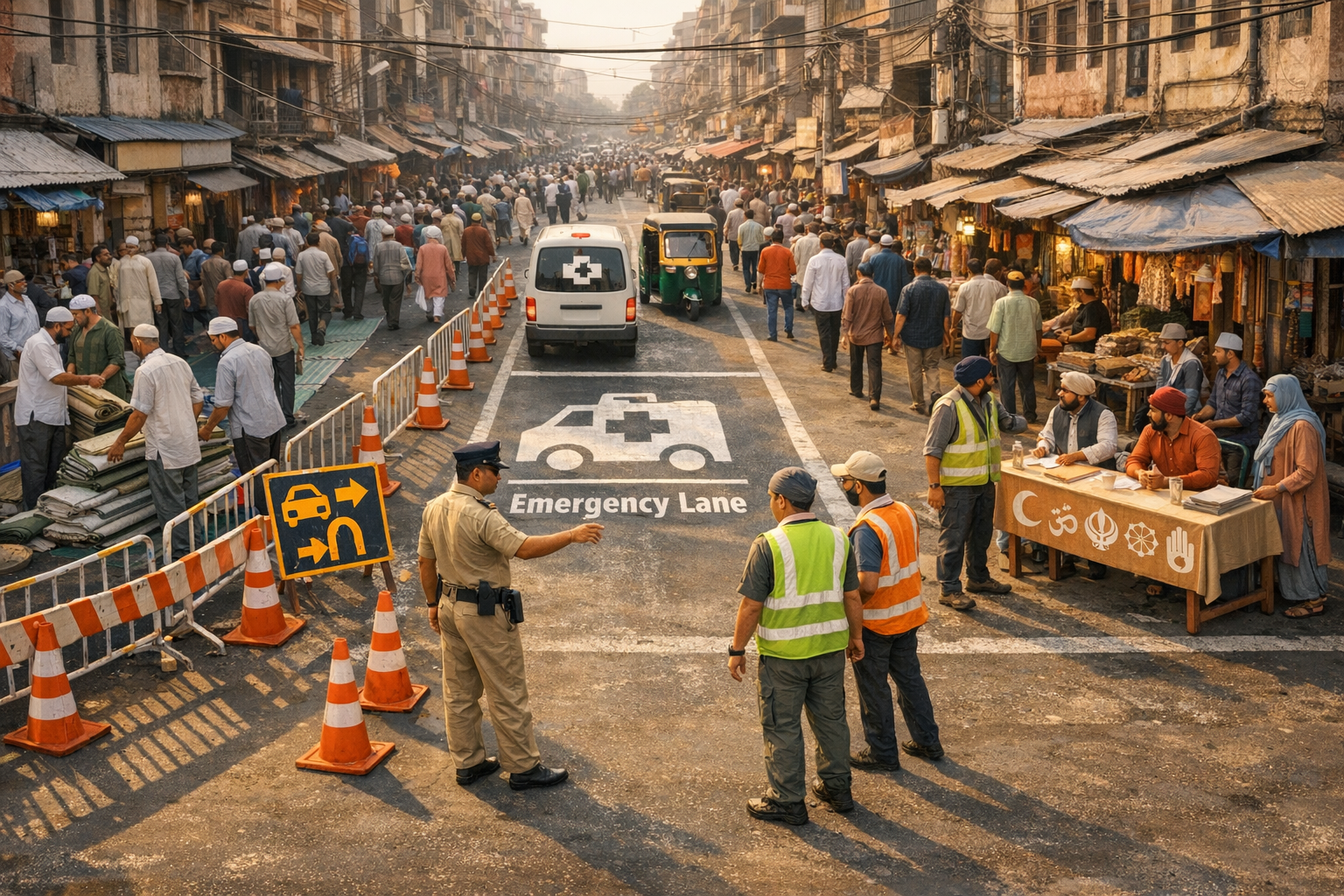
Emergency access must remain inviolable. Designated ambulance lanes, hydrant access, and police quick-response channels should be non-negotiable features of any plan that anticipates overflow onto a public road, however brief. These measures satisfy both public safety and the constitutional mandate to preserve public order.
Proportionality and minimalism are the touchstones of lawful restriction. If a few minutes of guided dispersal can reopen a carriageway, authorities should favor that over broad closures; if a nearby open ground can host overflow, it should be prioritized over a roadway; if microphones suffice, loudspeakers should respect notified decibel and time limits under applicable noise rules.
Kolkata’s civic legacy offers instructive precedents. Year after year, the city hosts large processions and festivals through consensual scheduling, route curation, and stewarding. Replicating that institutional muscle memory for weekly worship peak-loads is both feasible and faithful to the city’s ethos of coexistence.
From a rights perspective, the touchpoint is equality before the law. The same constitutional promise that safeguards Jumma Namaz safeguards a Shabad Kirtan, a Jain prabhat pheri, or a Hindu shobha yatra. Consistent enforcement nurtures a culture in which every community sees its neighbor’s worship as part of the city’s collective rhythm.
To consolidate these gains, a standing multi-faith coordination cell for Kolkata could meet monthly, with representation from imams, mahants, seers, bhikkhus, and granthis alongside municipal and police officials. The agenda would be practical: site inventories for overflow prayer, rotation rosters, volunteer training, and post-event reviews that refine Standard Operating Procedures for public space management.
Rumor containment is as vital as traffic re-routing. In the era of instant messaging, unverified clips can inflame sentiment in minutes. A verified, real-time bulletin from Kolkata Police and borough officesmirrored by faith-based institutionshelps inoculate neighborhoods against misinformation and sustains public confidence.
Socio-economic sensitivities also matter. Friday midday intersects with market cycles and daily-wage livelihoods in Rajabazar; small acts of accommodationbrief timing offsets, staggered dispersal, or loading-bay managementcan avert avoidable financial stress for traders, transporters, and small businesses.
Viewed through the wider lens of West Bengal’s plural civic fabric, the Rajabazar episode is a reminder rather than a rupture. Pluralism survives not by accident but by designthrough rules that are even-handed, plans that are precise, and relationships that are renewed week after week.
Moving forward, the actionable synthesis is straightforward: designate suitable non-road spaces for overflow where possible; when roads must be used, keep the closure narrow, timed, and stewarded; notify early; keep emergency paths open; and review outcomes transparently with community partners from all traditions.
Such discipline of law and empathy of practice reinforce one another. They allow Kolkata to honor Jumma Namaz, protect movement, and model the dharmic ethic of mutual respect that Hindus, Buddhists, Jains, Sikhsand indeed all communitiesaspire to embody.
In sum, Rajabazar’s moment of tension can yield lasting wisdom: public order and religious freedom are not rivals in a constitutional city; they are co-authors of its everyday harmony.
Inspired by this post on Struggle for Hindu Existence.