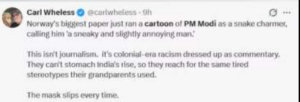
Norway’s largest daily, Aftenposten, recently published a political cartoon depicting India’s Prime Minister Narendra Modi as a snake charmer playing a flute to “charm” a serpent shaped like a fuel‑pump nozzle, during his diplomatic visit to Oslo. The image appeared with a headlinecredited to journalist Frank Rossavikstating “A sneaky and slightly annoying man.” The cartoon drew swift condemnation across India, Norway, and the global diaspora for reviving a racialized colonial trope historically used to diminish Indians, particularly Hindus.
This episode coincided with a separate flashpoint when journalist Helle Lyng asked, “Why don’t you take questions from the freest press in the world?” despite reportedly not being officially part of the visit’s press arrangements. The conjunction of a racially coded image and a sweeping claim about press freedom sharpened an already sensitive conversation about media ethics, public diplomacy, and cross‑cultural respect.
In subsequent remarks, Sibi George from India’s Ministry of External Affairs reiterated that “India believes in the rule of law,” emphasized that the country is frequently misunderstood, and highlighted Ancient India’s contributionssuch as the numeral systemlinking a long civilizational record of knowledge to contemporary Indian achievements.
From the standpoint of media history, the “snake charmer” motif is neither incidental nor harmless. Catalogued in colonial‑era photography, postcards, and editorial cartoons, it became a canonical Orientalist shorthand for depicting Indians as pre‑modern, irrational, or magical, rather than rational political actors. Popular‑culture echoesfrom travel brochures to films like Temple of Doomfurther normalized the trope. Repeating that code in 2026 reactivates a hierarchy that renders a modern nation’s policies as spectacle rather than subject for serious analysis.
The fuel‑nozzle serpent trains attention on energy politics while subtly discrediting Indian statecraft. By implying that New Delhi advances energy interests through “charm” rather than negotiated strategy, the cartoon elides the well‑documented policy landscape of price volatility, supply diversification, energy‑security trade‑offs, and decarbonization commitments. That framing neither informs readers nor treats India as an equal in the international system that Norway itself helps shape.
None of this negates press freedom; rather, it clarifies its ethical horizon. Journalism codessuch as the Society of Professional Journalists’ Code and the IFJ Global Charter of Ethicsrepeatedly stress minimizing harm, avoiding stereotyping, and providing context. Political satire is rightly protected, but satire that leans on racialized shorthand, especially Hinduphobic caricature, undermines the credibility that free media depend upon.
These dynamics are acutely felt by Western‑born members of Dharmic communitiesHindu, Buddhist, Jain, and Sikhwho frequently report schoolyard taunts about “snake charmers,” classroom exoticization of their traditions, and workplace microaggressions masked as humor about “mysticism.” The cumulative effect is a subtle but enduring marginalization that sits squarely within broader patterns of Hinduphobia and Western media racism.
A cross‑Dharmic lens underscores why this matters beyond any single incident. When Hindus are caricatured through Orientalist codes, social permission to belittle related Dharmic traditions often expands by contagion, weakening the climate for interfaith dialogue, comparative‑religion education, and the pluralist aspirations captured in Vasudhaiva Kutumbakam. Correcting such portrayals is therefore a shared interest for Hindu, Buddhist, Jain, and Sikh communitiesand for principled journalism.
Another concern is the frequent framing of Hindu community advocacy as inherently “nationalist” or “extremist,” which can chill legitimate speech about rights, representation, and safety. This reflex, combined with the near‑absence of Hinduphobia from many mainstream anti‑racism frameworks, reveals a research and policy gap. Expanding institutional definitions, case studies, and training materials to include Hinduphobia and South Asian religious diversity would better align anti‑bias commitments with lived realities.
Public responses in Norway and India reflected these nuances. Many Norwegiansincluding journalists and academicspublicly criticized the cartoon as a misjudgment, signaling that this is not a clash of civilizations but a question of editorial standards. In parallel, Norwegian leadership emphasized respect for democratic processes in partner countries, while Indian officials called for informed engagement grounded in law and history. These signals point toward an avenue of principled, mutually respectful discourse.
Constructive remedies are available. Newsrooms can adopt stereotype‑aware style guidance that flags colonial tropes for elevated review; convene standing diaspora and faith‑literacy advisory groups (including Hindu, Buddhist, Jain, and Sikh voices) to stress‑test sensitive visuals; require context notes when religious or civilizational symbols are deployed; measure decision‑point diversity; and create response protocols that pair accountability with transparent explanation of editorial intent. Journalism schools can embed modules on Orientalism, media semiotics, and South Asian religious literacy to close enduring knowledge gaps.
Readers and civil society can also help: engage press councils and ombudsmen when racialized imagery appears; support watchdogs that specialize in media bias and harmful stereotypes; and approach cross‑border controversies with a presumption of good faith, inviting clarification and dialogue rather than outrage cycles. Disagreement, even sharp critique, can be vigorous without lapsing into racialized coding.
Two short video clips documenting the controversy circulated widely online and are preserved here as plain links for reference: http://www.hinduhumanrights.info/wp-content/uploads/2026/05/YTDown_YouTube_Racist-Cartoon-Of-PM-Modi-Posted-By-Norw_Media_KSau6HeZOos_004_360p.mp4 and http://www.hinduhumanrights.info/wp-content/uploads/2026/05/YTDown_YouTube_Western-Media-s-Racist-Mind-Exposed-PM-M_Media_ZzRvQxm-IE8_004_360p.mp4.
Press freedom and human dignity are not adversaries. They are mutually reinforcing when journalism resists easy caricature and chooses explanatory rigor. Retiring colonial tropes like the “snake charmer” does not curtail satire; it elevates itopening space for sharper, more informed critique, and for relationships between India, Norway, and the wider world built on knowledge rather than myth.
Inspired by this post on Hindu Human Rights Blog.