Kerala’s Vishu poster controversy escalated swiftly after an online advertisement portrayed Lord Krishna alongside a non-vegetarian dish. The issue, which first drew public attention in Alappuzha, soon prompted complaints across multiple districts, including Malappuram. Police registered several First Information Reports (FIRs), and three individuals were arrested as investigations proceeded. Authorities emphasized the twin imperatives of protecting freedom of expression and ensuring public order while urging communities to remain calm during the legal process.
Reports from the ground underscored how quickly the debate moved from local conversations to statewide concern once the image circulated on social media. In response, Kerala Police opened inquiries into potential violations related to religious sentiments and incitement. While the precise penal provisions invoked vary by FIR, such cases in India are commonly evaluated under legal standards designed to prevent deliberate provocation and maintain communal harmony. The matter remains under investigation, and judicial oversight will determine liability, if any.
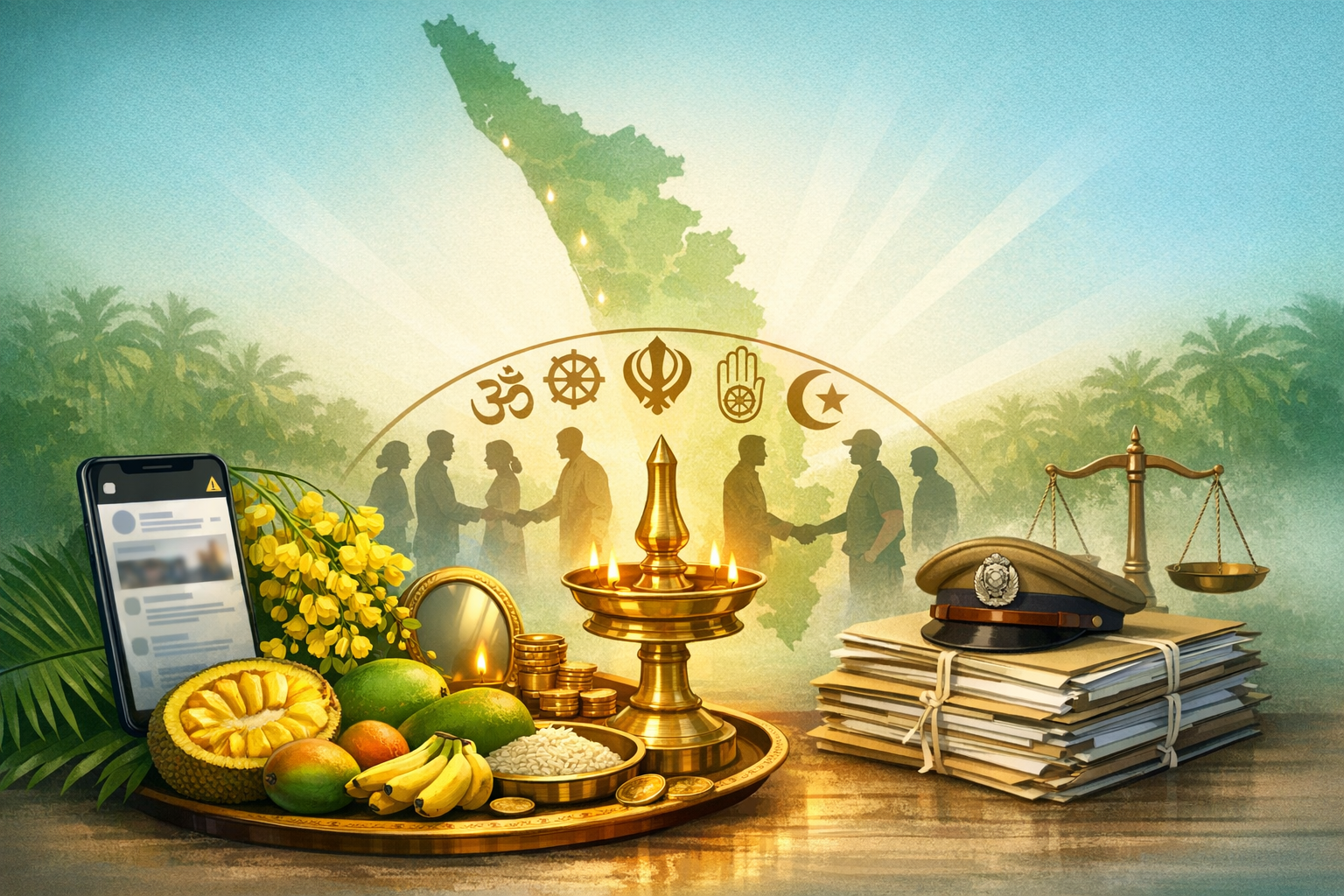
Understanding why the poster triggered strong reactions requires appreciating the cultural centrality of Vishu in Kerala. Vishu, often observed as the Malayali New Year, centers on the Vishukkanithe auspicious first sighting of the day, curated with lamps, flowers, fruits, grains, and sacred images. For many families, the festival’s quiet dignity marks a moment of renewal and gratitude. Sacred iconography, including depictions of deities such as Sri Krishna, is typically approached with devotional reverence rather than commercial juxtaposition.
In that context, the advertisement’s use of sacred imagery in proximity to a non-vegetarian dish felt discordant to many devotees. While culinary practices in Kerala are diverse, placing a revered deity within a commercial frame that could be perceived as irreverent unsettled segments of the public. Such reactions reflect not only personal devotion but also broader social norms about how holy symbols should be represented in public life.
The legal framework provides the scaffolding for adjudicating such disputes. Article 19(1)(a) of the Constitution of India guarantees freedom of speech and expression, while Article 19(2) permits reasonable restrictions to safeguard public order, decency, morality, and the sovereignty and integrity of India. In controversies touching religion, provisions often discussed include Sections 295A and 153A of the Indian Penal Code (IPC), which address, respectively, deliberate and malicious acts intended to outrage religious feelings and the promotion of enmity between different groups. Courts have repeatedly cautioned that these provisions must be applied with a high threshold to avoid chilling legitimate expression.
Indian jurisprudence has elaborated these principles over decades. In Ramji Lal Modi v. State of Uttar Pradesh (1957), the Supreme Court upheld restrictions on speech narrowly tailored to public order concerns. Later, in Pravasi Bhalai Sangathan v. Union of India (2014), the Court urged vigilant institutional responses to hate speech while recognizing the primacy of existing legal mechanisms. More recently, in Amish Devgan v. Union of India (2020), the Court reiterated that context, intent, and the likely impact on public order are central to any determination. These precedents inform how police, prosecutors, and courts will assess the Kerala FIRs.
Procedurally, investigations in such matters are guided by the Code of Criminal Procedure (CrPC). Police collect evidence, record statements, and, where warranted, effect arrests subject to constitutional safeguards. Judicial scrutinybail hearings, remand oversight, and trialprovides due-process guardrails. The Supreme Court’s guidance in Arnesh Kumar v. State of Bihar (2014) on responsible arrests remains a touchstone, emphasizing necessity, proportionality, and respect for personal liberty in offences that do not require custodial interrogation.
Beyond law, industry self-regulation offers important preventive cues. The Advertising Standards Council of India (ASCI) Code advises advertisers to avoid content that is likely to cause widespread or serious offence to any significant section of society, including on religious grounds. Responsible creative practice includes sensitivity reviews, stakeholder consultations, and pre-launch risk assessmentsespecially when campaigns incorporate sacred symbols or rituals. When unanticipated hurt occurs, good-faith corrections, transparent communication, and prompt withdrawals can significantly reduce social friction.
Brand safety and civic responsibility converge on a practical set of measures: map cultural calendars before campaigns, test messaging with diverse focus groups, consult faith-informed cultural experts where sacred imagery appears, and establish rapid-response protocols for addressing feedback. Such steps are not merely reputational hedges; they acknowledge that religious sentiments are anchored in lived heritage and should be engaged with humility and care.
Social media dynamics amplify both sentiment and misunderstanding. Visual content moves quickly across platforms, often stripped of original context. Algorithms privilege high-engagement material, which can intensify outrage cycles. Timely clarifications by official handles, trusted community intermediaries, and fact-checkers help address rumor cascades. A constructive normpause, verify, then sharehas repeatedly proven to be a powerful antidote to escalation.
For everyday Malayali families preparing the Vishukkani before dawn, the controversy intersected with an intimate, intergenerational practice. Elders narrate stories of Vishu’s symbolism to children, arranging lamps and flowers in quiet anticipation of a prosperous year ahead. When sacred imagery appears in contentious settings, it can feel like an intrusion into that personal sanctum. Recognizing this emotional landscape is essential to understanding public reactions and to crafting proportionate, empathetic responses.
At its core, Kerala’s social fabric is enriched by traditions of coexistence and dialogue. The unity of the dharmic traditionsHinduism, Buddhism, Jainism, and Sikhismoffers a reservoir of wisdom for navigating moments of strain. Anekantavada in Jain philosophy nurtures many-sided understanding; the Buddhist emphasis on metta (loving-kindness) encourages compassionate speech; Sikh teachings on Sarbat da Bhala (welfare of all) inspire inclusive action; and Sanatana Dharma’s ethos of reverence and mutual respect undergirds plural civic life. Together, these values point toward restorative conversation rather than recrimination.
Constructive de-escalation is attainable when stakeholders adopt a shared grammar of responsibility. Advertisers acknowledge inadvertent hurt and recalibrate content. Community leaders communicate calming, unifying messages that recognize legitimate emotions without endorsing hostility. Law enforcement preserves order with restraint and impartiality. Media outlets prioritize context over clicks, foreground verified facts, and avoid sensational framings that can deepen divides.
Institutions can further reduce recurrence through simple, structured protocols. A pre-campaign cultural risk scan, a cross-community advisory panel for sensitive imagery, and a 24–48 hour rapid-assessment cell for public feedback form a pragmatic triad. Post-incident, a documented learnings cyclewhat happened, what hurt, what repaired truststrengthens prevention. Such institutional muscle memory matters in a digital ecosystem where narrative velocity often outpaces rectification.
From a policy perspective, clarity and consistency are critical. Where FIRs are lodged across districts, coordinated investigations minimize duplication and ensure even-handedness. Training modules on constitutional speech principles, communal harmony, and de-escalatory policing can equip frontline officers. Transparent public briefings reduce speculation and build confidence in the process. Measured, lawful, and communicative state action is often the best prophylactic against rumor and polarization.
For content creators, the controversy is a teachable moment. Sacred symbols are not simply visual assets; they carry centuries of devotion, memory, and meaning. Applying the ASCI Code in spiritnot only in lettersignals respect. Seeking informed consent from cultural stakeholders when deploying religious motifs is not a hurdle to creativity; it is a path to more resonant, trustworthy storytelling.
Civil society and interfaith forums can turn flashpoints into bridges. Facilitated dialogues that begin with shared valuesahimsa, metta, anekantavada, and Sarbat da Bhalacreate common ground before addressing the specifics of a grievance. Listening circles featuring youth, elders, artists, and faith representatives often surface pragmatic solutions that institutional actors can implement. The goal is not to adjudicate theology but to restore trust.
Digital citizenship norms also deserve renewed attention. Thoughtful posting behaviorscrediting original sources, contextualizing content, avoiding derogatory captions, and flagging manipulated medialower the temperature of online spaces. Leaders and influencers, in particular, have an outsized role in modeling restraint and inviting followers to prioritize verification over virality.
Seen in full, the Kerala Vishu poster episode is as much about governance and ethics as it is about sentiment. It illuminates the delicate balance India’s constitutional order seeks to maintain: safeguarding expressive freedom while preventing deliberate affronts that imperil public order. It also shows how quickly commercial choices intersect with faith and identity in a hyper-connected public sphere.
As the legal process unfoldsFIRs investigated, evidence weighed, and courts, where necessary, rendering decisionsthe wider society has an opportunity to demonstrate maturity. Kerala’s long history of coexistence is a strength to be conserved through empathy, lawful conduct, and principled speech. When stakeholders choose dialogue over derision and remedy over rancor, the outcome is not only the resolution of a controversy; it is a reaffirmation of the plural, dharmic values that allow diverse communities to flourish together.
Inspired by this post on Struggle for Hindu Existence.