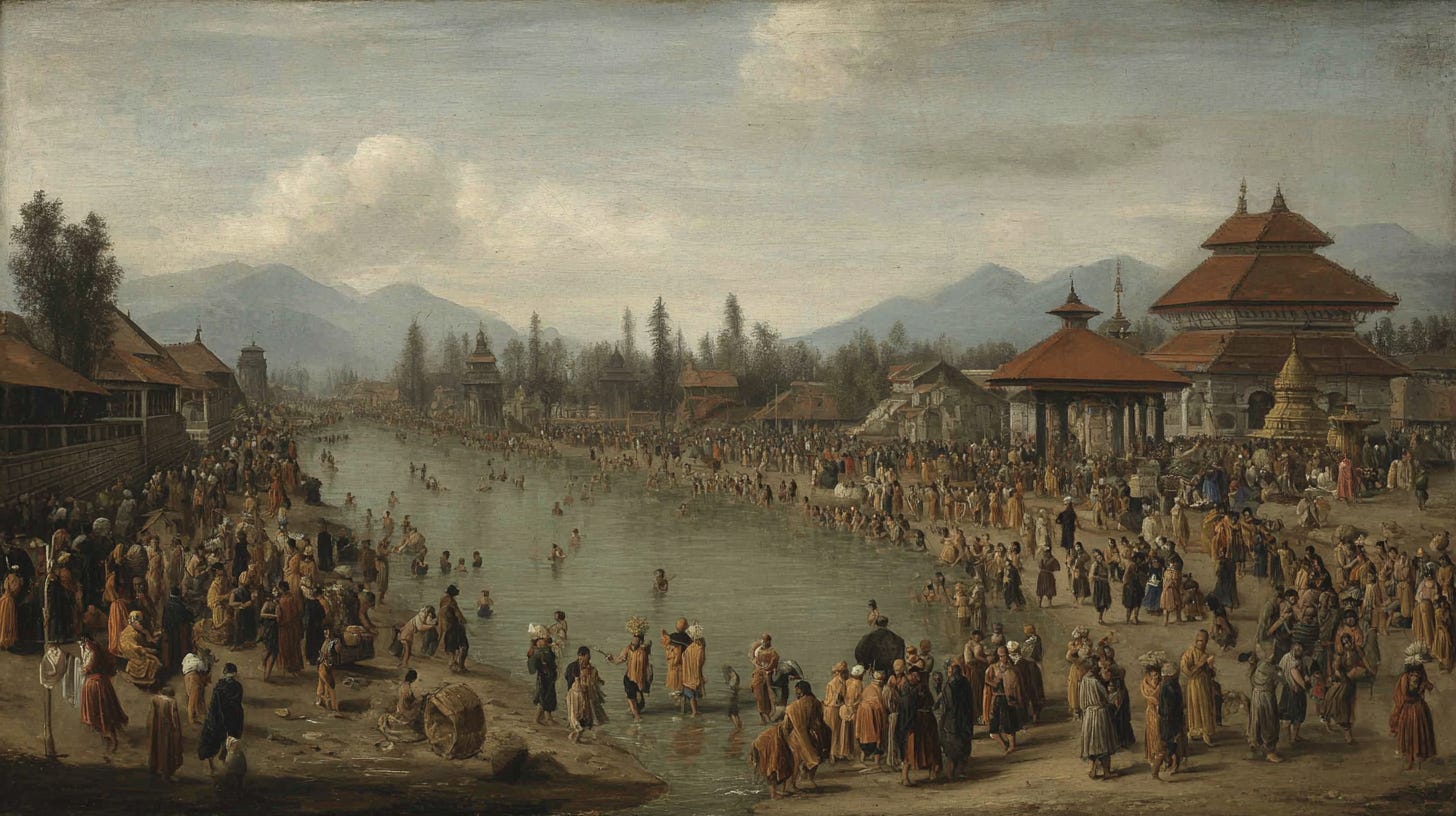
In the sacred geography of the middle Ganga, Mungerspelled “Monghyr” in British recordsoccupies a distinctive place within Sītāyana Sita Mata’s sanctifying journey. Textual memory links the region to Janaka, emperor of Mithila, and to the Mahabharata cycle in which, during Yudhishtira’s Rājasūya Yajña, Bhīmasena is said to have subdued a city known as Modagiri near present‑day Munger. Across early sources, the site appears as Mudgagiri‘the hill abounding in Mudga (Moong dal)’while exegetical traditions such as the Nirukta attribute its founding to Rishi Mudgala. Colonial philologists offered alternative etymologiesAlexander Cunningham from the Munda jana-jaati and Oldham from Muni-grihaunderscoring the range of historical speculation that attends the city’s name.
Epigraphic memory anchors a Gupta‑period identity: a sixth‑century rock inscription at the Kashtaharani ghat situates royal attention at the site, after which it was remembered as Guptagadh. Political authority thereafter moved in long arcsthe Palas, the Gahadavalas, the Karnata (Karnataka) kings of Mithila, and the Senasuntil the Turko‑Afghan commander Bakhtiyar Khalji drew the region into the ambit of the early Delhi Sultanate. Roughly six centuries of Sultanate–Mughal governance followed, ending when the East India Company seized the fort in 1763, a year before the Battle of Buxar.
Urban form offers a deeper continuity than dynasties. In classical Indian statecraft, Monghyr exemplifies the archetype Kaṭakasimultaneously a fortified capital, a garrisoned camp, and, by extension, the defended edge of a mountain ridge. Capitals from Kautilya’s era onward frequently embodied this typology: Devagiri (later Daulatabad) appears as a Kaṭaka in inscriptions, and the imperial metropolis of Vijayanagara elevated the form to an apex. The modern name “Cuttack” in Odisha preserves the same root, illustrating the concept’s long life in Indian urbanism.
Geography amplified Monghyr’s defensive logic. The fort crowns a grand bend of the Ganges, with high walls and a deep ditch inscribing a perimeter of more than two miles. Early nineteenth‑century traveller George, Viscount Valentia, first summed it up‘Monghyr is a large fort… of very considerable antiquity’and then expanded the picture: once past the gateways, the interior unfolded less like a garrison than a lived town, with river, mountains, and richly cultivated plains composing ‘an uncommonly fine’ prospect he ‘preferred to any thing [he had] yet seen in India.’
Valentia’s brief halt in February sketches a paradise in partial decayits beauty undeniable, its scars legible. As Governor of Bengal (c. 1640–1660), Shah Jahan’s second son, Shah Shuja, established a substantial palace complex within the fort. Adjacent stood what Valentia termed ‘a tolerably handsome Hindoo temple,’ with five arched entrances and richly carved niches designed for Mūrtis. His account records that during Shuja’s tenure the images were removed and the building adapted for use as a mosque, an alteration that signals how sacred architecture often bore the imprint of shifting polities. In later decades the structure was restored for Hindu worship, and today the wider ensemble, including the sacred precinct, is conserved under the care of the ASI (Archaeological Survey of India).
The temple’s placement intensified its significance: it rose directly above Sitakund, a perennial hot‑water spring woven into the lore of Sita Mata. Local tradition associates the site with a Punya-Snana following the Agni Pariksha, and its ritual calendar sustains an enduring pilgrimage. The Maghi Mela (Magha Snana), observed during the Kārtika and Māgha Māsa cycles, peaks on Māgha Poornima and, in scale, functions as a younger cousin to the Kumbh Mela. Valentia attested to ‘prodigious crowds’ of pilgrims thronging the rock of Monghyr and purifying themselves in the Ganges during this season.
Several sources, including Valentia’s narrative, also refer to levies imposed on pilgrims during Shah Shuja’s administration and to the temple’s interim conversion for Islamic worship. Such measures occurred at points across the subcontinent under diverse regimes and should be read within the fiscal and political logics of pre‑modern states rather than as indictments of any community. The episode nevertheless underscores a wider, shared imperative: sacred placeswhether revered by Hindus, Buddhists, Jains, or Sikhsrequire careful protection so that living traditions can flourish side by side.
Monghyr figured prominently in the mid‑seventeenth‑century Mughal succession struggle. Shuja, aligned at different moments against his brothers Aurangzeb and Murad Bakhsh during their contest with Shah Jahan, strengthened the fort but ultimately lost it. He withdrew east to Arakan (present‑day Rakhine, Myanmar), where chronicles and travelogues describe a chain of misfortunes. Such reversals were common in a turbulent era and left imprints not only on courts but on cities and shrines.
Valentia also preserved a striking local tradition attached to a large stepped well near the palace. The ‘singing well,’ as residents called it, was said to emit music every seven years, echoing the nautch performances once held in the nearby Zenana. The same oral history alleges that, in crisis, members of the women’s quarters met violent endssome immured within the well’s walls, others consigned to its depths. While unverified as archival fact, the story reveals how communities encode trauma and political upheaval into place‑memory.
Following the decline of central Mughal authority, Monghyr briefly served as a key node under Nawab Mir Qasim. In 1763, after a nine‑day siege, East India Company forces commanded by Major John Carnac captured the fort. The town then operated as a frontier depot for arms and ammunition until later administrative reformsparticularly under Lord Cornwallisreoriented British priorities and elevated Allahabad (Prayagraj) as a principal seat. Valentia’s onward journey from Monghyr to Bankipur (Patna cantonment) closes his vignette but leaves a usable past for urban and heritage historians.
Read synthetically, Monghyr’s dossier integrates sacred mythic time with hard epigraphy, regional polities with imperial contest, and aesthetic landscape with urban typology. The Kaṭaka form explains the city’s resilience; Sitakund anchors its ritual heart; and successive adaptations of religious architecture illustrate how power circled through, leaving both loss and renewal. For present‑day cultural preservationists, the case argues for a dharmic ethic of care: protecting sites like Sitakund and its temple complex safeguards not only Hindu practice but the shared civilisational matrix within which Buddhists, Jains, and Sikhs also recognize the Ganga’s sanctity and the subcontinent’s plural heritage.
There is, finally, an emotional register that the historical record does not forbid. It is difficult to encounter Monghyr’s fort walls, the legend of the singing well, and the crowds at Magh Mela without sensing both fragility and endurance. The city’s long arcfrom Guptagadh to Company garrisoninvites a practical commitment: document rigorously, conserve judiciously, and interpret generously, so that the fullness of India’s civilisational memory remains accessible to all its dharmic communities and to every curious traveler who comes upon the bend of the Ganges and pauses, as Valentia once did, to look.
Inspired by this post on Dharma Dispatch.