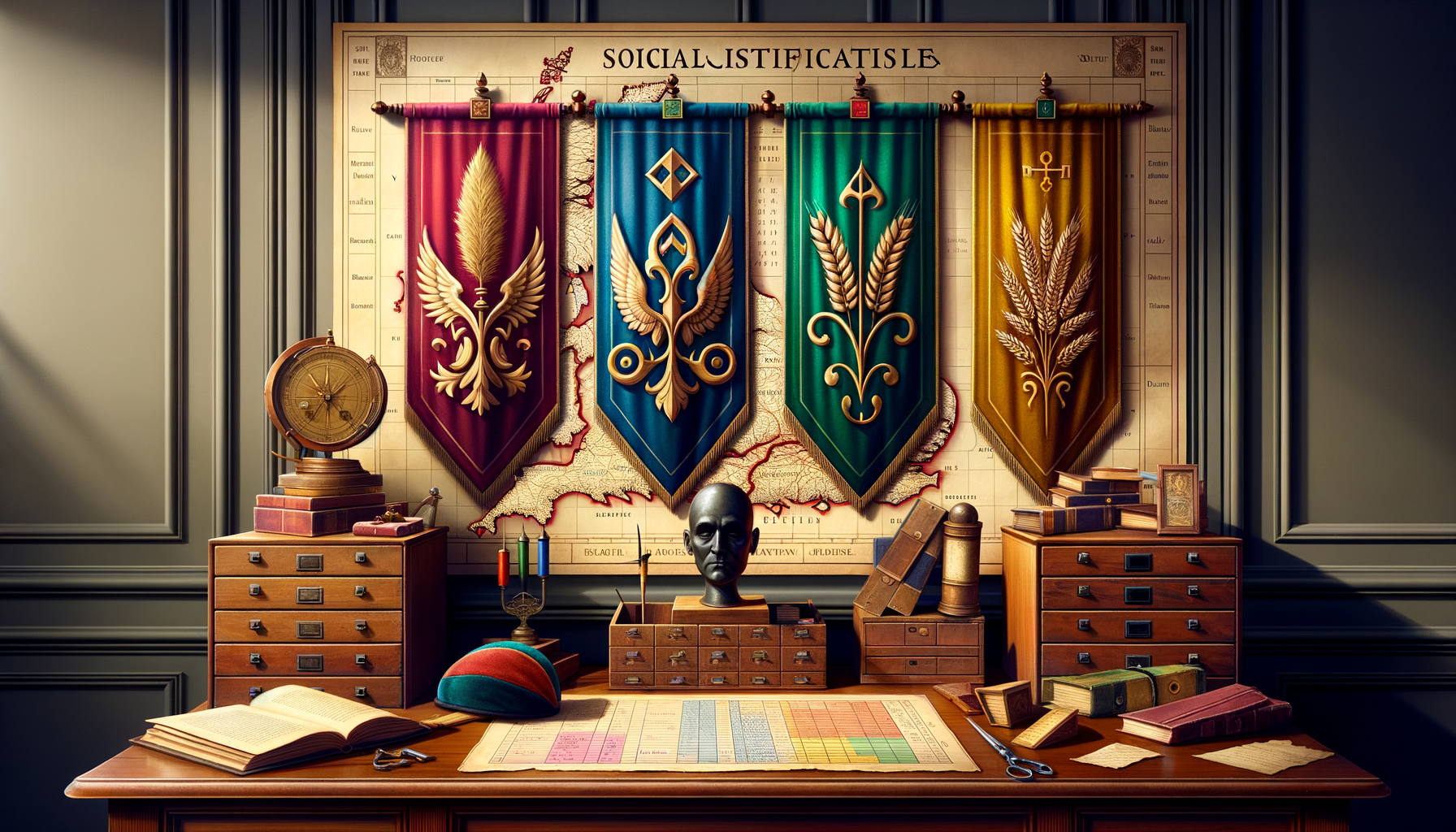
In the imagined year 2025 After Mahatma Gandhi (AMG), or 4025 Anno Domini, Bharat emerges as a maritime superpower overseeing vast trade networks and administering former imperial powers, including Britain. An administrative inquiry prepared by the Rajakaryalaya, in service of Samrashtra, examines the Islanders’ House system to guide census-making, classification, and equitable governance across the Western Isle.
The guiding ideal is enlightened governance: respecting local histories, religions, and customs while minimizing disruptive interference. Yet early observations reveal a labyrinth of British etiquette and ritualmodes of address for nobility, royal protocol, Boxing Day practices, culinary preferences like fish and chips with baked beans, reverence for genealogical lore recounted by publicans, and the long-standing mystery of separate hot and cold faucets. Much of this appears as unstated, inherited knowledge; explanations are often unavailable or forgotten, even as adherence is treated as a marker of civilization.
Confident in the value of comparative analysis and empirical observation, Bharatiya scholars set out to interpret British society on its own terms. The conviction is straightforward: better understanding can enable fairer administration and more faithful reportinggoals consistent with Samrashtra’s emphasis on harmony and justice.
The search for a unifying social theory converges on the Adventures of Harry Potteran ancient, widely known corpus whose provenance is debated but whose cultural force is unmistakable. This shared myth, the potterverse, appears to encode a canonical House System. Even while acknowledging textual corruption and divergent local transmissions, scholars note that the potterverse functions as a cultural charter for social identity.
Within this frame, four Houses structure social imagination. Two are styled as Upper Houses of ideals (Gryffindor and Ravenclaw), one as a Middle House of pragmatism (Slytherin), and one as the Lowest House of simple desires (Hufflepuff). House affiliation appears hereditary yet is ceremonially affirmed through a Sorting rite with a legendary “Rowling hat.” Endogamy is common, and inter-House marriage is portrayed as risky, even destabilizing.
Sub-Houses proliferateWindsor, Viking, Norman, Keynesian, Wicca, Cockney, Smith, Labour, Thatcherite, and many more. Intellectuals trace them to the four archetypal Houses, though complex contemporary mappings are attributed to textual and societal corruption. In daily life, these sub-Houses appear to index location, occupation, ideology, football allegiance, and lineage, all anchored by the four-House schema preserved in Harry Potter.
The semantic reach of “House” extends beyond the potterverse. Ancient religious texts refer to lineages such as the House of David, the House of Noah, and the House of Abraham, while secular narratives describe dynasties like the House of Rothschild and the House of Windsor. Such references reinforce the plausibility of a long-standing British tendency to think in Houses, even when terminology shifts across contexts.
Alongside the four-House architecture, a category of the Houseless is observedRoma (often labeled historically as “Gypsies”), Jewish communities, Pagans, and the fictional Elvesgroups frequently described as enduring chronic exclusion. Even celebrated narratives sometimes normalize disparagement or omission of these communities, a disquieting reminder of how stories can shape social horizons and institutional access.
A sustained reading highlights what may be termed Gryffindorian patriarchy: a graded hierarchy underpinning sub-House identities and marital preferences. Canonical culture, from Shakespeare’s struggles for honor to the Arthurian symbolism of the sword, appears to celebrate ideals associated with Gryffindor and, at times, to justify violence against perceived Slytherin counterparts. Many readers will recognize how powerful myths can naturalize stratification while presenting themselves as moral triumphs.
Modern historical upheavals can be reframed within this House logic, sometimes to troubling effect. For instance, World War II is recast as a struggle between a Slytherin House of Nazis, led by Hitler as a descendant of Voldemort, and a Gryffindor House of Windsor Allies, led by Churchill as a descendant of Harry Potter. The parable warns how reductive taxonomies can flatten complexity into emblematic rivalries.
Indigenous British scholars trained in Bharatiya institutions report that upper sub-Houses tend to be more socio-economically successful across generations, irrespective of individual wealtha pattern attributed to a cultural premium on descent from conqueror lineages aligned with Gryffindor or Ravenclaw. At the same time, the risks of circular reasoning are acknowledged: when myths define status, they can also become self-fulfilling classifications.
This House-based order challenges Samrashtra’s ethical imperative of impartiality. In response, administrators propose enumerating all sub-Houses under the four-House framework in the forthcoming census to ensure equal treatment and transparent reporting. Predictably, this creates incentives for sub-Houses to emphasize Ravenclaw affiliations to access opportunities otherwise foreclosed to those labeled Slytherin or Hufflepuff.
To expand access for disadvantaged groups such as the Smiths or those likened to Elves, policy makers introduce a legal designation akin to Depressed or Scheduled Houses. While not wholly satisfactory by scientific standards, the measure is viewed as a pragmatic step toward social justice, greeted with relief by some and suspicion by others who fear further rigidification of fluid identities.
From a dharmic perspective shared across Hinduism, Buddhism, Jainism, and Sikhism, the thought experiment illustrates a cautionary principle: external labels, once institutionalized, can obscure lived diversity and inhibit compassion, ahimsa, and mutual respect. A governance ethos aligned with Samrashtra would therefore prioritize human dignity over taxonomic neatness, fostering harmony across traditions and communities rather than reifying stereotypes.
Many readers will recognize the everyday resonance of these dynamics: how a label can shape opportunity, how a story can foreclose nuance, how a bureaucratic category can endure long after its rationale fades. This satire invites reflection through a decolonial lens, asking how to balance empirical description with ethical responsibility, and how to honor plural identities without confining them.
Post Script: This is speculative fictiona reversal of the colonial gaze. It does not claim Britain possesses a caste or House system. Rather, it asks what might happen if outsiders “discovered” hierarchies, codified them through law and census, and named the result enlightened governance. The deliberate absurdity exposes how external classification can distort internal social realities.
For readers seeking broader context, comparative histories show how colonial frameworks once hardened fluid identities into formal categories and how those legacies continue to influence contemporary policy debates far beyond their points of origin.
Inspired by this post on CoHNA.