
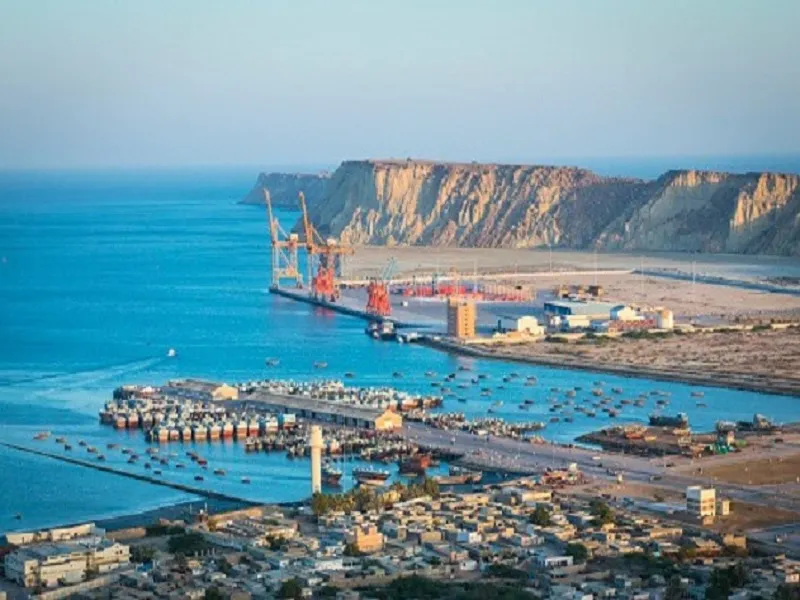
Russia’s possible use of Gwadar Port is not merely a transport question. It is a strategic test involving CPEC, Bharat’s sovereignty concerns over Pakistan-occupied Kashmir, China’s Belt and Road Initiative, Pakistan’s internal security crisis, and the delicate balance of Indo-Russian relations.
The proposal that Russia could utilize Gwadar Port, the terminal maritime node of the China-Pakistan Economic Corridor, has to be understood as part of a wider rearrangement in Eurasian geopolitics. Gwadar is not an ordinary port in a neutral commercial setting. It is embedded in CPEC, the flagship project of China’s Belt and Road Initiative, and CPEC itself passes through territory in the Pakistani-controlled part of Kashmir that Bharat claims as its own. That single fact transforms what might otherwise look like a trade corridor into a deeply sensitive sovereignty issue.
Pakistani Energy Minister Awais Ahmed Khan Leghari welcomed Russian Deputy Prime Minister Alexei Overchuk’s reported openness to the idea of Russia using Gwadar during discussions around Pakistan-Russia relations and the changing global order. The setting is important. Pakistan is trying to position itself as a connective state between Russia, Iran, China, Central Asia, and the Arabian Sea. Russia, under heavy Western sanctions, is looking for non-Western routes, new markets, and logistical options that reduce dependence on Western-controlled financial and maritime systems.
At a purely economic level, the logic has some force. Pakistan has a population approaching a quarter of a billion people, a large consumer base, and a geography that gives it access to the Arabian Sea, West Asia, Central Asia, and South Asia. For Moscow, the attraction lies in expanding trade with a large emerging market while using routes that are less exposed to Western pressure. For Islamabad, Russian interest in Gwadar would give political validation to CPEC and could help present Pakistan as a useful Eurasian logistics hub rather than merely a crisis-ridden state.
The North-South Transport Corridor, commonly discussed as the NSTC, provides the broader framework. The corridor’s central concept is to connect Russia with Iran, the Caspian region, South Asia, and the Indian Ocean through shorter and more diversified trade routes. Pakistan’s possible incorporation into this network through Iran would give Moscow another route toward the Arabian Sea. Even if disruptions caused by regional war or instability temporarily suspend particular segments, the underlying economic idea remains strategically relevant: Russia wants redundancy, access, and resilience in its external trade architecture.
Yet the economic argument cannot be separated from the political geography of CPEC. Bharat has consistently objected to the China-Pakistan Economic Corridor because it crosses areas of Jammu and Kashmir under Pakistani control. From Bharat’s perspective, foreign participation in CPEC is not a routine commercial act; it risks legitimizing infrastructure built through disputed territory. This is why any Russian association with Gwadar would be read in New Delhi through the lens of sovereignty, strategic trust, and China-Pakistan coordination.
For Bharat, the matter is especially sensitive because Russia is not simply another external power. India and Russia have historically described their relationship as a “special and privileged” strategic partnership. That partnership has included defence cooperation, energy ties, diplomatic coordination, and long-standing goodwill among sections of Indian society. If Moscow were seen as actively engaging with a CPEC-linked facility in a way that appears to disregard Bharat’s concerns, the political damage could be larger than the commercial benefit.
The soft-power cost for Russia would be real. Russian influence in Bharat has not depended only on arms sales or oil trade. It has also rested on historical memory, diplomatic reliability, and the perception that Moscow has generally shown sensitivity toward India’s core security concerns. A visible Russian move toward Gwadar could create the impression that Russia is becoming more willing to accommodate China and Pakistan at Bharat’s expense. Even if Moscow framed the move as economic and apolitical, Indian policymakers and public opinion may not accept that distinction.
There is also a serious security problem inside Pakistan itself. Gwadar is located in Balochistan, a province marked by long-running separatist militancy, economic grievances, heavy security deployment, and repeated attacks on state and foreign-linked projects. CPEC infrastructure has been a particular target for militant groups that view it as exploitative or as a symbol of external control over local resources. For Russian transport operators, engineers, or commercial personnel, this would raise practical risks ranging from convoy security to kidnapping, sabotage, and insurance costs.
The security risk is not theoretical. Balochistan’s instability has repeatedly complicated Pakistan’s effort to market Gwadar as a safe international logistics hub. A port may be strategically located on a map, but logistics require trust in roads, warehouses, customs systems, fuel supply, policing, and political stability. If overland routes to Gwadar remain exposed to insurgent attacks, then Russia’s use of the port would demand either heavy Pakistani security guarantees or a tolerance for operational risk that many commercial actors may find unacceptable.
China’s role adds another layer. Gwadar Port is operated by a Chinese company, and CPEC remains one of Beijing’s signature Belt and Road Initiative projects. Russian use of Gwadar would therefore not only expand Russia-Pakistan ties but also indirectly reinforce China’s regional infrastructure agenda. Moscow and Beijing have drawn closer under Western pressure, but Russia still has reasons to avoid looking like a junior partner within China’s Eurasian strategy. Any perception that Russia is being pulled further into Chinese-designed corridors could complicate Moscow’s diplomatic flexibility.
This matters because Bharat is already watching the Russia-China relationship closely. New Delhi has maintained ties with Moscow despite pressure from Western states, especially after the Ukraine war intensified global sanctions against Russia. Bharat’s continued purchase of Russian energy and its defence dependence on Russian platforms have shown that New Delhi values strategic autonomy. However, if Russia appears to move closer to Pakistan through a China-backed project that Bharat opposes, Indian strategic thinkers may reassess how much trust can be placed in Moscow over the long term.
The likely outcome would not be an immediate rupture. India’s armed forces still depend on Russian-origin military systems, spare parts, maintenance networks, and legacy platforms. Energy trade has also become an important pillar of the relationship. But geopolitics often shifts gradually before it changes visibly. Bharat could maintain essential defence and energy links while quietly accelerating diversification toward France, the United States, Israel, domestic production, and other partners. That would reduce Russia’s long-term strategic leverage in India.
Such a drift would not serve either India or Russia well. China, Pakistan, and the United States could each benefit in different ways from a widening gap between New Delhi and Moscow. China would gain if Russia became more dependent on Beijing’s political and logistical networks. Pakistan would gain if Russian engagement helped dilute its diplomatic isolation and gave CPEC greater legitimacy. The United States would gain if Indian doubts about Russia pushed New Delhi more firmly into Western strategic frameworks. For India and Russia, however, the result could be a loss of independent room for manoeuvre.
For Pakistan, the benefits of Russian interest in Gwadar are clear but not guaranteed. Islamabad would present such engagement as proof that CPEC is not merely a bilateral China-Pakistan project but a wider Eurasian platform. It could also use Russian involvement to strengthen its bargaining position with China, Iran, and Central Asian states. However, Pakistan’s ability to convert this into sustained trade depends on political stability, internal security, customs efficiency, currency reliability, and credible guarantees to foreign commercial actors.
For Russia, the benefits are more limited and more conditional. Moscow would gain one more route into South Asian markets, a stronger working relationship with Pakistan, and another signal that Western sanctions cannot fully isolate it. It could also use Gwadar as part of a broader strategy of testing multiple corridors, including routes through Iran, the Caspian Sea, Central Asia, and the Indian Ocean. Yet the benefit would have to be weighed against the diplomatic cost in Bharat, the security cost in Balochistan, and the reputational cost of appearing too closely aligned with China’s CPEC architecture.
The most prudent Russian approach would be cautious exploration rather than rapid commitment. Limited commercial trials, non-sensitive goods, indirect routing, or feasibility studies would carry less political risk than a high-profile strategic announcement. Moscow would also need to communicate transparently with New Delhi if it wishes to preserve trust. A state that values long-term relations with Bharat cannot treat CPEC as a politically neutral infrastructure project when Bharat has repeatedly and publicly objected to its route through Pakistan-occupied territory.
India’s response should also be calibrated. Bharat has every reason to defend its sovereignty concerns regarding Pakistan-occupied Kashmir and to object to foreign legitimization of CPEC. At the same time, a mature diplomatic response would distinguish between exploratory commercial discussion and a formal strategic embrace of Gwadar by Moscow. The objective should be to preserve India-Russia channels while clearly communicating red lines on CPEC, POJK, and projects that touch Bharat’s territorial claims.
The issue also reflects a larger reality of the emerging global order. Sanctions, wars, maritime insecurity, and great-power rivalry are pushing states to search for alternative corridors. Ports, railways, pipelines, and customs routes now carry geopolitical meaning far beyond trade. Gwadar, Chabahar, the NSTC, Central Asian rail links, and the Belt and Road Initiative are all part of this wider struggle over connectivity. The map of commerce is becoming a map of power.
Within that map, Gwadar remains both attractive and dangerous. Its location near the Arabian Sea gives it theoretical value. Its connection to CPEC gives it geopolitical weight. Its position in Balochistan gives it serious security vulnerability. Its link to Pakistan-occupied Kashmir gives it deep political controversy. These four factors cannot be separated. Any state considering Gwadar must confront the entire package rather than selecting only the convenient commercial argument.
The most balanced assessment is that the disadvantages currently outweigh the advantages for Russia. The economic logic is understandable, especially in a sanctions-driven environment where Moscow needs non-Western trade routes. However, the strategic downside is considerable. A visible Russian move toward Gwadar could strain Indo-Russian goodwill, reinforce Indian concerns about Russia-China alignment, expose Russian personnel to security risks, and hand Pakistan a diplomatic victory without guaranteeing meaningful trade volume.
This does not mean Russia will never use Gwadar. Geopolitics can change quickly. If Indo-Russian ties were to deteriorate for unrelated reasons, such as a sudden collapse in energy cooperation or a major shift in India’s defence procurement, Moscow might become more willing to use Pakistan-facing options as a form of strategic signalling. At present, however, India-Russia relations remain functional and important, and claims of a decisive rupture or betrayal should be treated with caution unless supported by concrete policy changes.
Ultimately, Gwadar is a test of strategic discipline. Russia must decide whether a possible logistics gain is worth risking trust with Bharat. Pakistan must prove that it can secure Balochistan and offer reliable trade infrastructure. China must recognize that CPEC’s disputed geography limits its acceptance among major powers. Bharat must continue articulating its sovereignty concerns with clarity while preserving diplomatic flexibility. The future of Gwadar in Russian strategy will depend not only on economics, but on whether each actor can manage the political costs attached to this contested corridor.
Inspired by this post on Hindu Post.







Leave a Reply
You must be logged in to post a comment.