
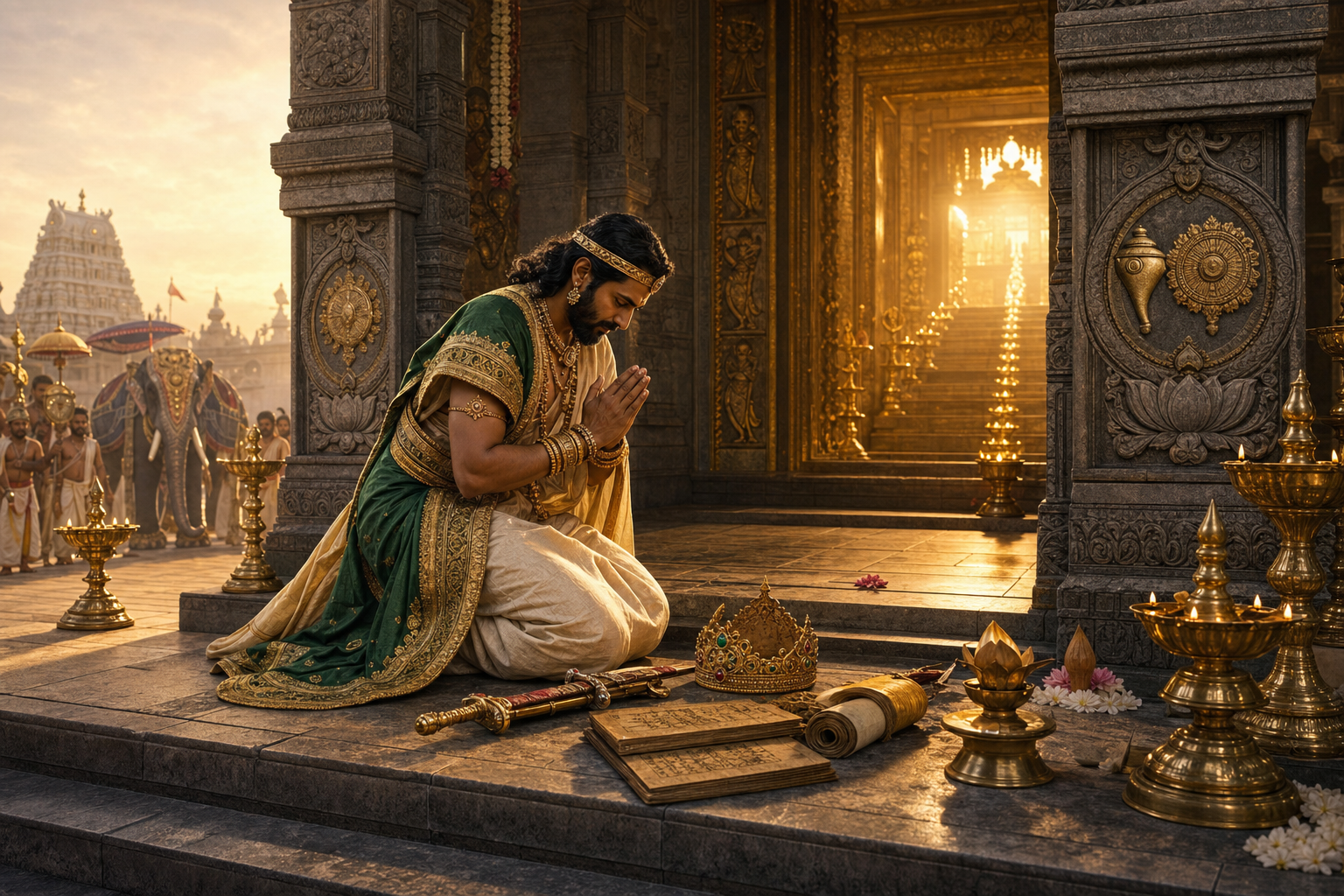
Kulashekhara Alvar occupies a distinctive place in the spiritual history of South India because his memory stands at the meeting point of kingship, poetry, temple culture, and devotional surrender. Revered as one of the twelve Alvars of the Sri Vaishnava tradition, he is remembered not merely as a saint who praised Vishnu, but as a ruler who found worldly authority insufficient before the deeper authority of bhakti. The inherited tradition presents him as a powerful Chera king of the western region, broadly associated with present-day Kerala, who willingly turned away from royal prestige when devotion became the central truth of his life.
The name appears in different spellings, including Kulashekhara Alvar and Kulasekhara Alvar, and both forms point to the same revered personality in Vaishnava memory. In academic discussions, he is often placed around the 9th century CE, though the historical record requires care. Sri Vaishnava hagiography, temple memory, and later literary traditions preserve a vivid portrait of the king-saint, while epigraphic and literary scholarship evaluates whether he may be identified with a Chera ruler such as Sthanu Ravi Kulasekhara or with the learned dramatist-king Kulasekhara Varma. This distinction matters because it allows devotion and history to be honored without forcing every inherited story into a single modern category.
What remains consistent across the traditions is the moral force of his life. Kulashekhara Alvar represents the transformation of rajadharma into bhakti-dharma: the king who protects territory becomes the devotee who protects sanctity, compassion, and surrender. In that sense, his story is not a rejection of responsibility but a refinement of it. Royal power, wealth, military command, and public honor are shown as temporary instruments, while devotion becomes the enduring measure of human greatness.
The Alvars were Tamil poet-saints whose hymns shaped the devotional imagination of South India and became central to Sri Vaishnava temple worship. Their compositions were gathered into the Naalayira Divya Prabandham, the celebrated Tamil devotional corpus of about four thousand verses. Within that sacred literary world, Kulashekhara Alvar contributed the Perumal Tirumoli, a Tamil work traditionally counted as part of the Divya Prabandham. It is especially important because it reveals a devotional voice that is emotionally intense, literary, theological, and deeply temple-centered.
The Perumal Tirumoli is generally described as containing 105 hymns devoted to Vishnu, known in Tamil Vaishnava tradition as Perumal. These hymns move across sacred geography and sacred emotion. They praise places such as Srirangam and Tiruvenkatam, and they enter the narratives of Sri Rama, Krishna, Devaki, and other figures with remarkable empathy. Kulashekhara Alvar does not merely retell stories; he inhabits them. His poetry shows the bhakta as one who feels the pain, longing, tenderness, and wonder of the divine narrative as if it were unfolding in the immediate present.
This is one of the most striking features of his devotional method. When the Ramayana is recited, the tradition says he does not hear it as distant literature. He experiences the danger to Sita and the struggle of Sri Rama as living reality. One popular account describes him becoming so absorbed in the episode of Rama facing danger that he commands his forces to march to Lanka. Whether read historically, symbolically, or devotionally, the episode reveals the emotional grammar of bhakti: sacred narrative is not entertainment, but participation.
Such stories also explain why Kulashekhara Alvar remains beloved among devotees of Sri Rama. He does not approach Rama only as an ideal king or a theological form of Vishnu, though both are present. He approaches Rama with loyalty, urgency, and personal tenderness. The Ramayana becomes a field of ethical identification. Rama’s suffering, Dasaratha’s grief, Sita’s vulnerability, and the anguish of separation become realities that shape the heart of the devotee. This emotional identification is not sentimental excess; it is a disciplined spiritual imagination that trains the mind toward compassion and fidelity.
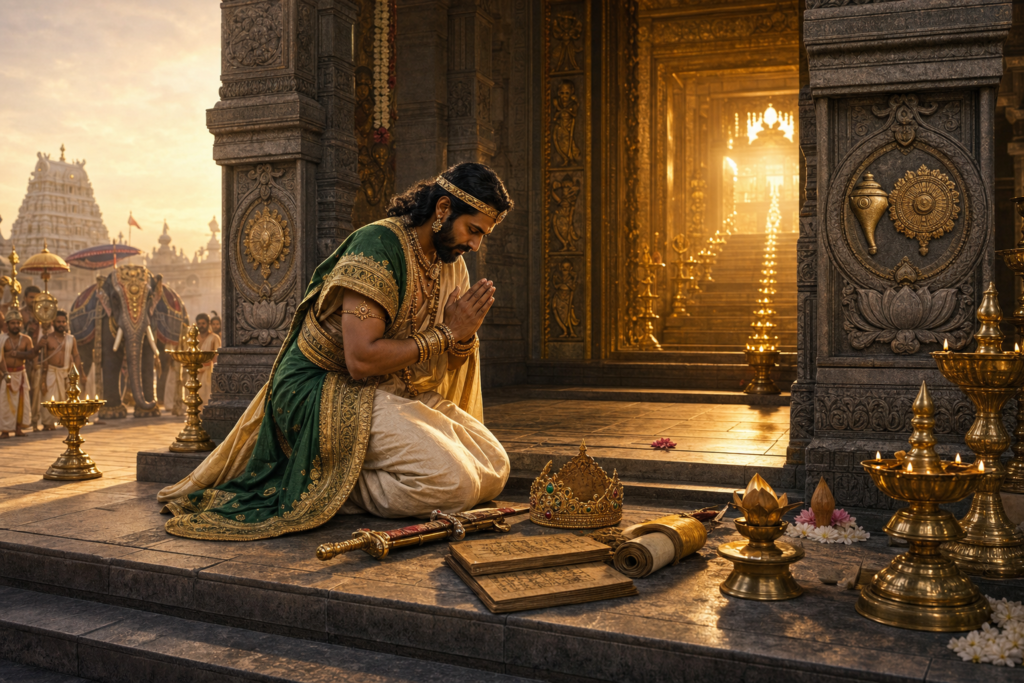
Kulashekhara Alvar is equally significant for devotees of Lord Venkateswara. His association with Tiruvenkatam, the sacred hill of Tirumala, is remembered with special reverence. The tradition of the Kulasekhara padi at Tirumala, the threshold near the sanctum beyond which ordinary pilgrims do not pass, is connected to his longing to remain close to the Lord in the humblest possible form. The theology behind this image is profound: the king who once stood above subjects wishes to become a step at the feet of the deity. Social height is transformed into sacred nearness.
In temple culture, thresholds are never insignificant. A threshold marks transition from the ordinary to the consecrated, from outer movement to inner stillness. The remembered wish of Kulashekhara Alvar to become associated with such a threshold expresses the essence of prapatti, or surrender. The devotee does not demand possession of the divine. The devotee asks for proximity, service, and remembrance. This is why the image of the Kulasekhara padi has endured with such emotional power in the devotional life of Tirumala.
His Sanskrit hymn Mukundamala adds another dimension to his legacy. Addressed to Mukunda, a name of Krishna, it is a work of intense devotional longing and philosophical urgency. The hymn turns the mind away from the instability of worldly attachments and toward the salvific remembrance of the divine name. In the broader Sanskrit stotra tradition, Mukundamala is valued for its directness: the soul recognizes the fragility of embodied existence and seeks refuge in Krishna with clarity rather than ornamented abstraction.
The technical importance of Kulashekhara Alvar lies partly in his bilingual devotional presence. The Perumal Tirumoli belongs to Tamil sacred literature, while Mukundamala belongs to Sanskrit devotional expression. This dual presence matters for understanding Hindu spiritual culture. It shows that bhakti did not operate within a rigid separation of regional and pan-Indian languages. Tamil temple poetry and Sanskrit hymnody could carry the same longing, the same surrender, and the same theological insight through different literary forms.
The traditional biography describes Kulashekhara as a Chera ruler born in the western country, sometimes associated with Vanchi and with royal lineages of Kerala. Later narratives say that he ruled with strength, patronized devotees, and eventually renounced the throne. These accounts should be read with the usual care required for hagiographical literature. They are not modern court chronicles, but they preserve values that communities considered historically and spiritually meaningful: protection of devotees, humility before the divine, generosity toward temples, and the willingness to subordinate ego to dharma.
One traditional episode tells of ministers who grew uneasy with the king’s closeness to Vaishnava devotees. When devotees were falsely accused, Kulashekhara is said to have placed his own body at risk to prove their innocence, even undergoing an ordeal involving a pot of snakes. The historical details may be debated, but the moral structure is clear. The king does not use devotion as royal decoration. He accepts personal danger to defend the integrity of the devotional community. In this narrative, kingship becomes meaningful only when it serves truth and protects the innocent.
The account of his abdication is central to his spiritual profile. He is remembered as one who discovered that sovereignty without surrender is incomplete. The renunciation of the throne should not be read as contempt for worldly duty. Rather, it dramatizes a hierarchy of values. Political power can organize society, but it cannot satisfy the deepest hunger of the soul. Wealth can build palaces and armies, but it cannot replace the intimate assurance of divine remembrance. Kulashekhara Alvar’s life therefore becomes a study in the limits of achievement.
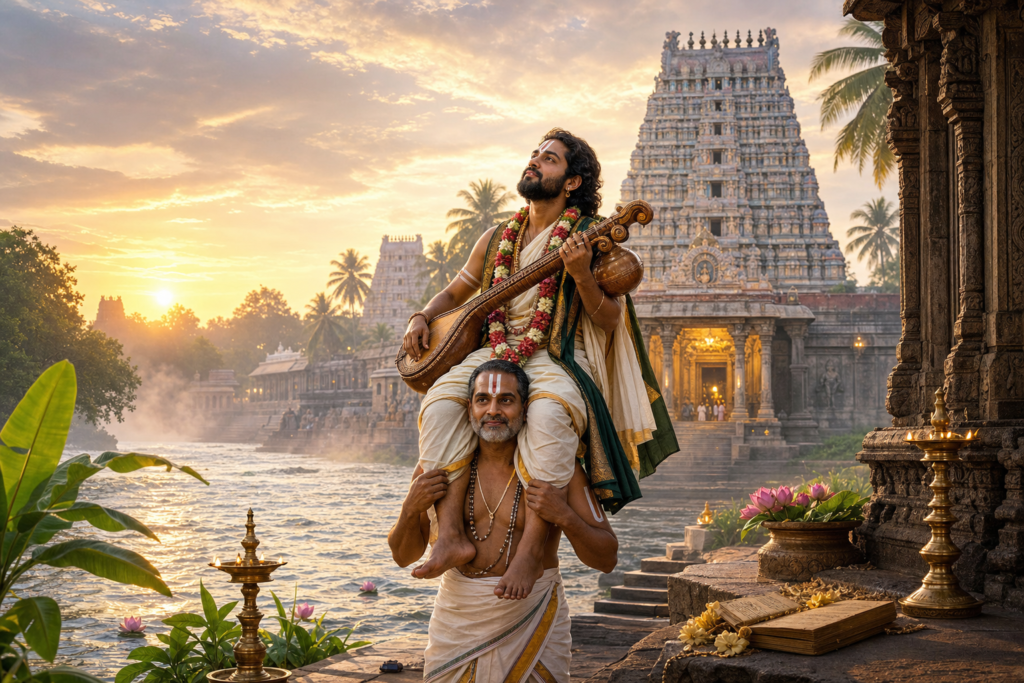
His pilgrimage tradition further strengthens this portrait. Accounts connect him with Srirangam, Tiruvenkatam, Tiruvayodhya, Tillai-Chitrakutam, Tirukannapuram, Tirumalirunjolai, and other sacred places. These journeys place him within the geography of Divya Desams, the Vishnu temples celebrated by the Alvars. Pilgrimage here is not tourism or royal patronage alone. It is a disciplined movement from possession toward presence, from the court to the sanctum, from command to contemplation.
Srirangam holds special importance in the Kulashekhara tradition. Later accounts describe his devotion to Lord Ranganatha and connect him with temple service, structural contributions, and the memory of his daughter Cherakula Valli Nachiyar. Such traditions reveal how deeply the king-saint became woven into temple memory. In South Indian Hinduism, temples are not only ritual centers; they are archives of emotion, patronage, music, poetry, and local identity. Kulashekhara Alvar’s remembered presence in Srirangam reflects the way saintly lives become part of sacred architecture.
His poetry also gives a rare window into devotional empathy. In some compositions, he enters the feeling-world of Devaki, the birth mother of Krishna, who is separated from her child. This is a sophisticated theological move. The poet does not remain fixed in a male royal identity. He adopts the emotional standpoint of a grieving mother, showing that bhakti can cross boundaries of gender, role, and social status. The soul’s relationship with the divine is not limited by the external identity of the body.
This capacity to assume different devotional roles is a hallmark of bhakti literature. The devotee may become servant, friend, parent, beloved, witness, or child. Kulashekhara Alvar’s genius lies in making these roles feel spiritually serious rather than theatrical. His emotional transformations are not escapism. They are methods of inner refinement. By learning to feel as Devaki, as Dasaratha, as a servant of Rama, or as one longing for Krishna, the devotee learns to loosen the rigid self and enter a wider field of compassion.
For modern readers, this is one reason his life remains relevant. Many people experience success, status, or institutional responsibility while still sensing an unresolved inner incompleteness. Kulashekhara Alvar’s narrative gives that condition a dignified spiritual vocabulary. It does not shame worldly duty, but it refuses to let worldly duty become the final definition of a person. His life suggests that the highest use of influence is service, and the highest form of service is surrender without loss of ethical clarity.
His legacy is also important for a broader Dharmic understanding of unity. Although Kulashekhara Alvar belongs specifically to the Sri Vaishnava and Hindu bhakti tradition, the values illuminated by his life resonate across Hinduism, Buddhism, Jainism, and Sikhism: humility before truth, restraint of ego, compassion for living beings, reverence for sacred discipline, and the refusal to reduce spiritual life to external power. Such shared ethical concerns do not erase doctrinal differences. They show that Dharmic traditions can remain distinct while still participating in a civilizational conversation about liberation, self-mastery, devotion, and service.
From an academic perspective, Kulashekhara Alvar also demonstrates the need to read Indian spiritual history through multiple kinds of evidence. Hagiography provides devotional memory. Inscriptions provide institutional and chronological clues. Literary works provide theological and aesthetic insight. Temple practice preserves embodied continuity. No single source is sufficient by itself, but together they create a layered portrait. This method prevents both naive literalism and dismissive skepticism. It allows the saint to be studied with rigor and approached with reverence.
The epigraphic record shows that compositions associated with Kulashekhara were known in temple contexts by the medieval period. References to the recitation of portions of the Perumal Tirumoli at Srirangam and records connected with places such as Kodungallur, Mannarkovil, and even wider Indian Ocean networks show that his devotional influence was not confined to one locality. The spread of memory around his name reflects the larger movement of Vaishnava temple culture across regions, languages, and patronage networks.
His possible connection with the Chera court also reveals the sophistication of early medieval Kerala. The region was not culturally peripheral. It participated in Sanskrit learning, Tamil devotional production, temple patronage, maritime exchange, and complex political formations. If Kulashekhara Alvar is considered alongside the literary figure Kulasekhara Varma, discussions naturally extend to Sanskrit drama, Kudiyattam traditions, and the intellectual life of Kerala courts. Even when identifications remain debated, the debate itself shows the richness of the historical field.
The central religious concept in his life is surrender, but surrender in this context should not be misunderstood as passivity. In Sri Vaishnava thought, surrender is an active reorientation of the self toward divine grace. It includes trust, discipline, humility, and service. Kulashekhara Alvar’s remembered acts show this clearly. He defends devotees, longs for pilgrimage, composes hymns, honors sacred places, and seeks closeness to the Lord. Surrender becomes the strongest form of agency because it frees action from vanity.
His devotion to Sri Rama and Lord Venkateswara also helps explain why he remains a bridge figure for many devotees. Rama represents dharma embodied in moral action, sacrifice, and righteous kingship. Venkateswara represents accessible grace in the age of Kali, drawing pilgrims from many languages and communities. Kulashekhara Alvar’s heart moves naturally between these forms of Vishnu, showing that devotion can be both disciplined and intimate, royal and humble, literary and ritual, philosophical and emotional.
There is also a subtle critique of power in his story. A king normally seeks remembrance through conquest, monuments, administration, or dynastic continuity. Kulashekhara Alvar is remembered because he wished to be near the divine feet. The inversion is powerful. The public identity of ruler gives way to the interior identity of servant. In a culture that often measures worth through visibility, his life argues for another scale of value: nearness to truth, steadiness in devotion, and the capacity to let go when a higher calling becomes clear.
This is why the original account of him as a king who abdicated because wealth and power felt meaningless before divine love is spiritually precise. It captures the emotional heart of the tradition. Yet the fuller view makes the claim even stronger. Kulashekhara Alvar did not merely abandon luxury; he redirected kingship into poetry, pilgrimage, temple memory, and devotional theology. He became a ruler whose most enduring kingdom was not territorial but liturgical, preserved wherever his hymns are sung and his surrender is remembered.
In the study of Hindu saints, Kulashekhara Alvar therefore deserves attention as a historical personality, a literary voice, a theological exemplar, and a cultural symbol of Kerala’s contribution to Indian spirituality. His life helps readers understand the Alvar movement, the Naalayira Divya Prabandham, the devotional significance of Perumal Tirumoli, the Sanskrit appeal of Mukundamala, and the living temple traditions of Srirangam and Tirumala. More importantly, it shows how bhakti can transform the meaning of power itself.
The enduring lesson is simple but demanding. Authority becomes sacred only when it bows to dharma. Learning becomes luminous only when it softens the heart. Devotion becomes mature only when it expresses itself as humility and service. Kulashekhara Alvar’s legacy continues because it speaks to this enduring human struggle: how to hold responsibility without pride, how to love the divine without narrowness, and how to recognize that the deepest throne is found at the feet of the Lord.
Research orientation: this rewrite draws on the supplied HinduPad summary and standard reference material on Kulasekhara Alvar, Perumal Tirumoli, Mukundamala, Naalayira Divya Prabandham, and the Tirumala tradition connected with Kulasekhara padi. These sources are best read alongside temple tradition, Sri Vaishnava commentarial memory, and modern historical scholarship on early medieval Kerala.
Inspired by this post on Hindu Pad.



Leave a Reply
You must be logged in to post a comment.