
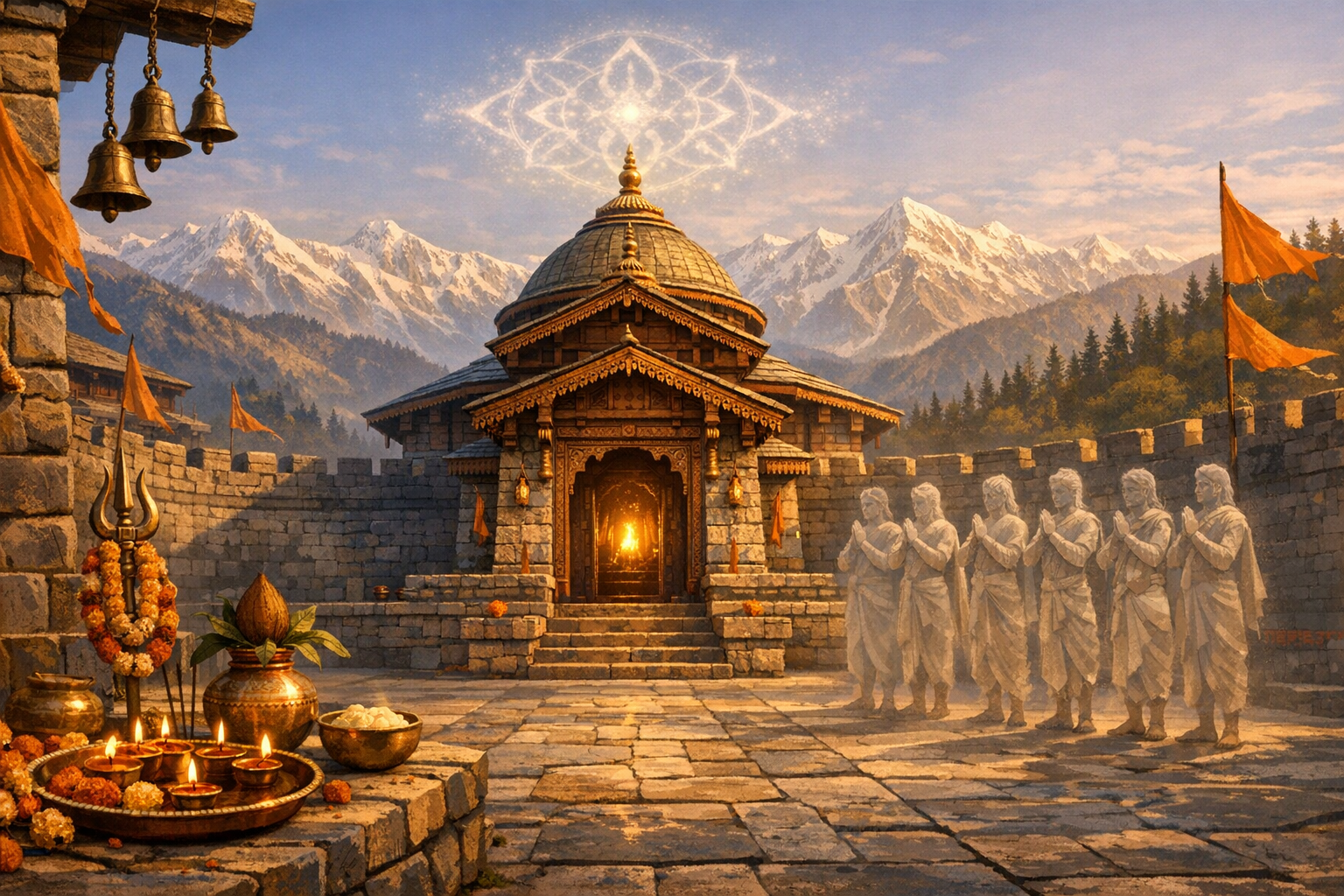
Nagarkot Mata Mandirwidely known as the Brajeshwari Devi Temple and venerated as Vajreshwari in Kangra, Himachal Pradeshholds an eminent place among the Shakti Peeths of the Indian subcontinent. The shrine’s renown rests on a layered confluence of sacred geography, Puranic cosmology, and regional memory that links it to the Pandavas of the Mahabharata. In local tradition, a divine command from the Devi guided the Pandavas to consecrate this site, making the temple not only a locus of worship but also a living repository of civilizational memory in the western Himalaya.
Within the Shakta theological framework, a Shakti Peeth is a nodal center of primordial energy anchored in the narrative of Sati and Shiva. Classical sources such as the Kalika Purana and the Devi Bhagavata Purana enumerate Shakti Peeths in varying numbers (commonly 51, 52, 64, or 108), reflecting a pan-Indic sacred network. Kangra’s Vajreshwari/Brajeshwari is traditionally associated with the falling of Sati’s left breast, a symbolism that expresses the nurturing aspect of Shakti and the fecund abundance attributed to this valley. This mapping of divinity onto landscape has, for centuries, sustained a unifying pilgrimage culture across regions and communities within the broader dharmic family.
Oral histories in and around Kangra preserve a consistent motif: at a time framed either during their vanavasa/agyatavasa or in the aftermath of the Kurukshetra War, the Pandavas received a svapna-adesha divine vision and instructionfrom the Devi to establish or restore the sanctity of Nagarkot. In response, they are said to have installed the sacred emblem of the Goddess and performed rites of propitiation. While such accounts lie outside the critical textual recension of the Mahabharata, they endure in temple kathas and local mahatmyas, embodying the cultural memory of dharma safeguarded by Shakti.
The “divine vision” themefound widely in Tantric and Puranic literatureframes Vajreshwari as the lightning-like force (vajra-shakti) that illumines and protects. Devotees encounter this presence in the garbhagriha, where the sanctum’s iconography emphasizes the Goddess’s sovereignty and maternal grace. The experiential arc of worship moves from the hush of the inner sanctum to the cadence of aarti, tracing a devotional progression from inward stillness to communal celebration of the Devi’s protective power.
Architecturally, the temple expresses a regional Nagara idiom through its sanctum (garbhagriha), vestibule (antarala), and assembly hall (mandapa), set within fortified precincts that recall Kangra’s historical defensive landscapes. The robust enclosure walls, gateways, and circumambulatory path (pradakshina) articulate a sacred choreography in stone, while the valley’s light and the Dhauladhar range beyond infuse the precinct with a distinctive Himalayan luminosity. Over time, spatial modifications and restorative work have been guided by the continuity of worship rather than strict antiquarian replication, prioritizing living tradition.
Ritual life at Nagarkot Mata Mandir follows a dynamic annual cycle. Navratriboth Chaitra and Sharadaanimates the shrine with nine nights of recitation, music, and community fasting, culminating in Kanya Pujan, which honors the living embodiment of Shakti. On Makar Sankranti, a ritual anointment with butter (navanīta-lepana), reflecting a regional belief in the Goddess’s post-war healing after the slaying of asuric forces, underscores the temple’s unique theological aesthetics: compassion, restoration, and the renewal of cosmic order through Devi’s grace.
The temple’s historical record reveals resilience amid upheaval. Chronicles such as al-Utbi’s Kitab al-Yamini note that in 1009 CE, Mahmud of Ghazni plundered the famed wealth of Nagarkot’s sacred precincts, an event often cited in discussions of medieval temple economies and political contestation. In the modern era, the devastating Kangra earthquake of 1905 significantly damaged the structure, after which the community undertook sustained reconstruction, ensuring that ritual continuity and the Devi’s worship remained unbroken. This patternrupture and renewalmirrors the broader story of many Himalayan temples, where seismicity and history together have shaped sacred architecture.
As a pilgrimage destination, Brajeshwari Devi Temple interlinks with the celebrated Shakti circuit of Himachal PradeshNaina Devi, Jwalamukhi, Chintpurni, and Chamundaoften combined with journeys to Vaishno Devi and other northern shrines. This integrated pilgrimage culture fosters a shared devotional vernacular across Hindu lineages and resonates with allied dharmic sensibilities: the reverence for the feminine sacred in Shakta Hinduism finds thematic kinship with Buddhist veneration of Prajnaparamita/Tara and with Jain devotions to Yakshis such as Ambika, while the region’s multi-sited pilgrimage habits reflect a broader Sikh and Hindu travel ecology in the western Himalaya. Such convergences strengthen cultural cohesion without erasing doctrinal distinctiveness.
Beyond worship, the temple serves as a locus for reflecting on the Mahabharata’s ethical grammardharma under pressure, rightful action in conflict, and the humility to seek divine guidance. The Pandava-linked memory at Nagarkot underscores a perennial theme: worldly power without alignment to Shakti (the animating moral-spiritual force) is incomplete. For many visitors, the temple goes beyond mythic remembrance and becomes a place for ethical introspection in the cadence of bells, dhoop’s fragrance, and the valley’s quiet dawns.
Practical access is straightforward: Kangra Airport (Gaggal) serves the region, and road connectivity from Dharamshala and Pathankot is well established. The Kangra Valley Railway’s narrow-gauge line includes stations that facilitate access to the town, with local transit bridging the short distance to the temple precinct. Peak visitation coincides with Navratri and Makar Sankranti; basic temple etiquettemodest attire, mindful movement in crowded corridors, and respect for local customsensures a dignified darshan for all.
Nagarkot Mata Mandir endures as a synthesis of Shakti theology, Mahabharata memory, and Himalayan cultural ecology. Its living heritage is measured not only by stone and stucco but by the continuity of aarti, the cadence of seasonal rites, and the intergenerational transfer of reverence. In honoring the Devi here, devotees also affirm the broader unity of India’s dharmic traditionsdiverse in form, convergent in their quest for ethical clarity, inner strength, and compassionate action.
Inspired by this post on Hindu Blog.










