It is difficult to encounter B.G.L. Swamy’s Mysore Diary or pass the once-revered corridors of Maharaja’s College without sensing the ache of a civilizational loss. The unforgettable vignette he recordsof an English lecturers’ hall turned into a literal cattle-shedoperates as more than a scene; it is a stark allegory of the institutional and epistemic decay that overtook parts of the University of Mysore. For anyone who has sat in a sunlit, high-ceilinged classroom and felt the quiet dignity of a scholarly space, such imagery invokes both disbelief and grief.
A Prophecy: Long before the nadir that Swamy witnessed, S.L. Bhyrappa’s Bhitti had already diagnosed the drift. The modalities of factional capture he documentsfavouring one’s own caste in academic appointments, suppression of the meritorious, sudden promotion of the undeserving, conspiracies against faculty of a perceived “enemy” caste, and shuttering subjects labelled “Brahmin”were not mere anecdotes but patterns. They also ensnared students. Central to the metastasis was the cultivation of student coteries bound by personal loyalty to professors, a practice that later swelled into the “private durbars” of the teaching staff that Swamy so trenchantly describes.
Inner Currents: The decline at Mysore was not a single-cause story. It reflected the convergence of identity-driven campus politics, party patronage, and ideological factionalismcurrents that drew energy from the Aryan–Dravidian debate as it travelled from philological controversy into organised mobilisations (including Justice Party networks) and then into faculty rooms, recruitment committees, and curricula. What took hold was not intellectual pluralism but patronage pluralism: multiple camps, each reproducing loyalty instead of learning.
In this reading, early casualties matter. Diwan Mokshagundam Visvesvarayyaarchitect of Mysore’s modernisation and a founder of the University of Mysorestands as a signal example of how administrative excellence could be undermined once factional alignments overshadowed institutional purpose. As subsequent decades unfolded, and as Justice Party devotees (such as C.R. Reddy in the broader ecosystem of higher education) normalised a politics of academic antagonism, the once-enviable ecosystems at Maharaja’s College and Manasagangotri were, as Mysore Diary suggests, imperilled and in places emptied of their scholarly centre.
Post-Independence offered an opening to transcend colonial-era divide-and-rule habits. Instead, many Indian universities remained battlegrounds of party influence and identity blocs. The universities of Calcutta, Jadhavpur, Patna, Lucknow, and Banaras Hindu University saw intense cycles of politicisation and disruption; by comparison, the University of Mysore was spared the worst flames, though it was in no sense unscathed. The contrast here is not between nectar and poison, but between poison and Halāhala.
It is analytically rigorousand ethically necessaryto observe that structures, not scapegoats, primarily drive such declines: opaque appointments; incentives that reward loyalty over scholarship; and the slow replacement of academic norms with factional etiquette. In this sense, faculty who steward norms and incentives matter as much as, and sometimes more than, passing political dispensations. Where teachers embody integrity, meritocratic standards endure; where they organise “durbars,” scholarship atrophies.
The Real Decline: What is seenthe broken frames, the neglected roomsis the surface. What is lostthe culture of knowledge itselfis the soul. Mysore’s founding vision was exquisitely civilizational: a continuation of the cultural renaissance inaugurated by Krishnaraja Wodeyar III and consolidated under Krishnaraja Wodeyar IV, coupled with Visvesvarayya’s administrative courage. The University of Mysore, in this view, was not a mere degree factory; it was a knowledge commonwealth designed to nurture a modern, dharmic, and dialogic intellectual life.
Scholars of Kannada and Indian thought often speak of a “golden age” stretching from the university’s establishment until the exit of K.V. Puttappa (Kuvempu)a span that literary historians situate from the Navodaya to the Navya period, or metaphorically from M. Hiriyanna’s Krtayuga to U.R. Ananthamurthy’s Kaliyuga. Across these decades, the institution sent forth a procession of cultural giants who embodied a synthesis of śāstra and śruti with modern critical method. Their legacy illustrates a distinctive Indian modernity: rooted, plural, exacting.
A.N. Murthy Rao captured this ethos with a warmth that scholarship rarely achieves without sentimentality. His writing on Mysore reads like homage to a living tradition as much as to a place. Old issues of Prabuddha Karnataka bear witness to that vitality; they show not only the productivity of a university system, but the conviviality of a sabhā where learning was a shared joy. Classrooms were full to the rafters, sometimes with students from other faculties who abandoned their own classes to listen to Mackintosh, Wadia, Radhakrishnan, Venkannayya, S.V. Ranganna, D.L. Narasimhachar, B.M. Srikantaiah, S. Srikanta Sastri and others. The “celebrity” was the guru, and the attraction was not spectacle but substance.
Murthy Rao’s evocation remains irresistible:
“Our senior gurus… were anchored in their place like the eight diggajas holding up this earth from its eight corners. They did not leave their places and wander… There was never any conflict between their profession and personal pleasures. Without even consciously placing a sense of duty before them, duty was fulfilled. Ten of them would assemble to read a play, sharing roles among themselves; or they would ask their younger colleagues to read aloud Kuvempu’s latest poems; or they would conduct an in-depth study of some book were all these duty or pleasure? […]
“On one side, we received weapons-training from the Rishis of Bharata and on the other, from Aristotle, the Greek. The merit we earned by pouring oblations to them was obtained by studying Shakespeare, Aeschylus, Kalidasa, Bhavabhuti, and others…
“If we acquired scholarship back then, it was not scholarship washed by shedding our tears. Just as children gain knowledge of the world while playing, we acquired whatever scholarship we did.
“Along with all our professional duties… gossip and snacking also continued uninterrupted. The statement comparing us to drunkards is not entirely untrue. But this liquor was prepared in a special way. It was distilled by adding ingredients such as Tyagaraja’s lyrics, Dikshitar’s compositions, and the plays of Aeschylus and Shakespeare… The habit of swaying after drinking this brew still remains with us…”
Against this backdrop, Swamy’s later visit reads like an anti-epiphany. What he encountered was not merely administrative neglect but a symbolic inversion of the scholarly order. The shock is compounded because it is set against living memory of excellence; one is compelled to ask how a culture could forget itself so completely.
Swamy’s description remains searing:
“During the time when T.S.V., B.M.S., S.V.R., T.N.S., D.L.N. and others were engaged in the teaching profession, I had once walked through the classrooms and teachers’ rooms of Maharaja’s College. When I passed through those same rooms forty years later, nausea seized me…
“When I entered through the main gate, the first scene that met my eyes bemused me. Behind the staircase, four or five members of the lower staff were sitting around smoking bidis and playing cards. Although they noticed me, they pretended not to and remained absorbed in the game. […]
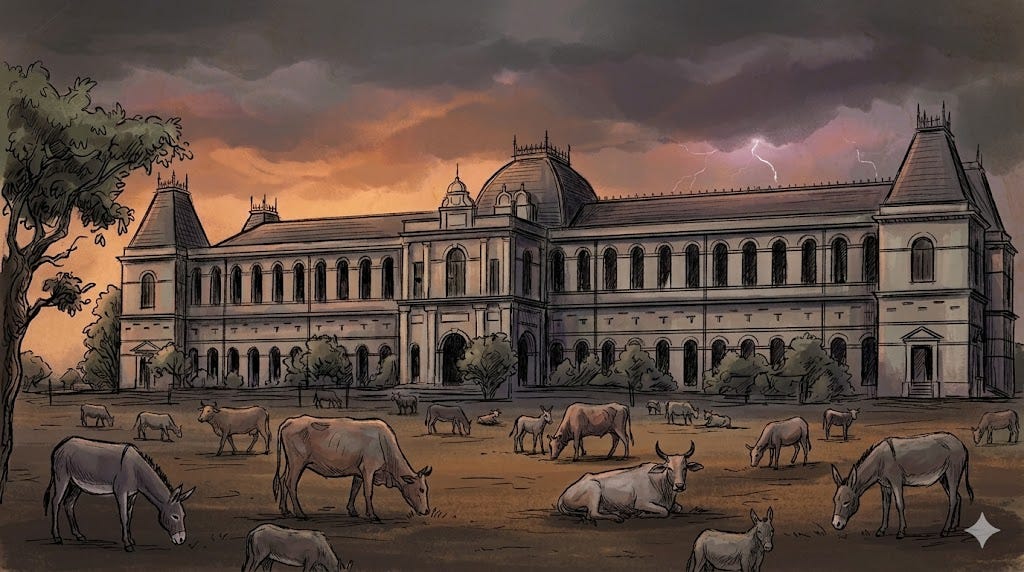
“Next, the English Lecturers’ Hall appeared before me. There was no one inside. The portrait of Rollo, who had once been a professor, was hanging upside down from a broken cord on the wall. Two cows were peacefully chewing cud and had dropped dung on the floor. Just as I approached the door of the adjacent room, a donkey came out from inside, kicked me from behind with its hind legs, and went away.”
Understanding Decline Mechanically: An academic lens clarifies how such decay proceeds. First, hiring and promotion drift from peer-reviewed merit to clientelist exchange, substituting epistemic authority with social capital. Second, curricular decisions become symbolic markers in identity contestsselect “enemy” fields are defunded or closed (Sanskrit, classical literature, and philosophy often being mischaracterised), eroding continuity with India’s knowledge traditions. Third, informal “private durbars” reshape departmental life: seminars turn into caucuses, colloquia into caucus theatres. Over time, the habits of scholarshipcitation, critique, replication, debateatrophy, replaced by the habits of factionsignalling, allegiance, veto, reprisal.
The visible symptoms then predictably multiply: libraries underfunded; laboratories idle; classrooms empty or repurposed; routine maintenance deferred; and a slow exodus of talent who refuse to transact their vocation for favour. Once these feedback loops lock in, reversal requires more than budgetary injections; it requires moral reconstitutionrenewed norms, transparent governance, and a reanchoring in the higher purpose of vidyā.
A Dharmic Frame for Renewal: The University of Mysore’s finest era exemplified the dharmic grammar of learning shared across Hindu, Buddhist, Jain, and Sikh traditions: reverence for the guru-śiṣya relationship; pursuit of universal knowledge (not sectarian victory); and a sabhā-like collegiality where insight, not identity, conferred standing. In that capacious ethos, Kalidasa and Aeschylus, Tyagaraja and Shakespeare, śāstra and science coexisted without anxietyan intercultural poise that is civilizationally Indian.
Restoring such an ethos is not nostalgic indulgence; it is a technical programme of governance and culture. It entails: transparent, peer-led appointments and promotions; strong conflict-of-interest rules; curricular pluralism that honours both classical Indian knowledge systems and modern disciplines; protected time and space for research; institutional sabhās that revive the joy of shared reading and rigorous debate; and student formation that rejects patronage dependence in favour of inquiry, character, and service. Most of all, it demands faculty who model integrity and hospitalitywelcoming dissent, rewarding merit, and building community across traditions.
If an English lecturers’ hall could degrade into a cattle-shed, it can also be reconsecrated into a temple of learningprovided the will, the norms, and the structures are restored. Mysore’s story, seen whole, is less a lament than a summons: to rebuild universities where knowledge is not an instrument of faction, but a shared good that uplifts allfaithfully aligned with the plural, dharmic spirit that once animated their rise.
Inspired by this post on Dharma Dispatch.