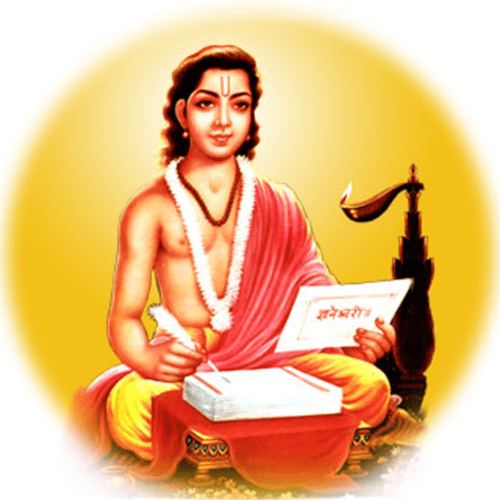
Chandidasa (often spelled Chandidas) occupies a pivotal place in the cultural and spiritual history of Bengal and the wider Bhakti tradition in medieval India. Active in the fifteenth century, his Middle Bengali corpusespecially Sri Krishna Kirtanahelped consolidate the aesthetics, theology, and performance ecology of Krishna devotion long before the Gaudiya Vaishnava efflorescence under Chaitanya. The poetry’s enduring appeal lies in its synthesis of emotive intensity, accessible language, and ritual-musical adaptability, all of which transformed intimate spiritual yearning into a shared community experience.
Situated within the dynamic milieu of fifteenth-century Bengalan era of shifting polities, expanding vernacular literatures, and vibrant inter-regional exchangesChandidasa’s work demonstrates how devotion (bhakti) could serve as both theological insight and social practice. As vernacular literary production flourished across medieval India, Middle Bengali emerged as a powerful medium for affective and doctrinal expression. In this context, Sri Krishna Kirtana harnessed familiar narrative motifs of Radha-Krishna while refining an idiom suited to congregational singing, intimate recitation, and didactic instruction.
Authorship and chronology have been the subject of sustained scholarly attention. Multiple poets bearing the name Chandidas are attested in Bengal’s literary record, and philologists often distinguish at least two or three figures by that name based on dialectal, stylistic, and doctrinal cues. Despite such debates, a coherent picture emerges: the Chandidasa associated with Sri Krishna Kirtana composed in early Middle Bengali, likely in the fifteenth century, and his work stands among the earliest and most influential Radha-Krishna narratives in the region’s literary canon.
Sri Krishna Kirtana is best understood as a narrative cycle organized into thematically linked songs (padas) that dramatize key episodes in the divine love-play (lila) of Radha and Krishna. The text’s architecture navigates the emotional spectrum of love-in-separation (vipralambha) and love-in-union (sambhoga), interweaving pastoral scenes, intimate dialogues, and ethical dilemmas. Many padas close with a bhanitaan authorial signature line of the form “Chandidas bole”which both frames performance and affirms devotional intent.
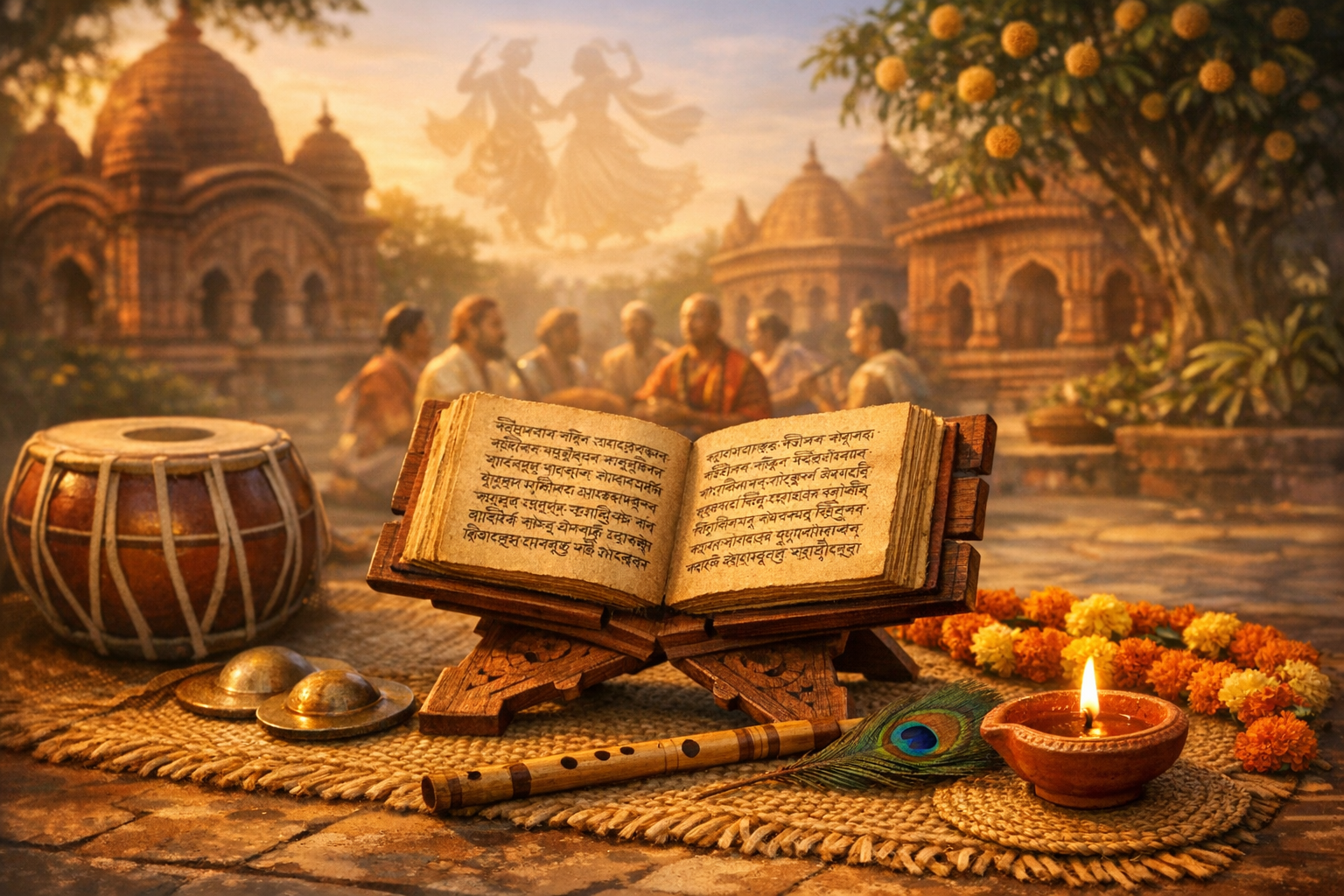
Linguistically, the poetry belongs to Middle Bengali, displaying lexical and morpho-syntactic features transitional from Old Indo-Aryan through Apabhramsha to the emerging eastern vernaculars. The diction balances colloquial clarity with lyrical ornamentation, making the songs memorable for oral transmission. Prosodically, the poems draw on simple rhythmic patterns optimized for kirtanacall-and-response singing accompanied by mridanga and kartalso that even complex theological insights become singable and therefore teachable.
At the level of poetics, Chandidasa’s achievement lies in pairing theological density with rasa theory. The dominant aesthetic is sringara (erotic love), articulated through Radha-Krishna’s yearning, misunderstandings, reconciliation, and ecstatic fulfillment. Yet the poems constantly sublimate human love into a vehicle of divine intimacy, aligning experiential devotion with the later Gaudiya exegetical tradition, in which works like Bhakti-rasamrita-sindhu would elaborate rasa as a disciplined pathway for spiritual realization. In this way, Sri Krishna Kirtana anticipates and informs the refined theological-aesthetic synthesis that later blossomed in Gaudiya Vaishnavism.
Theologically, the poems center Radha as the sovereign of devotionan exemplar of unwavering, affect-laden surrender whose interior life reveals the highest truths about the soul’s relationship to the divine. The narrative often foregrounds emotional ambivalence and moral tension to demonstrate how worldly entanglements can be reoriented as means toward transcendence. Nama-sankirtana (the congregational singing of the divine names) thus becomes not merely a practice of remembrance but a transformative communal pedagogy that aligns conduct, emotion, and metaphysical understanding.
As performance literature, Sri Krishna Kirtana created a durable template for devotional assemblies. Its vocabulary and imagery are readily adaptable to different tempos and tunes, facilitating inclusive participation across age, caste, and profession. This participatory quality helped embed the poetry in the social fabric of Bengal, where kirtana became a locus of communal bonding, ethical instruction, and spiritual consolationan approach that harmonizes with the broader Dharmic ethos of plural paths and shared values across Hinduism, Buddhism, Jainism, and Sikhism.
Intertradition resonances are unmistakable. While rooted in Krishna Bhakti, the emphasis on sung devotion and contemplative attunement resonates with Sikh kirtan, with its raga-grounded congregational singing of revealed verse, and with contemplative chanting practices across Buddhist and Jain communities. Such convergences affirm a civilizational principleunity in spiritual diversitywhere distinct theological lineages share performative and ethical commitments to inner transformation, compassion, and communal harmony.
Textual transmission adds further fascination. Sri Krishna Kirtana circulated in manuscript form for centuries, subject to regional recensions, performative adaptations, and scribal interpolations characteristic of living devotional corpora. Its modern rediscovery and critical editing in the early twentieth century catalyzed fresh scholarship on Middle Bengali literature and clarified the poem’s chronological and doctrinal position in Bengal history. Variants across manuscripts illuminate how communities curated, taught, and loved the textan index of its vitality rather than a mark against its authenticity.
From a philological perspective, key features include recurrent rhetorical devices (upama and rupaka), refrains that stabilize communal singing, and signature lines that signal authorship and frame interpretation. Lexical choices oscillate between pastoral concreteness and metaphysical abstraction, a dual register that keeps the poetry grounded even as it gestures to the ineffable. The result is a disciplined simplicityeasy to remember and hard to exhaustthat marks the finest devotional literature.
The poem’s influence on later Bengali padavali kirtan is profound. While prefiguring the emotional intensity of Vidyapati’s Maithili love lyrics and the Gaudiya Vaishnava song traditions of the sixteenth century, Chandidasa also provided literary precedents for the devotional theater and narrative performance that would animate Bengal’s temple courtyards and village squares. Subsequent poets and kirtaniyas drew on his imagery, cadence, and theological motifs to shape a repertoire that remains vibrantly alive.
Contemporary reception underscores how the text continues to offer ethical and emotional guidance. Readers and listeners find in Radha’s steadfast devotion a model for navigating conflict, longing, and joy; in Krishna’s play, a reminder that the sacred and the everyday interpenetrate; and in kirtana itself, a collective method for transmuting personal pain into shared hope. These insights resonate far beyond sectarian boundaries, inviting collaborative celebration across Dharmic communities that honor devotion, discipline, and the dignity of plural paths.
Scholarly debates about authorship multiplicity and the poem’s candid portrayal of love have at times generated controversy. Yet a mature hermeneutic recognizes that devotional literature often employs the language of human love as a precise instrument for approaching divine intimacy. Read through that lens, Sri Krishna Kirtana’s emotional candor functions not as transgression but as pedagogy: it teaches how the most potent human sentiments, when sanctified by remembrance, become ladders to transcendence.
In sum, Chandidasa’s Sri Krishna Kirtana is a luminous fifteenth-century Bengali masterpiece that shaped the Bhakti tradition’s language of feeling, thought, and song. It stands at the nexus of literature, theology, music, and social practicean enduring contribution to Bengal history, to the living heritage of kirtan, and to the civilizational ideal that diverse Dharmic traditions can find unity in shared devotion. Its pages still sing, and in their song a plural, compassionate vision of spiritual community continues to thrive.
Inspired by this post on Hindu Blog.