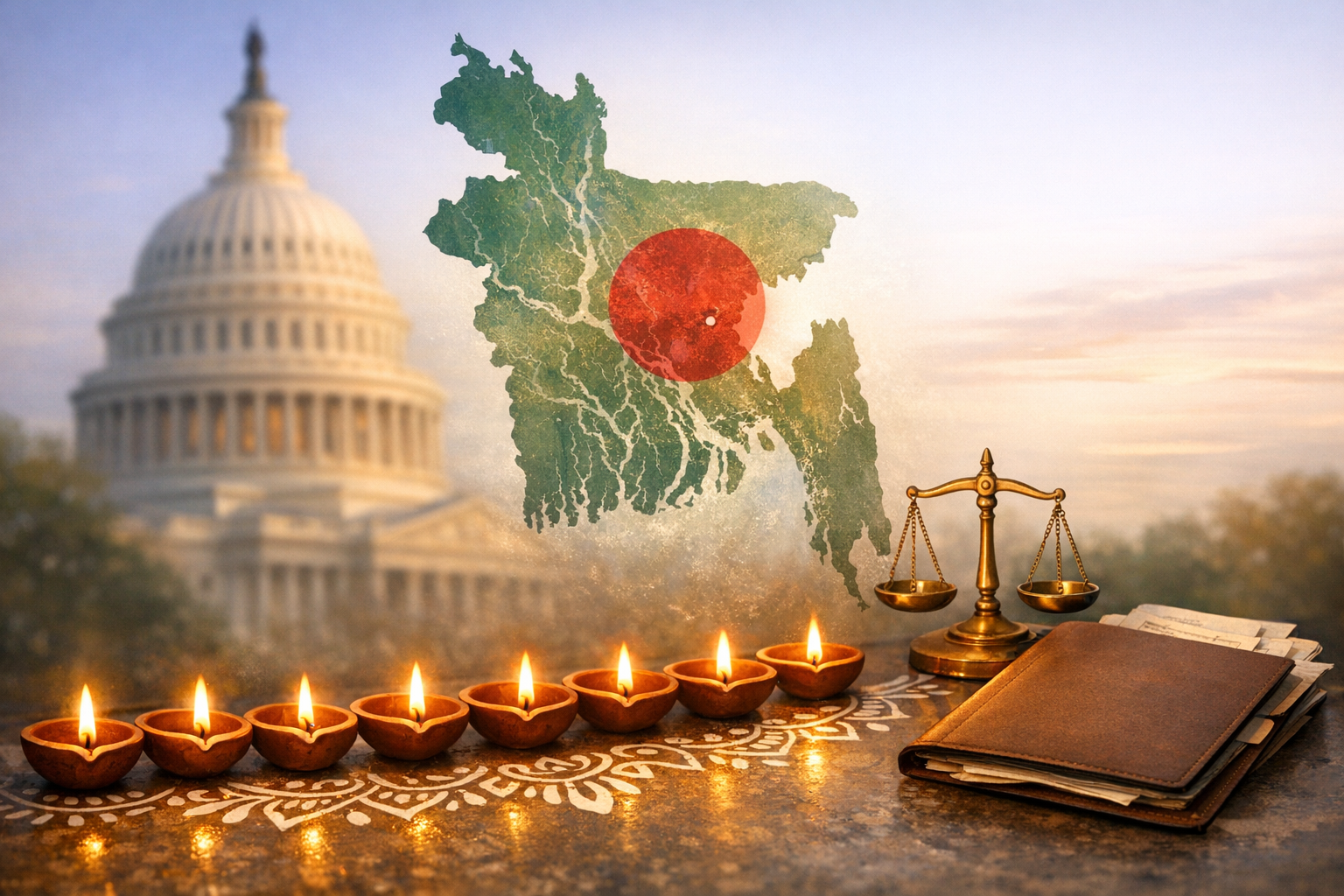
Washington, D.C., March 20, 2026 A landmark measure, H. Res. 1130, has been introduced in the US House of Representatives seeking formal recognition of the 1971 Bangladesh genocide. The resolution condemns atrocities committed by elements of the Pakistan Army and their auxiliary militias, including those aligned with Jamaat-e-Islami, and underscores the documented, disproportionate targeting of Bengali Hindus during the conflict. Backed by a bipartisan grouping and championed by Representative Greg Landsman, the text positions recognition as a step toward truth-telling, remembrance, and durable minority protections in South Asia.
The 1971 Liberation War, precipitated by the Pakistan Army’s launch of Operation Searchlight on March 25, 1971, unfolded into one of the twentieth century’s most devastating episodes of mass violence. Estimates of the death toll vary widelyfrom several hundred thousand to the Government of Bangladesh’s cited three millionalongside large-scale sexual violence, with credible scholarly ranges often placed between 200,000 and 400,000 survivors. Approximately 10 million people, the majority of them Hindus, fled to India, producing one of the largest refugee crises in the region’s modern history.
Multiple contemporaneous and retrospective sources attest to the specific vulnerability of Hindus in East Pakistan (now Bangladesh). Declassified US diplomatic communications, including the April 1971 “Blood Telegram” sent by US Consul General Archer K. Blood, used the term “genocide” and documented evidence consistent with selective targeting of Hindus. Investigative reporting, notably Anthony Mascarenhas’s 1971 exposé titled “Genocide” in the Sunday Times, amplified global awareness of orchestrated violence against Bengali civilians and minorities.
Patterns of killings in Hindu neighborhoods and among Hindu refugees are well documented: the Shankhari Bazar (Shankharipara) massacre in Dhaka within days of Operation Searchlight; the Jathibhanga massacre in Dinajpur in April 1971; and the Chuknagar massacre in May 1971 targeting fleeing civilians. The late-war abductions and murders of intellectuals in Dhaka by Al-Badr units, aligned with Islamist auxiliaries, further illustrate the systematic nature of the campaign and the use of ideological militias to terrorize communities perceived as aligned with Bengali nationalism and religious minorities.
From the standpoint of international law, acts reported in 1971 meet core elements in the UN Genocide Convention: killing members of a protected group; causing serious bodily or mental harm; deliberately inflicting conditions of life calculated to bring about the group’s physical destruction in whole or in part. The group protections explicitly include religious communities, a category under which Bengali Hindus fell. The documented violence also included crimes against humanity and war crimes, highlighting the multi-layered character of the atrocity.
H. Res. 1130 is a non-binding measure that articulates the sense of the House of Representatives. Even so, congressional recognitions shape public memory, guide executive-branch human rights engagement, and encourage archival openness and educational programming. In this instance, the resolution calls for recognition of the 1971 Bangladesh genocide, condemns the roles of the Pakistan Army and Jamaat-e-Islami-linked auxiliaries, and urges commemoration, education, and survivor-centered justicewithout weaponizing memory for present-day retribution.
The resolution’s focus on Hindu targeting rests on a solid evidentiary base. Archival materials from 1971 describe discriminatory identification practices, targeted raids in Hindu-majority localities, and systematic intimidation designed to force migration. These practices created a pipeline of dispossession and flight into India during the spring and summer of 1971, reflected in refugee camp demographics and humanitarian reporting of the time.
Domestic accountability efforts in Bangladesh since 2010 through the International Crimes Tribunal (ICT-BD) have sought to hold individuals responsible for 1971 atrocities, including senior leaders of Jamaat-e-Islami. While legal proceedings have drawn international debate on due process, the body of judgments, witness testimonies, and documentary exhibits assembled by the tribunal contributes to the historical record on crimes committed against civiliansHindus prominently among themas well as against Bengali Muslims, Buddhists, and others deemed disloyal to the Pakistan state.
Key historical inquiries, including Pakistan’s own Hamoodur Rahman Commission Report, and extensive scholarly work have documented command failures, militia mobilization, and the use of ideological auxiliaries such as Razakar, Al-Badr, and Al-Shams. These sources, read alongside declassified US records and survivor testimonies, form a triangulated evidentiary foundation for genocide recognition, even as casualty figures remain the subject of divergent scholarly estimates.
The broader significance of H. Res. 1130 lies in its contribution to transitional justice and prevention. Recognition helps align official narratives with survivor memory, supports curricular inclusion in genocide studies, and encourages states to open archives for independent research. It also strengthens the hand of civil society organizationsacross the Bangladeshi, Indian, and wider South Asian diasporasthat document atrocity histories and advocate for minority protections today.
The resolution resonates with the lived memories of communities across the Dharmic traditionsHindu, Buddhist, Jain, and Sikhwho emphasize interfaith solidarity, protection of pluralism, and remembrance without collective blame. In that spirit, the text’s framing condemns specific actors and extremist ideologies rather than any faith community, aligning with an ethic of unity and non-violence at the heart of South Asia’s civilizational heritage.
For contemporary policy, recognition underscores the imperative of safeguarding minorities in Bangladesh and elsewhereHindus, Buddhists, Christians, and indigenous groupsthrough rule-of-law reforms, rapid accountability for communal attacks, and local-dialogue mechanisms. It also supports structured cooperation among India, Bangladesh, and international partners on atrocity prevention, refugee protection standards, and heritage preservation in sites tied to the 1971 Liberation War.
Historically informed diplomacy can strengthen regional stability. The United States has, in recent years, recognized other genocides after protracted public debate; in a similar vein, H. Res. 1130 places the 1971 Bangladesh genocide within a universal framework of human rights and atrocity prevention. It invites Pakistan to acknowledge historical facts and open archives, Bangladesh to continue strengthening minority protections and memorialization, and the global community to learn from 1971 to prevent future atrocities.
Educationally, recognition encourages rigorous, source-driven scholarship in genocide studies programs, integration of 1971 case studies in comparative courses, and digitization of archival material for open access. Diaspora networksHindu, Buddhist, Jain, and Sikh alikeplay a constructive role by preserving testimonies, supporting research fellowships, and building museums and memorial initiatives that foreground survivor dignity.
Methodological clarity remains essential. While precise casualty figures will continue to be debated, the patterned, group-directed character of violence against Bengali Hindus and other civilians is robustly substantiated across independent sources. Recognition, therefore, is less about settling a single number and more about affirming the historically verified structure and intent of mass atrocities under international law.
H. Res. 1130 marks an important, if overdue, step in aligning policy language with historical evidence. By centering truth, remembrance, and the protection of pluralistic societies, it advances justice for victims and survivors of the 1971 Bangladesh genocideespecially those from the Hindu community who were singled outwhile reaffirming the shared, dharmic commitment to compassion, non-violence, and unity across traditions.
Inspired by this post on Struggle for Hindu Existence.