
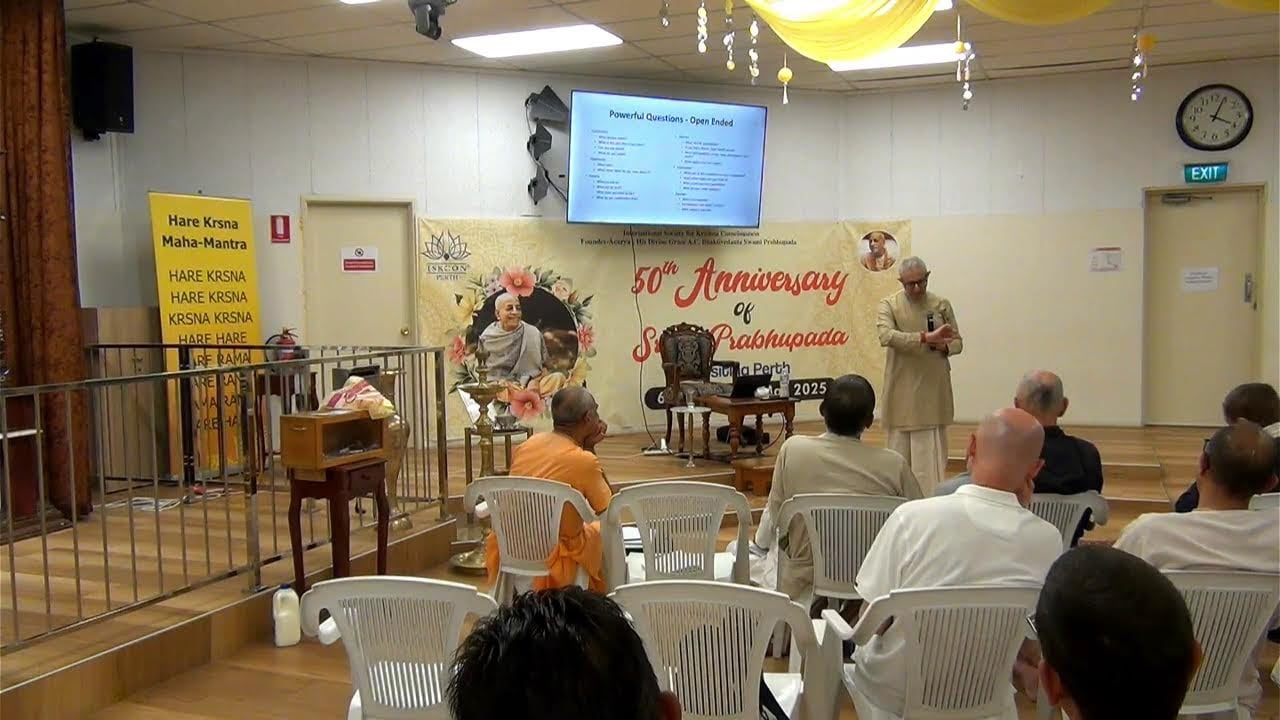
ISKCON Resolve has, since 2002, provided a structured, compassionate, and confidential avenue for addressing disagreements within the International Society for Krishna Consciousness (ISKCON). Anchored in the teachings of Srila Prabhupada and informed by contemporary best practices in mediation and facilitation, the service cultivates skills that sustain healthy communities. The upcoming Foundation Course led by HG Vraj Vihari Prabhu on 5 April offers a careful introduction to conflict literacy, practical tools for dialogue, and a dharmic framework for restoring trust and cooperation.
At its core, ISKCON Resolve operates on a simple yet robust premise: conflicts are natural in dynamic spiritual communities, and with appropriate processes they can become catalysts for growth. The program’s ombuds-style approach emphasizes neutrality, confidentiality, and voluntary participation. Facilitators support parties in identifying interests beneath positions, reframing language to reduce blame, and building agreements that are both principled and practical. This orientation preserves relationships, reduces organizational friction, and aligns conduct with Vaishnava etiquette.
While rooted in the Vaishnava tradition, the course situates conflict transformation within the broader, unifying ethos of dharmic thought. Buddhism’s Right Speech (truthful, beneficial, and timely), Jainism’s Anekantavada (the many-sidedness of truth), and Sikh principles such as Sarbat da bhala (the welfare of all) reinforce the same ethic that guides ISKCON Resolve: dignity for every participant, non-violence in word and deed, and sincere effort toward mutual understanding. The course thus speaks to a shared civilizational commitmentacross Hinduism, Buddhism, Jainism, and Sikhismto resolve differences without animosity and to strengthen communal harmony.
HG Vraj Vihari Prabhu’s facilitation style exemplifies this synthesis of scriptural insight and modern method. Participants encounter a learning environment that is both rigorous and compassionate, where humility, patience, and clarity of purpose set the tone. Case-based discussions, reflective exercises, and structured dialogues cultivate practical competencies while remaining faithful to spiritual principles such as cooperation in service and respect for each person’s spiritual journey. Devotees and leaders frequently report that such instruction translates directly into day-to-day improvements in communication, teamwork, and decision-making.
The Foundation Course typically introduces a coherent set of frameworks that are widely used in faith-based and nonprofit mediation. First, conflict literacy clarifies how disputes often arise from mismatches in values, roles, resources, information, and expectations. Second, interest-based negotiation helps parties move from rigid positions to underlying needs, opening possibilities for integrative solutions. Third, communication toolssuch as active listening, reframing, and compassionate inquiryreduce defensiveness and surface actionable common ground.
Technical modules outline process mechanics. A standard arc includes confidential intake, early case assessment, consent to proceed, ground rules for psychological safety, joint sessions with the option for caucuses, option to engage elders or subject-matter experts, and agreement drafting. Facilitators use careful sequencing to rebuild trust: starting with narratives and impact statements, then clarifying interests, brainstorming options, stress-testing proposals, and finally memorializing specific commitments. Agreements emphasize clarity (who will do what, by when), verification (how progress will be reviewed), and flexibility (how adjustments will be made if conditions change).
In alignment with a dharmic ethic of accountability and compassion, restorative practices feature prominently. When relationships have frayed, restorative circles can allow parties to voice concerns, acknowledge harms, and co-create amends. This is consonant with Vaishnava reflections on aparadha (offense), where repair and recommitment to service are vital. The goal is not merely cessation of conflict but reestablishment of trust and the renewal of shared purpose in devotional and community life.
Ethics and governance form a critical backbone. The course highlights confidentiality boundaries (what can and cannot be shared), informed consent, voluntary participation, and conflict-of-interest checks for neutrals. It emphasizes a non-adversarial posture that complements formal leadership structures rather than replacing them. Good record-keeping practices protect privacy, and feedback loops ensure continuous improvement of services. These safeguards help institutions remain both compassionate and credible.
Skill-building components are granular and practice-oriented. Participants learn to formulate open-ended questions that invite depth rather than defensiveness, summarize and reflect to show comprehension, and reframe accusatory statements into solvable problems. Techniques such as “looping for understanding,” emotion labeling, and interest-charting transform difficult conversations into constructive dialogues. Special attention is given to cross-cultural sensitivity, power dynamics, gender safety, and communication across hierarchical lines common to service organizations.
Contemporary realities receive careful attention. Many communities now operate across time zones and rely on digital tools. The course reviews how to design safe and effective online mediations, manage asynchronous communication, and account for the additional ambiguity of text-based messaging. Participants learn to set digital ground rules (camera use, turn-taking, confidentiality online), build rapport through brief check-ins, and document outcomes transparently without compromising privacy.
Measurement and learning analytics are essential to institutional maturity. The course encourages communities to track resolution timelines, agreement durability, user satisfaction, and qualitative indicators such as restored collaboration or reduced turnover. Aggregated and anonymized insights can guide training priorities, policy refinements, and leadership development. Evaluating both outcomes (agreements reached) and processes (fairness, respect, and felt safety) ensures that conflict transformation is sustainable rather than episodic.
Testimonials gathered in various contexts repeatedly point to concrete benefits. Devotees describe relief after being heard without judgment, managers report smoother collaborative planning after facilitated dialogues, and volunteer teams observe fewer escalations once basic reflective listening becomes habitual. Where disagreements previously lingered, structured processes convert energy from contention into shared service. Such results illustrate a larger truth of dharmic life: clarity, compassion, and discipline together enable communities to grow stronger through trials.
The integrative vision underpinning ISKCON Resolve has implications beyond one institution. Sanghas, parishes, and community associations in diverse dharmic settings can adapt these methods without strain, because the approach is principle-driven rather than personality-driven. When a shared commitment to non-violence, truthfulness, and mutual uplift guides the process, techniques such as interest-based negotiation or restorative conferencing become natural extensions of spiritual values rather than foreign imports.
The 5 April Foundation Course by HG Vraj Vihari Prabhu is designed to be an accessible yet substantive starting point for community members, volunteers, and leaders who wish to cultivate conflict competence. Participants can expect a balanced blend of conceptual frameworks, scriptural resonances, and hands-on exercises. The course demystifies mediation, equips individuals to de-escalate everyday tensions, and shows how to align organizational procedures with dharmic principles that honor the dignity and agency of every person.
In sum, ISKCON Resolve exemplifies how a living tradition can meet contemporary challenges with wisdom and method. By uniting scriptural guidance with evidence-informed practice, the Foundation Course nurtures communicative clarity, ethical courage, and restorative community bonds. The result is not only fewer conflicts but also deeper cohesion across devotees and, in a wider sense, across dharmic communities committed to peace, seva, and shared flourishing.
Inspired by this post on Dandavats.
