
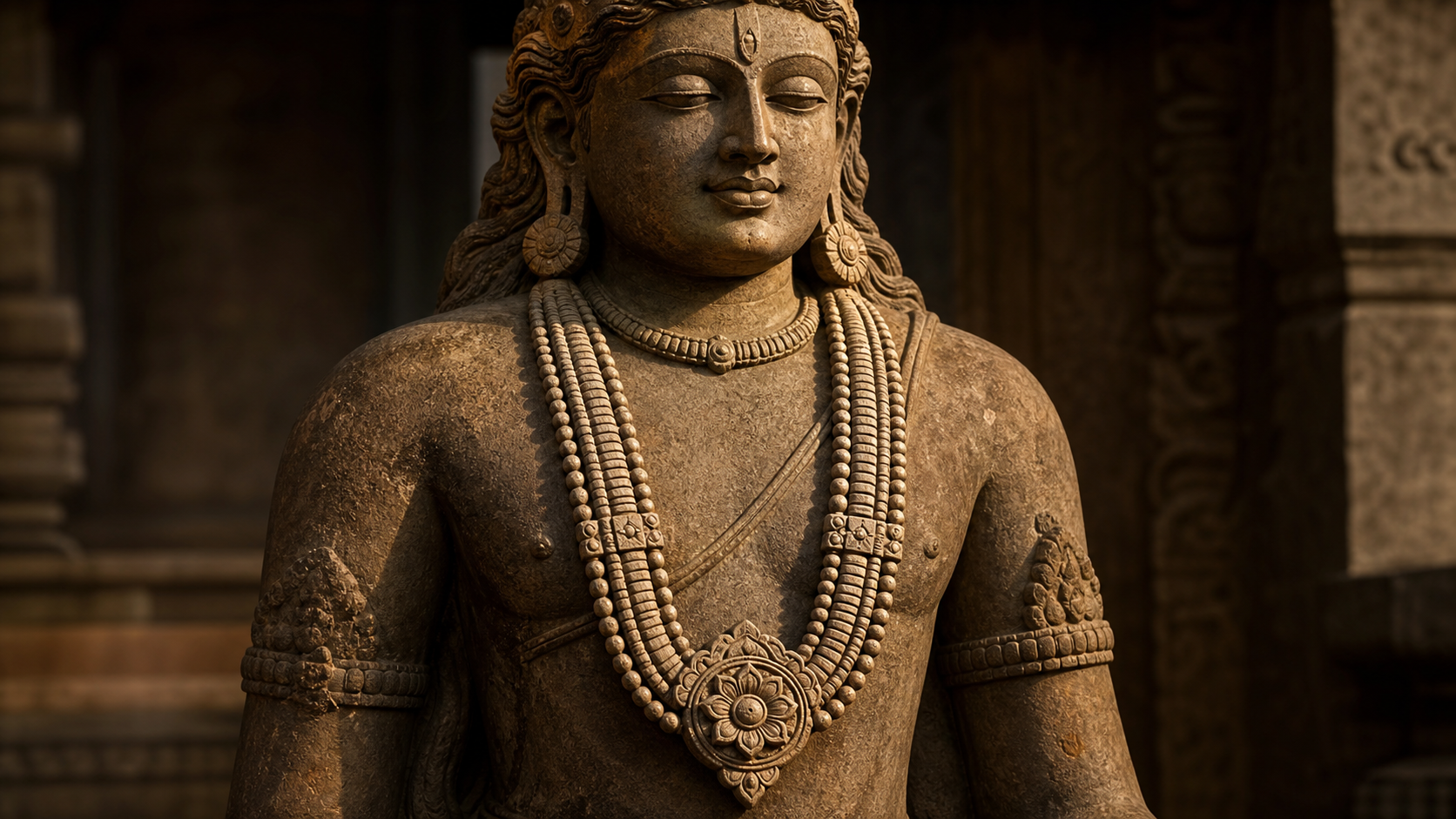
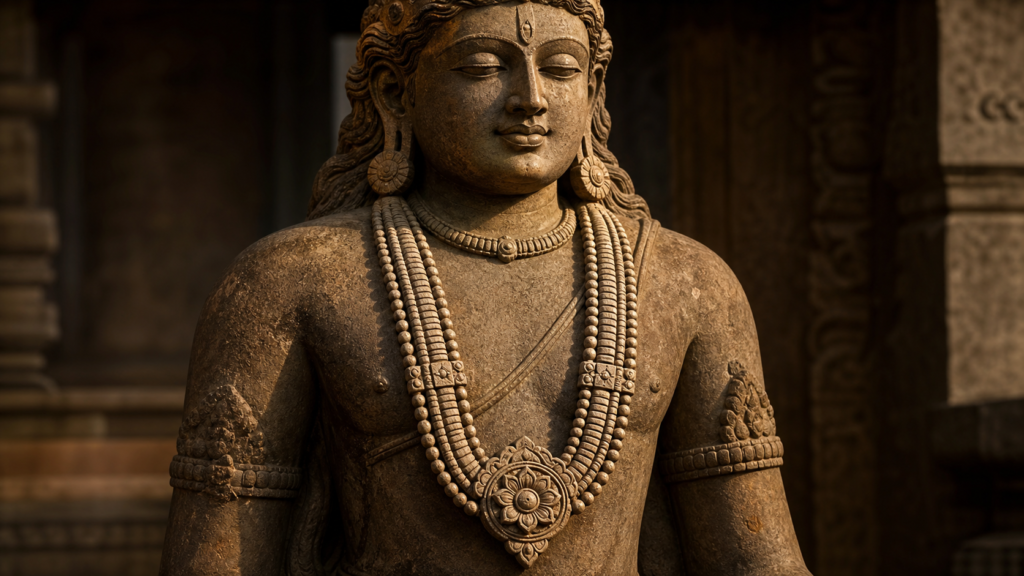
The sacred necklace in plain view. Among the many ornaments that animate Hindu sculpture, the hara occupies an especially commanding place. It descends from the neck across the chest, where its strands, plaques, beads, and pendants organize a large part of the figure’s visible surface. A casual glance may register only jewellery; closer examination reveals a carefully designed element that guides the eye, clarifies rank, reinforces bodily rhythm, and contributes to the deity’s radiant presence. The hara is therefore best understood not as decorative excess but as part of the visual language through which gods, goddesses, celestial beings, rulers, donors, and attendants become legible in sacred Indian art.
A practical definition of hara. In its broad Sanskrit sense, hāra can denote a necklace or garland. In the working vocabulary of Hindu iconography, the term commonly identifies a necklace that falls from the neck onto the chest rather than remaining confined to the throat. It may terminate near the upper sternum, extend toward the solar plexus, or descend farther according to the deity, region, period, and composition. A hara can consist of one substantial strand, several graduated strings, linked ornamental plaques, or a combination of beads and a central pendant. Length is important, but placement, structure, and relation to neighboring ornaments are equally significant.
Terminology requires scholarly caution. Historical texts, regional workshops, museum catalogues, and modern iconographic studies do not always use jewellery terms in precisely the same way. The IGNCA Ajanta glossary, for example, defines hāra simply as a necklace and ekāvalī as a single-stringed chain. The Government of India publication Elements of Indian Art likewise gives hāra a general definition while separately describing ornaments such as the graiveyaka, niṣka, Kaustubha, and Vaijayantī. Consequently, the label hara should be treated as a useful analytical category rather than an inflexible name that every sculptor across India applied identically.
Hāra and Hara are not the same term. English transliteration can conceal an important distinction. Hāra, with a long first vowel, refers here to a necklace or garland. Hara is also a celebrated name of Shiva, usually understood in relation to his power to remove, take away, or dissolve. A title such as “the hara of Shiva” therefore refers to Shiva’s necklace, not to an ornament named after Hara. Context normally prevents confusion, but careful transliteration is valuable in academic discussion and digital cataloguing.
Ornament functions as visual structure. Hindu image-making does not treat the body as an empty support to which jewellery is added at the end. Crown, earrings, necklaces, armlets, sacred thread, girdle, anklets, clothing, attributes, posture, and gesture are coordinated into a unified composition. The hara links the head and throat to the torso, creates a downward visual axis, and often frames the chest. Its curve may echo the shoulders, counterbalance raised arms, or stabilize an otherwise dynamic pose. Even when the beads are small, the necklace can perform a major architectural role within the image.
The chest is an important iconographic field. The chest may carry a sacred thread, sectarian mark, divine jewel, garland, cross-belt, or multiple necklaces at once. The hara must therefore be read as one element in a layered system. Its location can encourage devotional associations with inwardness, generosity, protection, or the spiritual heart, but an academic interpretation should not automatically identify every chest necklace with the anāhata chakra. Such a reading may be meaningful within a particular devotional or yogic setting, yet it is not a universal iconographic rule established merely by placement.
How the hara differs from a kanthi. A kaṇṭhī is generally understood as a comparatively short neck ornament situated close to the throat or collar line. In sculpture, it may appear as a compact strand, band, torque-like form, or closely arranged row of beads. A hara normally creates a more pronounced descent over the torso. Both can occur on the same image: the short ornament visually anchors the throat, while the longer necklace opens across the chest. Their coexistence is not redundant; it establishes hierarchy, depth, and rhythm among the layers of divine ornamentation.
How the hara differs from an ekavali. Ekāvalī literally emphasizes a single strand, not an absolutely fixed length. Many examples sit close to the neck, which explains why the term is often contrasted with a long hara, but a single strand can also descend farther. The decisive feature is its unitary construction. A fifth-century Gupta Ekmukha Shiva Linga in the Museums of India repository is specifically described as wearing an ekavali close to the neck. Such documented objects demonstrate why strand count and placement should be recorded separately instead of assuming that one feature automatically determines the other.
The graiveyaka presents a special problem. The supplied distinction between the long hara and throat-level ornaments is visually useful, but graiveyaka is not consistently defined as a narrow collar. Some art-historical glossaries describe it as a broad necklace covering the upper chest, while particular catalogues use the term for a close neck ornament. The variation may reflect textual differences, historical change, regional usage, or modern classification. When identifying an individual sculpture, a descriptive phrase such as “broad upper-chest necklace” is often safer than forcing an uncertain technical label.
The hara is a family of forms. There is no single silhouette that exhausts the category. A hara may be a smooth U-shaped loop, a shallow crescent, a deep pendant-bearing chain, a tiered arrangement of graduated strands, or a broad composition of connected plaques. Some examples are restrained and almost linear; others cover much of the chest with dense ornamental detail. The most reliable identification combines several observations: where the ornament begins, how far it descends, how many strands it contains, whether it bears a pendant, and how it interacts with the body.
Hara and vanamala should not be conflated. A vanamālā is fundamentally a garland associated with flowers or vegetal forms and can descend far below the chest. In Vaishnava imagery, the Vaijayantī or Vaijayantīmālā is a distinguished long garland connected with Vishnu. Sculptors may render a garland as repeated floral or leaf-like units, while a hara is more often conceived as jewellery made from beads, pearls, gems, discs, or metal elements. Weathering can blur the distinction, and stylized flowers may resemble beads, so the entire ornament and the identity of the figure must be considered.
Kaustubha, Shrivatsa, and hara occupy related but distinct categories. In Vaishnava iconography, Kaustubha is the particular divine jewel associated with Vishnu. Śrīvatsa is a sacred mark on the chest rather than a necklace. A hara may frame, support, or visually accompany these features, but it should not automatically be identified with either one. Likewise, the presence of a central jewel does not by itself prove that the pendant represents Kaustubha. Secure identification depends on the full iconographic program, textual tradition, provenance, and comparison with related images.
Cross-body ornaments follow another logic. The yajñopavīta passes diagonally across the torso and expresses a ritual identity distinct from that of a necklace. A channavīra or ornamental cross-belt forms one or two diagonals and may carry heroic, ceremonial, or costume-related associations. These elements can intersect a hara, creating a dense network of lines over the chest. Their points of overlap are diagnostically useful: a hara normally hangs symmetrically from the neck, whereas a sacred thread or cross-belt traverses the body asymmetrically or in an X-shaped arrangement.
Silhouette is the first level of design. Before individual beads are examined, the necklace’s overall contour should be traced. A shallow curve emphasizes the shoulders and upper chest; a deep U-shaped hara lengthens the torso; a V-shaped arrangement draws attention to a pendant or chest mark. Multiple loops can broaden the body, while a single narrow strand preserves open space around the torso. These decisions are especially important in frontal icons, where symmetry and axial clarity contribute to an impression of stability and concentrated presence.
Strand architecture reveals technical intention. A sculpted hara may contain parallel strands of equal length, graduated rows, twisted cords, alternating bead sequences, or loops suspended between decorative plaques. The sculptor must make each strand readable without weakening the stone or confusing it with adjacent ornaments. In metal images, wax modelling permits finer relief and more continuous curves. Whether rendered in stone or bronze, the structure frequently imitates the behavior of a flexible necklace while remaining adapted to the physical and visual demands of the image.
Bead morphology carries information. Round pearls, ribbed beads, barrel-shaped units, faceted forms, floral rosettes, discs, and jewel-like settings produce different textures. A row of uniform spheres suggests one material and rhythm; alternating large and small units creates hierarchy; clustered beads simulate richness and weight. Niṣka-type ornaments may be represented through repeated disc-like or coin-like elements, although a precise identification requires contextual support. Bead form can assist stylistic comparison, but it should not be used alone to assign a date or dynasty.
The pendant establishes a focal point. Many haras culminate in a central pendant, medallion, plaque, tassel, floral unit, or gem setting. This element lies on the vertical axis of the body and can connect the necklace visually with the face, navel, pedestal, or principal hand gesture. Lotus forms, rosettes, geometric settings, auspicious creatures, and abstract jewel shapes are all possible. A pendant may carry specific meaning, but its motif must be clearly preserved before a theological interpretation is proposed.
Terminals and suspension points matter. The upper ends of a hara may disappear behind the neck, attach to shoulder-level plaques, or be integrated with a broad collar. Small side clasps, spacers, and linking elements can show how the imagined jewellery was assembled. These details reveal close observation of real craftsmanship, even when the sculpted necklace is idealized. They also help distinguish a suspended hara from a garment border, chest band, or garland that happens to occupy the same area.
Material must be inferred with restraint. Historical necklaces could be fashioned from gold, silver, pearls, gemstones, glass, shell, seeds, flowers, and other organic or mineral materials. Stone sculpture can suggest luminosity, rarity, or texture, but it rarely proves the exact substance represented. A smooth round bead might evoke a pearl, a polished gem, or an idealized ornamental unit. Unless an inscription, text, surviving inlay, pigment analysis, or secure comparison supplies stronger evidence, “pearl-like” or “jewel-like” is more accurate than a categorical material identification.
Stone transforms jewellery into light and shadow. Sculptors use drilling, incision, raised bosses, undercut edges, and contrasting planes to simulate separate beads and suspended chains. Deep drill holes make dark points between pearls; crisp ridges catch light; undercut pendants cast shadows that visually detach them from the torso. In hard stone, the ornament may be concise and geometric. Softer sandstone can permit more elaborate modelling but is vulnerable to abrasion. The apparent richness of the hara therefore depends as much on the sculptor’s management of shadow as on the number of carved details.
Bronze preserves another kind of delicacy. In lost-wax casting, the necklace can be modelled directly in wax as raised strands, minute beads, loops, and plaques before the image is cast. The resulting ornament follows the body with an organic continuity that differs from separately manufactured jewellery. Chasing, polishing, inlay, or later ritual handling may further alter the surface. On many South Indian bronzes, the hara does not conceal the anatomy; it articulates the chest while allowing the sensuous balance of the figure to remain visible.
Ancient sculpture was not necessarily monochrome. Pigment, gilding, inlay, applied metal, textiles, and real ornaments may once have intensified details that now appear subdued. Evidence varies greatly from object to object, and later ritual additions must be distinguished from original treatment whenever possible. A weathered stone hara should not automatically be imagined as plain. At the same time, hypothetical reconstruction should be identified as such rather than presented as certainty. Scientific examination, early photographs, and documented conservation history offer firmer grounds for interpreting lost surface effects.
The hara can make still stone appear to move. On a strictly frontal icon, balanced loops reinforce composure. On a dancing, turning, or flexed figure, the necklace may shift to one side, lift from the torso, or follow the curve of the breasts and shoulders. Such displacement converts jewellery into evidence of implied motion. A Metropolitan Museum publication describing a medieval celestial dancer notes how a long necklace follows the figure’s contours, demonstrating the close relationship between ornament and bodily energy in Indian sculptural design.
Proportion governs visual credibility. Indian image-making traditions commonly organize the divine body through proportional units such as tāla and aṅgula, although systems vary by text and workshop. The hara must be scaled to this idealized anatomy. If it is too small, it loses its compositional authority; if too broad, it obscures chest marks, sacred threads, or gestures. Skilled design allows the necklace to appear sumptuous without dissolving the clarity of the icon. Its dimensions are therefore aesthetic, technical, and iconographic decisions at once.
Negative space is part of the ornament. The open areas between strands, pendant, arms, and torso prevent a richly decorated image from becoming visually inert. On some sculptures, the smooth chest serves as a calm field against which a few beads appear exceptionally luminous. On others, closely packed necklaces deliberately create ceremonial density. Neither restraint nor abundance is inherently more sacred. Each belongs to a particular aesthetic solution shaped by scale, material, intended viewing distance, regional style, and the identity of the image.
Alankara is more than embellishment. In Hindu ritual and aesthetics, alaṅkāra encompasses adornment, beautification, and the fitting enhancement of a form. A divine image is not beautified because it lacks completeness; rather, ornament manifests splendor in a form accessible to human sight. The hara contributes to this revelation by making radiance, abundance, order, and ceremonial presence visible. Its theological force arises from the whole adorned image, not from the monetary value that a real necklace might possess.
Sovereignty and auspiciousness are recurring associations. Rich chest ornaments can evoke royal dignity, prosperity, victory, fertility, generosity, and divine favor. Concepts such as śrī, maṅgala, and tejas provide an interpretive vocabulary for this radiant fullness. Yet these meanings are contextual rather than mechanically encoded. A simple hara on an ascetic deity may communicate controlled power, while an elaborate one on a royal form may intensify majesty. The surrounding crown, weapons, attendants, posture, vehicle, and shrine context determine which associations become most persuasive.
The hara is not gender-specific. Hindu sculpture places necklaces on male, female, composite, and multiform divinities, as well as on human patrons and celestial attendants. Differences in design can relate to role, age, status, regional fashion, or aesthetic convention, but a long necklace should not be treated as inherently feminine. Gods may wear luxuriant strings of pearls, while goddesses may appear with restrained ornamentation in particular forms. The visual culture of sacred jewellery is more flexible than modern assumptions about gendered dress often suggest.
Vishnu’s hara participates in an ensemble of divine regalia. Crown, earrings, armlets, sacred thread, chest jewel, garland, girdle, and necklaces together express preserved cosmic order and royal serenity. A short neck ornament may be layered above a deeper hara, while the vanamala descends beyond both. Kaustubha and Śrīvatsa require separate identification even when located near the necklace. The resulting arrangement is not merely lavish: it establishes a controlled hierarchy in which each line and emblem contributes to the recognizable Vaishnava form.
Shiva’s necklaces articulate a creative tension. Shiva can appear as ascetic, householder, teacher, dancer, warrior, or supreme lord. Rudrākṣa beads, serpentine ornaments, simple cords, and jewelled haras may therefore occupy the same general region of the body while carrying different associations. A richly adorned Shiva does not negate ascetic power; it can reveal the deity’s simultaneous transcendence and sovereignty. Conversely, a restrained necklace may intensify yogic concentration. The necklace must be interpreted together with the jaṭāmukuṭa, crescent, third eye, serpent, weapons, posture, and attendant figures.
Devi’s hara expresses presence rather than passive luxury. On forms of Lakshmi, Parvati, Durga, Saraswati, and other goddesses, chest ornaments may communicate beauty, abundance, authority, martial sovereignty, learning, maternal grace, or an integration of several powers. The hara can frame the torso, reinforce frontal majesty, or swing with the energy of a dynamic pose. Reducing such jewellery to a marker of feminine attractiveness overlooks its iconographic work. In many contexts, ornament is an active sign of śakti made visible through ordered, radiant form.
Other deities reveal the hara’s adaptability. Ganesha’s rounded torso causes a long necklace to follow a broad, often gently curved path. Skanda or Karttikeya may wear ornaments that support youthful, martial, or royal identity. Brahma, Surya, guardians, river goddesses, dikpalas, and divine attendants can also carry elaborate chest jewellery. The same formal category changes character according to anatomy, posture, attributes, and theological role. This adaptability helps explain why the hara became so widespread within Hindu iconographic tradition.
Gods and mortals share an ornamental vocabulary. Kings, queens, donors, musicians, dancers, yakshas, yakshis, and celestial beings may wear necklaces resembling those of deities. Shared form does not imply equal status. Scale, placement, complexity, material suggestion, accompanying insignia, and position within the composition establish hierarchy. A donor’s hara can indicate dignity or prosperity, while a deity’s necklace participates in a sacred body defined by attributes and ritual identity. The distinction lies in the complete image rather than in one ornament alone.
Ornament can mark rank without functioning as a social census. Rich jewellery often signals elevated status, but sculpture does not provide a transparent record of everyday dress. Divine ideals, poetic conventions, patronal aspirations, workshop habits, and ritual prescriptions shape what appears on the image. It is therefore unsafe to infer a wearer’s precise caste, occupation, or economic condition solely from a hara. Iconography represents an ordered world of meaning; it is historical evidence, but evidence mediated by sacred purpose and artistic convention.
No single symbolism explains every hara. The necklace may contribute to majesty, auspiciousness, beauty, protection, abundance, devotion, or compositional balance, yet it need not encode all these ideas in every image. Some examples are primarily identifiers within a prescribed ensemble. Others respond to regional fashion or the sculptor’s formal imagination. Responsible interpretation distinguishes three levels: what is visibly present, what comparison makes probable, and what theological reflection makes possible. Keeping those levels separate protects both scholarly accuracy and devotional depth.
Early Indian sculpture supplies the wider foundation. Necklaces appear on yaksha and yakshi figures, royal images, narrative reliefs, and sacred figures across early Buddhist, Jain, and Brahmanical settings. These works demonstrate the antiquity of elaborate chest ornament in the subcontinent’s visual culture. Later Hindu iconography inherited, refined, and reorganized that shared repertoire. Applying a later technical label to every early necklace would be premature, but the early record shows that jewellery already communicated vitality, abundance, rank, and superhuman presence.
Gupta-period art often favors lucid integration. In many fourth- to sixth-century works, ornament is clearly articulated while remaining subordinate to the calm continuity of the ideal body. A necklace may be reduced to a precise strand or a few controlled units, allowing the face, posture, and torso to retain visual serenity. The close ekavali on the documented Gupta Ekmukha Shiva Linga offers a useful comparison with deeper chest ornaments. Such examples show that restraint can carry as much iconographic authority as later ornamental density.
Pallava and Chola traditions refine the relationship between body and jewel. South Indian stone and bronze images frequently coordinate necklaces with elegant shoulders, narrow waists, balanced stances, and rhythmic hand gestures. On Chola bronzes, the raised detail of the hara participates in a continuous surface conceived in wax and transformed into metal. The ornament remains legible in ritual movement and lamplight without severing the unity of the body. This balance between sensuous anatomy and disciplined regalia became one of the most admired features of South Indian sacred sculpture.
Deccan workshops explore depth and ornamental layering. Chalukya, Rashtrakuta, and later Hoysala traditions developed distinct solutions to chest jewellery. At sites and monuments associated with these traditions, necklaces may range from broad, forceful bands to exceptionally fine networks of beads and pendants. Hoysala stone carving is especially celebrated for minute surface articulation, where jewellery contributes to the almost textile-like richness of the figure. Yet even the most elaborate hara remains coordinated with posture, architectural frame, and the larger rhythm of the sculptural program.
Northern, central, and eastern schools create their own accents. Mathura, post-Gupta central India, Chandella centers, Odisha, Kashmir, Rajasthan, and Pala-Sena regions cannot be reduced to one ornamental sequence. Some favor massive beads and strongly defined medallions; others prefer slender strings, sharp jewel settings, or densely layered regalia. Stone type, image scale, patronage, and workshop practice all influence the result. Comparative study is most reliable when it begins with securely provenanced works rather than treating “North Indian” or “East Indian” as self-explanatory styles.
Vijayanagara and later South Indian images often amplify ceremonial richness. Layered neck ornaments, broad pendants, and rhythmic bead sequences contribute to an emphatic sacred presence suited to temple ritual and processional culture. An IGNCA study of Garuda images in the Salar Jung Museum describes both a kanthahara and a hara among the ornaments of a South Indian figure associated with Vijayanagara influence. The example is valuable because it documents how short and long necklace categories can coexist on one sculpted body.
There is no simple evolution from plain to elaborate. Indian sculptural history does not move uniformly from minimal jewellery toward ever greater complexity. Restrained and sumptuous forms coexist in many periods. A small icon intended for intimate worship may require different treatment from a monumental exterior figure. An ascetic manifestation differs from a royal one, even within the same century and region. Chronology must therefore be built from inscriptions, archaeological context, style, material, and comparison—not from the necklace’s complexity alone.
Workshop knowledge crossed religious and political boundaries. Sculptors, metalworkers, jewellers, patrons, and pattern traditions circulated through regions governed by changing dynasties and supporting multiple communities. Bead sequences, pendant forms, and methods of rendering flexible chains could be shared even when the images served different theological systems. The hara thus preserves both continuity and innovation: it belongs to a broad Indian history of ornament while acquiring specific meaning within each deity, temple, lineage, and ritual setting.
A sculpted hara is fixed, but divine adornment can remain changeable. Consecrated images may possess jewellery permanently carved or cast into their forms and may also receive actual necklaces during worship. These two layers should not be confused. The sculpted ornament belongs to the image’s designed iconography; the applied ornament belongs to a living cycle of service, festival, patronage, and presentation. At certain moments the real jewellery may cover the carved hara completely, producing a sacred appearance that differs from the form visible in a museum photograph.
Ritual alankara makes sacred time visible. Clothing, flowers, sandal paste, jewels, garlands, and other offerings may change according to the day, season, vow, festival, or local custom. The hara becomes part of seva when it is offered, fastened, displayed, and viewed as an expression of devotion. Its significance is therefore not exhausted by formal analysis. The same category exists simultaneously within textual prescription, sculptural design, historical jewellery, temple economy, embodied ritual, and the devotee’s experience of darśana.
Darshana gives ornament an interpersonal dimension. A viewer standing before an adorned murti may experience the hara as a luminous threshold between material craftsmanship and divine presence. That response is emotionally real even when it cannot be measured like an object’s dimensions. Academic study need not dismiss such experience; it can distinguish devotional reception from demonstrable historical fact. The distinction allows sacred art to be approached with empathy and precision at the same time.
The broader Dharmic context encourages unity without erasing difference. Hindu, Buddhist, and Jain sculpture often shares regional workshops, materials, body ideals, and ornamental vocabularies, including long necklaces comparable to the hara. Each tradition, however, integrates ornament into a distinct theology and ritual world. Sikh sacred culture has a different relationship to anthropomorphic cult images while participating in wider South Asian histories of jewellery, metalwork, textiles, and reverential craftsmanship. Comparison is most fruitful when common heritage becomes a basis for mutual respect rather than a reason to collapse distinct teachings into one system.
A disciplined reading begins with placement. The first question is not “What does this necklace symbolize?” but “Where does it rest?” The observer should note whether it encircles the throat, touches the clavicles, crosses the upper chest, reaches the sternum, or descends toward the abdomen. Its lowest surviving point should be recorded, along with any asymmetry caused by posture or damage. Placement immediately narrows the range of possible identifications and prevents a close collar from being mislabeled as a long hara.
The second step is to count and map the strands. A single string may indicate an ekavali-type construction, while two or more rows may form a graduated or clustered hara. The observer should determine whether the strands remain separate, twist together, meet at plaques, or support one pendant. Photographs taken from only one angle can conceal the upper attachments, so side views and high-resolution details are valuable. Strand structure often provides more dependable evidence than a general impression of richness.
The third step is to identify ornamental units. Beads should be described by visible shape rather than presumed substance: spherical, ribbed, barrel-shaped, disc-like, faceted, floral, or irregular. Repeated sequences may expose a deliberate pattern. Drilled depressions can separate pearls, while incised grids may represent linked settings. A description that records these features remains useful even if the technical name later changes. Precise observation is the foundation on which interpretation can safely develop.
The fourth step is to examine the focal element. A central pendant should be assessed for shape, suspension, symmetry, motif, and relation to the body’s axis. Any lotus, face, creature, gem setting, tassel, or geometric design must be distinguished from accidental breakage or later repair. If the pendant is missing, the surviving attachment points may still establish its former presence. Specific identifications such as Kaustubha require corroboration from the deity’s complete iconography rather than resemblance alone.
The fifth step is to trace every overlap. The hara may pass above or below a sacred thread, cross-belt, garment edge, garland, hair lock, or hand. Those intersections reveal which element was conceived as structurally separate. They also show the intended depth of the relief. When abrasion merges several lines, raking light or three-dimensional imaging can clarify the sequence without physical intervention. Overlap analysis is particularly valuable on heavily ornamented medieval sculpture.
The sixth step is to read the whole deity. Crown, hairstyle, faces, arms, mudras, weapons, vehicle, attendants, pedestal, chest marks, and surrounding architectural niche must be considered together. A necklace rarely identifies a deity by itself. The same hara form can appear on Vishnu, Shiva, Devi, Ganesha, a guardian, or a royal donor. Iconographic meaning emerges from a constellation of features, not from an isolated jewel.
The seventh step is to establish provenance and date. Findspot, temple location, material, inscription, acquisition record, and secure archaeological context should take priority over stylistic intuition. Comparison is strongest when the reference objects share region, scale, material, and approximate period. A hara can support an attribution by showing workshop preferences, but it should not bear the full burden of dating. Jewellery motifs travel readily and may survive long after other stylistic features change.
The eighth step is to assess condition. Breakage can remove the lowest loop and make a long hara appear short. Abrasion can erase bead divisions, while mineral deposits, oil, pigment, flowers, textiles, or applied jewellery may obscure the sculpted surface. Modern fills can create false continuity. Every identification should therefore distinguish original carving from loss, restoration, and ritual accretion. A condition-aware reading is more accurate and more respectful of the object’s complete history.
Conservation demands both technical and religious sensitivity. Cleaning an ornamented image is not merely a matter of making its details easier to see. Surface substances may include original pigment, historic coatings, later worship materials, or evidence of prolonged ritual use. Their removal can destroy information and offend the living community connected with the image. Examination, sampling, treatment, and display should therefore involve qualified conservators, curators, and—where relevant—temple authorities or community representatives.
Photography can clarify and distort. Frontal lighting may flatten bead relief, while sharp side lighting can exaggerate depth. A low-resolution image may convert a multi-strand necklace into one dark band. Museum mounts can hide the rear clasp, and applied display lighting may create a false impression of inlay. Reliable documentation should include frontal, oblique, and side views; scale; material information; condition notes; and, when appropriate, photogrammetry or three-dimensional scanning.
Is every long necklace a hara? Not necessarily. Hāra can function as a broad word for necklace, but a long chest ornament may instead be a floral garland, a Vaijayantī-type form, a bead mala, a serpent ornament, or another regionally named object. The visible construction and iconographic setting decide whether hara is the most useful label. When certainty is unavailable, a neutral description such as “long multi-strand chest necklace” preserves accuracy.
Can a hara identify a deity? It can support an identification but rarely determines one. A specific pendant or combination of necklaces may be associated with a particular tradition, yet many forms circulate across divine and human figures. Attributes such as Vishnu’s chakra and shankha, Shiva’s third eye and trishula, or a goddess’s weapons and vehicle generally carry greater diagnostic weight. The hara refines the reading after the larger iconographic identity has been established.
Does sculpted jewellery reproduce a real necklace? Sometimes it may closely observe actual construction; at other times it idealizes, enlarges, simplifies, or combines forms for visual and sacred purposes. The National Museum’s Alamkara jewellery collection demonstrates the diversity and technical sophistication of Indian ornament, but later surviving jewels cannot be projected unchanged onto every ancient sculpture. Comparison should illuminate possibilities without erasing differences of period and context.
Why is the hara considered sacred? Sacredness does not arise from necklace shape alone. It arises from the hara’s incorporation into a consecrated divine form, its relationship to scriptural and workshop conventions, its use in ritual adornment, and its reception through devotion. The same physical type worn by a mortal can express status or beauty without carrying an identical theological role. Context transforms ornament into sacred iconography.
Why does the hara remain important today? It offers an unusually accessible path into the technical and spiritual intelligence of Hindu sculpture. Learning to distinguish its strands, pendants, overlaps, and neighboring ornaments trains the eye to see the murti as an integrated whole. The study also connects sculpture with jewellery-making, metallurgy, ritual practice, aesthetics, conservation, social history, and the shared artistic heritage of Dharmic communities. A necklace that first appears peripheral ultimately opens a wide field of cultural knowledge.
A final vision of the sacred hara. Across stone reliefs, freestanding icons, bronzes, and living temple images, the hara transforms the chest into a field of ordered radiance. It can be quiet or magnificent, linear or densely layered, fixed in sculpture or renewed through ritual offering. Its deepest significance lies in this union of precision and presence: the ornament follows gravity, material, and craftsmanship while participating in a form understood as more than material. To study the hara closely is to discover how Hindu sculpture makes beauty intellectually legible, emotionally resonant, and spiritually alive.
Research note. Terminology and object-based distinctions in this study have been cross-checked against resources from the Indira Gandhi National Centre for the Arts, the Government of India’s Museums of India repository, the National Museum in New Delhi, and the Metropolitan Museum of Art. These sources also demonstrate an essential methodological principle: museum labels and glossaries are valuable guides, but jewellery terms should always be tested against the visible object, its documented context, and the wider iconographic ensemble.
Inspired by this post on Hindu Blog.







Leave a Reply
You must be logged in to post a comment.