
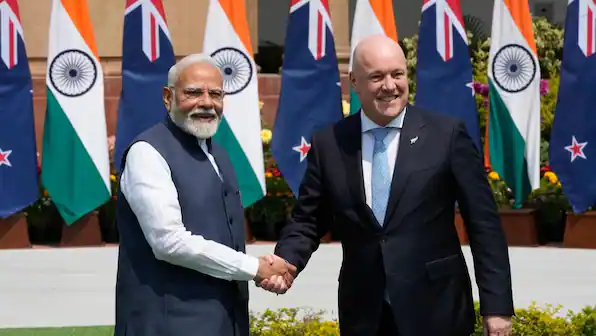
Prime Minister Narendra Modi’s visit to Auckland on 10–11 July 2026 marked the first visit to New Zealand by an Indian prime minister in forty years. The India–New Zealand Free Trade Agreement naturally dominated the headlines, but tariffs and market access explain only part of its significance. The deeper development was the conversion of a cordial, intermittently engaged relationship into a structured strategic partnership spanning maritime security, defence logistics, hydrography, counter-terrorism, technology, disaster resilience and sustained diplomatic coordination. The India–New Zealand Joint Statement consequently deserves to be read as a security and statecraft document as much as an economic one.
The strategic argument had already been advanced in the Firstpost analysis published on 10 July 2026. Events one day later strengthened that assessment. Modi and Prime Minister Christopher Luxon formally elevated bilateral relations to a Strategic Partnership and endorsed the India–New Zealand Strategic Partnership: Roadmap to 2030. They also established an aspirational target of NZ$7 billion, approximately ₹35,000 crore, in two-way trade by 2030. The outcome demonstrated that commerce was intended to provide economic ballast for a much wider Indo-Pacific relationship.
The distinction matters at a human level. For an exporter waiting for perishable goods to clear customs, the relationship concerns predictable border procedures. For a naval officer, it concerns access to fuel, charts, training and trusted operational partners. For an Indian student in Auckland or a New Zealand researcher working in the Himalayas or Antarctica, it concerns mobility and institutional continuity. For families connected across the two countries, it concerns whether a warm social relationship can finally be matched by dependable transport, education and diplomatic infrastructure. Strategy becomes durable only when such practical interests reinforce one another.
From a warm relationship to strategic architecture
India and New Zealand have maintained diplomatic relations since 1952 and share parliamentary traditions, common-law institutions, Commonwealth links and a deep enthusiasm for cricket and hockey. Yet the bilateral relationship long remained friendly without being strategically dense. Geographic distance, modest trade volumes and differing security priorities limited the frequency of high-level engagement. A forty-year interval between visits by Indian prime ministers therefore represented more than a scheduling curiosity; it reflected how rarely each country had treated the other as central to its external strategy.
The decisive groundwork was laid during Christopher Luxon’s visit to India in March 2025. The two governments launched free-trade negotiations, signed a Memorandum of Understanding on Defence Cooperation and expanded cooperation in education, customs, horticulture, forestry and sport. Their March 2025 joint statement identified military exercises, staff-college exchanges, naval port calls, maritime safety and the protection of sea lanes as continuing priorities. Luxon’s role as chief guest at the Raisina Dialogue also signalled that New Zealand wanted engagement with India to extend beyond commercial diplomacy.
This sequencing is important. Defence cooperation was not appended to a completed trade agreement as a ceremonial gesture. Security discussions, military contacts and political trust developed alongside the negotiations and helped create the environment in which an unusually rapid trade agreement became possible. Trade and defence were therefore parallel expressions of the same policy change: Wellington and New Delhi had begun to see each other as long-term partners in managing economic vulnerability and strategic uncertainty.
What changed in Wellington’s security assessment
New Zealand’s strategic environment became visibly less benign in February 2025. A three-ship People’s Liberation Army Navy task group entered the Tasman Sea and conducted live-fire activity beneath a busy trans-Tasman aviation corridor. The vessels operated in international waters, so their presence was not itself unlawful. The concern centred on the unusual location, the sophistication and reach of the deployment, and the way safety notification reached civilian aircraft and regional authorities. New Zealand and Australia monitored the group throughout its movement, as recorded by the New Zealand Defence Force.
The legal and strategic questions should not be conflated. Freedom of navigation protects Chinese naval movement in international waters just as it protects other navies. Nevertheless, a lawful operation can still carry a deliberate strategic message. The deployment demonstrated that distance no longer prevents a major power from sustaining capable surface combatants near New Zealand’s principal air and maritime approaches. It also exposed the operational burden placed on a relatively small defence force when an unfamiliar task group must be tracked across an immense area.
A second warning emerged from the Cook Islands, a self-governing state in free association with New Zealand. Wellington retains important defence and security responsibilities under that relationship, while the Cook Islands conducts its own government and international engagement. In February 2025, the Cook Islands signed a Comprehensive Strategic Partnership and associated agreements with China covering areas that included infrastructure, economic cooperation and seabed minerals. New Zealand objected primarily to the absence of consultation on matters it considered relevant to shared strategic interests and subsequently paused NZ$18.2 million in development assistance for 2025–26, according to Radio New Zealand’s account of the dispute.
No publicly released agreement established a Chinese military base in the Cook Islands, and an academic assessment should not imply otherwise. The episode was consequential because strategic influence in the Pacific rarely begins with a declared basing arrangement. Infrastructure finance, control of data, access to ports, resource agreements, elite networks and technical dependence can alter a country’s choices gradually. For Wellington, the dispute revealed that constitutional familiarity and historical ties could no longer be assumed to produce automatic strategic alignment.
The Tasman Sea deployment and the Cook Islands dispute did not alone cause New Zealand’s defence reassessment; capability planning necessarily predates individual incidents. They did, however, make an abstract deterioration in the regional environment tangible to the public. The central lesson was that geographic isolation had become a thinner shield and that influence in the South Pacific could be exercised through military presence, economic statecraft or a combination of both.
New Zealand’s rearmament is structural, not rhetorical
New Zealand’s 2025 Defence Capability Plan described the country as facing its most difficult strategic environment in decades. It committed indicative spending of NZ$12 billion on major capabilities and critical support over four years, including NZ$9 billion above the previous baseline, and set a path toward defence expenditure exceeding two per cent of gross domestic product within eight years. The plan emphasised a combat-capable force, greater interoperability with Australia and other partners, and improved intelligence, surveillance and reconnaissance. These priorities are detailed in the official 2025 Defence Capability Plan.
The technical programme is heavily maritime. Near-term priorities include sustaining the Anzac-class frigates, acquiring persistent surveillance through uncrewed autonomous vessels, replacing ageing maritime helicopters, improving long-range remotely piloted aircraft, developing counter-drone systems, strengthening space-enabled communications and surveillance, and examining longer-range strike options. The plan also anticipates replacement of frigates and offshore patrol vessels, possibly with greater commonality of hulls and systems to reduce training and maintenance burdens.
This modernisation responds to a difficult geometry. New Zealand must monitor an extensive exclusive economic zone, a vast search-and-rescue region, the Southern Ocean and wider Pacific approaches while retaining the capacity to assist regional partners after cyclones, earthquakes and tsunamis. Crewed ships and aircraft are expensive and personnel-intensive, making persistent uncrewed surveillance, satellite access and information-sharing especially valuable. A small military cannot be everywhere; it must instead detect earlier, share data faster and deploy scarce assets with greater precision.
Partners are therefore not optional additions to New Zealand’s force structure. They are part of the operating model. Australia remains the indispensable ally, and Five Eyes relationships remain central to intelligence and interoperability. India offers something complementary: a large, operationally experienced maritime power with an expanding presence across the Indian Ocean and Indo-Pacific, substantial training institutions, growing defence-industrial capacity and a preference for flexible partnerships rather than rigid bloc politics.
Why India has become more valuable to New Zealand
India sits astride sea lanes connecting the Persian Gulf, eastern Africa and the Malacca Strait. Its navy routinely undertakes anti-piracy patrols, maritime surveillance, evacuations, humanitarian assistance and multinational exercises. For New Zealand, whose prosperity depends on shipping routes extending far beyond the South Pacific, security in the western Indian Ocean and the approaches to Southeast Asia is not a remote concern. Disruption in those waters quickly reaches New Zealand through higher freight, insurance, fuel and food costs.
Combined Task Force 150 provided an early test of operational trust. During New Zealand’s command in 2025, India supplied personnel including the deputy commander to the multinational formation, which works to deter narcotics trafficking, terrorism and illicit maritime activity in the Middle East and western Indian Ocean. This was more meaningful than a ceremonial port call because Indian and New Zealand officers worked within the same command process, shared an operational picture and contributed to common missions.
The March 2025 defence memorandum added an institutional layer to earlier port visits, professional military education and officer exchanges. Such mechanisms are deliberately incremental. Regular staff talks create familiarity with doctrine and decision-making; reciprocal training exposes officers to different operational environments; naval visits test communications and logistics; and exercises reveal whether procedures work under pressure. Strategic trust is rarely produced by a single summit. It is built through repeated, technically demanding cooperation.
India also enables Wellington to diversify its partnerships without abandoning strategic independence. New Delhi cooperates closely with the United States, Japan, Australia, France and several Southeast Asian states, yet it retains strategic autonomy and avoids treaty-alliance obligations. That posture fits New Zealand’s interest in a broad, overlapping regional network. The relationship need not replace any existing alliance to be valuable; it increases the number of capable states with which New Zealand can exchange information, train and respond to maritime contingencies.
What the July 2026 security agreements actually do
The July outcomes turned general intent into a more usable architecture. A Memorandum of Arrangement on Maritime Cooperation created a framework for dialogue, coordination, information exchange and joint activity. The leaders endorsed bilateral naval exercises, established an annual Maritime Security Dialogue and agreed that New Zealand would make maritime security its priority pillar within India’s Indo-Pacific Oceans Initiative. Illegal, unreported and unregulated fishing was identified as a specific area for cooperation. The complete package appears in India’s official list of visit outcomes.
An implementing arrangement on hydrography and nautical cartography is especially practical. Hydrography involves surveying water depth, seabed features, tides, currents and navigational hazards. Accurate, interoperable charts improve the safety of naval and commercial shipping, disaster response and port access. Joint chart production, data exchange, training and capacity-building can also improve maritime-domain awareness across regions where survey coverage is uneven and environmental conditions change rapidly.
The Mutual Logistics Support Arrangement could have an equally important operational effect. It allows the Indian Navy and New Zealand Defence Force to provide approved reciprocal support during agreed activities and operations. Depending on the implementing procedures, such support can include fuel, provisions, spare parts, repair assistance, berthing or other services. This can extend operational endurance and reduce the need to negotiate every transaction from the beginning. It does not create an Indian base in New Zealand, grant automatic access or impose a mutual-defence obligation; it is an enabling mechanism governed by consent.
The partnership also extends beyond conventional naval activity. A Joint Working Group on Counter-Terrorism is intended to facilitate information exchange and coordination. The two governments agreed to deepen work against cyber-enabled crime, illicit finance, narcotics trafficking, people smuggling and terrorism-related offences. Cooperation between India’s National Disaster Management Authority and New Zealand’s National Emergency Management Agency covers earthquakes, tsunamis, coastal hazards, preparedness and recovery. In a region where natural disasters can be as immediately destructive as military crises, resilience is properly treated as a security capability.
The cumulative effect is more significant than any single instrument. Maritime dialogue provides strategic direction; hydrographic cooperation improves shared knowledge; logistics arrangements increase reach; exercises test interoperability; counter-terrorism mechanisms connect agencies; and disaster cooperation gives the partnership a public-purpose dimension. Together, they create a ladder of engagement ranging from peacetime capacity-building to coordinated responses during serious contingencies.
Why New Zealand matters to India
The relationship is not a one-way search by a small state for support from a larger one. New Zealand occupies a strategically consequential position in the South Pacific, administers and supports responsibilities extending into a wide maritime area, maintains established relations with Pacific Island countries and contributes to ASEAN-led security institutions. Its ports, maritime data, Antarctic experience, disaster-management expertise and understanding of Pacific political priorities can all assist India’s wider Indo-Pacific engagement.
The strategic inference is that New Zealand gives India greater connective reach rather than raw military mass. It can help New Delhi understand a region where policy credibility depends on listening to island states, supporting local priorities and avoiding the appearance that the Pacific is merely an arena for competition among larger powers. Cooperation on illegal fishing, climate resilience, hydrography, disaster relief and sustainable maritime development is likely to generate more trust than overtly militarised initiatives alone.
Wellington also provides diplomatic value. New Zealand reaffirmed support for India’s permanent membership of a reformed United Nations Security Council and acknowledged the value of Indian membership in the Nuclear Suppliers Group. Both countries participate in the East Asia Summit, ASEAN Regional Forum and ASEAN Defence Ministers’ Meeting Plus. These positions strengthen India’s claim that its expanding global role is supported not only by major powers and neighbouring states but also by independent, rules-oriented democracies in the Pacific.
Scientific cooperation adds another layer. The July package included collaboration between India’s National Centre for Polar and Ocean Research and the University of Canterbury on Antarctic research. The two countries also connected the National Maritime Heritage Complex at Lothal with the New Zealand Maritime Museum. These initiatives may appear peripheral to hard security, but knowledge of oceans, polar systems, navigation and maritime history helps create the institutional relationships from which durable strategic cooperation grows.
Free trade remains essential—but its details require precision
The India–New Zealand Free Trade Agreement was signed in New Delhi on 27 April 2026 after negotiations launched in March 2025. It had not entered into force at the time of Modi’s visit; domestic legal procedures must be completed and formal notifications exchanged. This distinction is important because tariff reductions, visa commitments and several institutional mechanisms begin only after entry into force. The agreement should therefore be described as signed and concluded, not yet fully operational.
The agreement nevertheless offers substantial market access. New Zealand’s official summary states that 57 per cent of its current exports to India will receive full tariff elimination from the first day, rising to 82 per cent over time, while another 13 per cent will receive sharp reductions. Tariffs on all Indian goods entering New Zealand will be removed when the agreement takes effect. The package covers forestry, wool, sheep meat, seafood, horticulture, honey, wine, manufactured products and multiple service sectors. Detailed outcomes are available through the New Zealand Ministry of Foreign Affairs and Trade.
The asymmetry reflects different economic structures. New Zealand already applies relatively low tariffs to many imports, while Indian agricultural tariffs protect a large and politically sensitive rural economy. India secured immediate duty-free access for labour-intensive exports such as textiles, apparel, leather, footwear, engineering products and processed foods. New Zealand gained valuable preferences for products in which it is globally competitive, including immediate or phased access for much of its forestry trade, quotas for apples and kiwifruit, reduced wine tariffs and preferential treatment for mānuka honey.
Dairy requires particular care because it has often been reduced to a binary question of access or exclusion. India protected core sensitive categories such as milk, cream, cheese, yoghurt, whey and casein from broad liberalisation. However, the agreement provides limited outcomes for selected preparations and inputs, including bulk infant formula, certain dairy-based preparations and milk proteins. It also creates a fast-track route for New Zealand ingredients imported for further manufacturing and re-export, along with consultation if India later offers comparable dairy access to another economy. Market opening and technical cooperation in animal husbandry must therefore be assessed separately.
Customs commitments may prove as valuable as tariff schedules. India is required, once the agreement is in force and applicable requirements are satisfied, to release goods within 48 hours and to endeavour to clear perishables and express consignments within 24 hours. Faster clearance reduces spoilage and working-capital costs, particularly for small exporters. The agreement also creates mechanisms to address sanitary, phytosanitary and technical barriers rather than assuming that a lower tariff automatically produces usable market access.
Services and mobility form another major component. New Zealand has committed to a maximum of 5,000 three-year Temporary Employment Entry visas at any one time, principally for occupations facing recognised skill shortages, with a smaller allocation for specified Indian professions. A separate scheme is intended to allow up to 1,000 young Indian graduates annually to undertake working holidays, subject to safeguards. Student work and post-study provisions, professional-services rules, traditional-medicine cooperation and more transparent licensing procedures broaden the agreement beyond merchandise trade.
The investment chapter is unusually consequential. New Zealand undertakes to promote investment into India with the aim of increasing it by US$20 billion over fifteen years after entry into force. This is an investment-promotion objective involving private capital rather than a promise that the New Zealand government will transfer public funds. The agreement provides staged consultations, a possible grace period and proportionate temporary rebalancing measures if unresolved differences arise. Its design therefore creates a strong incentive for both governments to maintain commercial momentum, as explained in New Zealand’s National Interest Analysis.
The FTA’s strategic function is diversification. New Zealand gains better access to a large and expanding market, while India obtains reliable sources of forestry products, wool, selected food inputs, education and specialised services. India gains a platform for labour-intensive exports and professional mobility; New Zealand gains an opportunity to reduce excessive dependence on a narrow range of markets. Neither outcome eliminates exposure to global disruption, but a wider portfolio of suppliers, customers and investors increases resilience.
The diaspora is strategic because it is human
Approximately 300,000 New Zealand residents identified as being of Indian descent in the 2023 census, amounting to about six per cent of the population. This community contributes to business, medicine, technology, education, agriculture, public service, culture and sport. Its value cannot be reduced to lobbying power or ceremonial visibility. Diaspora networks lower the information costs of trade, connect institutions, sustain language and cultural knowledge, and create personal relationships that survive changes of government.
The absence of direct flights illustrates the difference between social warmth and practical connectivity. A family journey involving multiple connections, a student navigating unfamiliar regulations or a small firm searching for a trustworthy partner experiences foreign policy as time, cost and uncertainty. Encouraging non-stop aviation, improving recognition of seafarer qualifications, expanding university partnerships and establishing predictable visa pathways can make the strategic partnership visible in ordinary life.
India’s civilisational diversity should also be treated as a strength. Hindu, Sikh, Buddhist, Jain and other Indian-origin communities in New Zealand are distinct traditions and civic participants, not a single geopolitical instrument. Cultural diplomacy is most durable when it respects that plurality and encourages cooperation across Dharmic traditions. The FTA’s recognition of Ayurveda, Yoga and other Indian knowledge systems alongside Rongoā Māori offers a constructive model: traditional knowledge can be researched, regulated and shared without erasing the identity of the communities that preserve it.
The partnership’s limits must remain visible
A Strategic Partnership is not a military alliance. Neither country has accepted an automatic obligation to fight for the other, and their strategic cultures will not always coincide. New Zealand is embedded in an alliance and intelligence architecture centred on Australia and other Western partners. India maintains strategic autonomy, a distinct nuclear posture and relationships with states that Wellington may assess differently. Mature cooperation requires those differences to be managed openly rather than hidden beneath summit language.
The relationship should not be framed solely as an anti-China alignment. China remains economically important to both countries, and each has an interest in stable, lawful engagement with Beijing. The purpose of closer India–New Zealand cooperation is better understood as reducing vulnerability, widening strategic choice and strengthening the capacity to uphold freedom of navigation, sovereignty and peaceful dispute resolution. A partnership built only around opposition to a third country would be brittle; one built around practical interests can endure changes in the regional balance.
Implementation capacity presents a more immediate risk than diplomatic disagreement. New Zealand’s defence plan is expensive, personnel-intensive and spread across several capability programmes. India’s military and bureaucracy must manage a growing network of strategic partners. Exercises, dialogues and memoranda can multiply faster than trained personnel and budgets. The test is whether the two governments prioritise a manageable set of projects, assign responsible agencies, establish timelines and publish enough information for parliamentary and public scrutiny.
Commercial legitimacy will matter as well. The FTA must complete domestic procedures, businesses must understand its rules of origin, and mobility pathways must be administered with safeguards and transparency. Agricultural cooperation should raise productivity without undermining vulnerable farmers. Investment promotion should be measured accurately, distinguishing announced intentions from capital actually deployed. Public confidence is more likely to endure when benefits and adjustment costs are reported with equal precision.
What should be measured by 2030
The Roadmap to 2030 should be judged through observable results. Relevant indicators include the FTA’s entry into force; progress toward NZ$7 billion in two-way trade; the value and sectoral distribution of actual investment; the frequency and complexity of naval exercises; practical use of the logistics arrangement; joint hydrographic products; exchanges of maritime data; action against illegal fishing; counter-terrorism and cyber cooperation; defence-college participation; direct air connectivity; research projects; and regular ministerial reviews. Outputs matter more than the number of agreements signed.
The broader benchmark is whether the partnership increases freedom of action for both countries. New Zealand should gain better maritime awareness, more operational options, diversified trade and stronger access to Indian institutions. India should gain a credible partner in the South Pacific, improved reach across maritime and scientific networks, stronger commercial access and additional support in multilateral forums. Mutual benefit, rather than symbolic alignment, is the foundation on which the relationship can survive political transitions.
A strategic turn confirmed
Modi’s New Zealand visit was historic not simply because it ended a forty-year absence, but because it converted accumulated economic, military and social links into an organised programme. The FTA supplies incentives for businesses and citizens to invest in the relationship. The defence and maritime arrangements give officials and armed forces mechanisms through which trust can be tested. The diaspora, educational links and plural cultural traditions provide social depth. Each element supports the others.
The central conclusion is consequently more substantial than the claim that defence matters alongside trade. Economic security and maritime security have become inseparable for two trading democracies separated by oceans but connected through the Indo-Pacific. The strategic partnership will succeed if it remains lawful, transparent, practical and attentive to smaller Pacific states rather than treating them as pieces on a geopolitical board. If those conditions are met, the Auckland visit may be remembered as the moment India and New Zealand moved from friendly distance to durable strategic cooperation.
Inspired by this post on Hindu Post.










Leave a Reply
You must be logged in to post a comment.