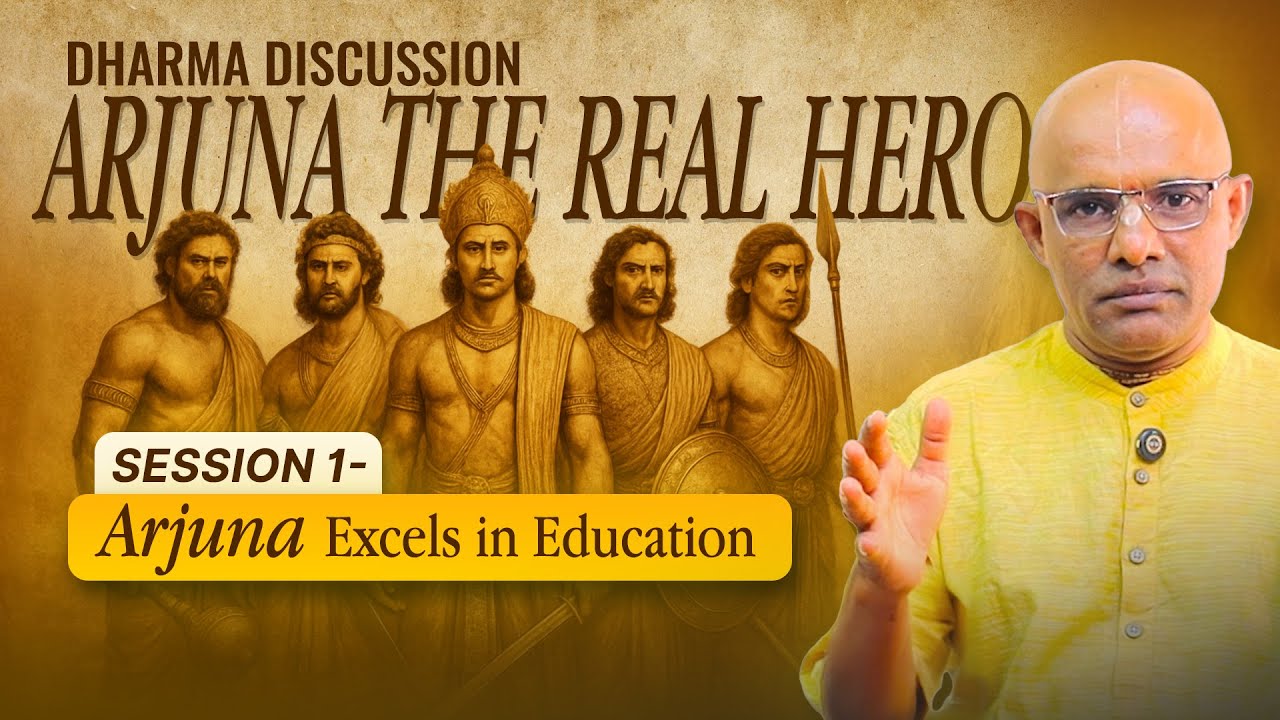
Arjuna stands in the Mahabharata as a complete exemplar, harmonizing rigorous endeavour with deep earnestness. A Dharma discussion by HG Govinda Das highlights how Arjuna represents both limitless knowledge and profound dependence on the divine. His narrative illuminates the interplay of human potential and human limitation, and shows how educationin both worldly learning and spiritual insightadvances when sincere effort is joined with God’s grace.
Viewed through the lens of education, Arjuna’s formation reflects the guru–shishya tradition at its best: attentive learning (śravaṇa), critical reflection (manana), and steady internalization (nididhyāsana). His disciplined practice, humility before Śrī Krishna, and willingness to seek correction demonstrate that mastery is not merely technical skill but ethical refinement and self-knowledge. This synthesis aligns naturally with the Bhagavad Gita’s emphasis on karma-yoga and bhakti as complementary paths of growth.
The tension Arjuna experiencesbetween striving and surrenderremains pedagogically instructive. Genuine progress arises from abhyāsa (consistent practice) supported by prapatti (surrender to grace). In an academic context, this translates to disciplined study habits anchored in intellectual humility; in a spiritual context, it becomes fervent sādhanā grounded in trust. Such balance prevents both complacency (overreliance on grace) and burnout (overreliance on effort).
Contemporary readers often face similar dilemmas: balancing professional demands, family responsibilities, and personal growth while seeking clarity of purpose. Arjuna’s model offers a relatable blueprintcultivate one-pointedness (ekāgratā), accept the reality of limits, and invite higher guidance. Many find that progress quickens when resilience, ethical restraint, and reflective inquiry are practiced together, just as Arjuna learned at the feet of Krishna on the threshold of Kurukṣetra.
The values embodied by Arjuna resonate across dharmic traditions and thus foster unity. In Buddhism, right effort paired with letting go illuminates a balance akin to disciplined striving and surrender. In Jainism, self-discipline (vrata, tapas) tempered by ahimsa and compassion mirrors the fusion of effort with higher ideals. In Sikhism, aligning with hukam through seva and nimrata (humility) reflects dependence on the Divine while acting courageously. This shared emphasis on ethical action, humility, and trust in transcendent reality underscores a common dharmic ethos that promotes harmony among Hinduism, Buddhism, Jainism, and Sikhism.
Key educational implications are clear. Disciplined practice refines talent; humility keeps learning dynamic; guidance from a qualified teacher accelerates insight; reflective self-assessment prevents arrogance; service-oriented action purifies intention; and devotion sustains long-term motivation. Together, these principles transform learning from mere information acquisition into character formation and spiritual growth, just as the Bhagavad Gita frames knowledge as inseparable from dharma.
Session 1Arjuna Excelsthus establishes a foundation for understanding why Arjuna’s excellence is not accidental but cultivated: skill anchored in surrender, knowledge guided by wisdom, and effort illumined by grace. This integrative model remains relevant for students, educators, and seekers who wish to align personal excellence with a higher purpose, in continuity with the Mahabharata’s enduring insights.
Inspired by this post on Dandavats.