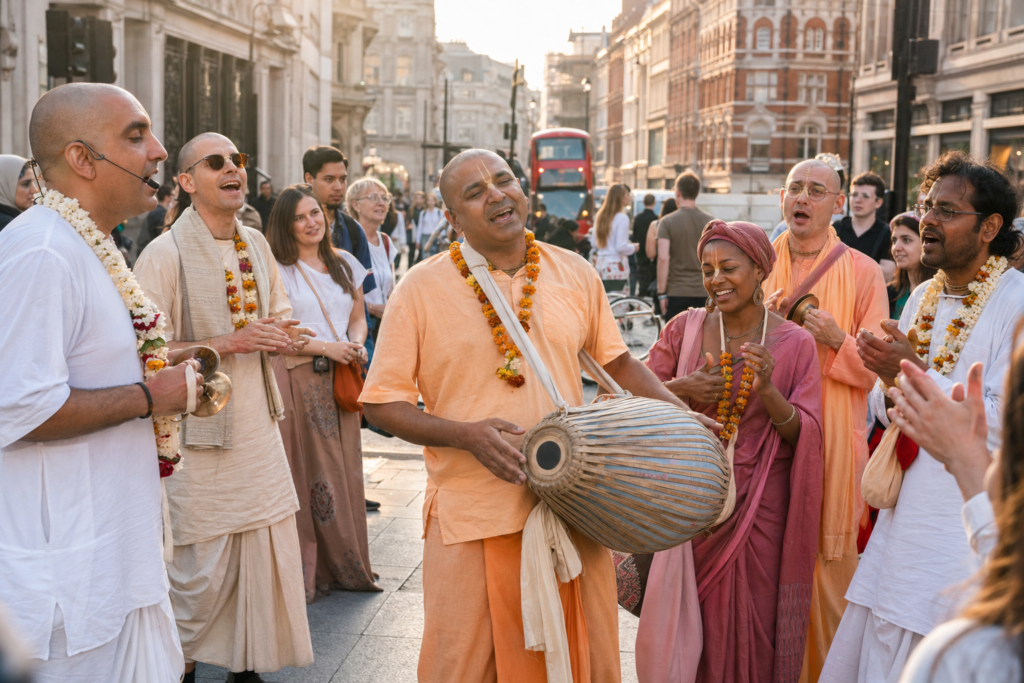
This documentary presents a clear, compelling portrait of three Hare Krishna devotees in Ireland and examines how Vedic philosophyparticularly as taught in the Bhagavad-gitareshapes their everyday lives. Set within a small but vibrant sanga, the film offers an ethnographic window on Gaudiya Vaishnavism in a contemporary European context, foregrounding practice, community, and meaning-making. It situates these narratives in relation to the global movement inspired by Srila Prabhupada, whose teachings continue to guide seekers grappling with fundamental questions of birth, old age, disease, and death.
Historically, the film’s arc connects to Srila Prabhupada’s arrival in the West in 1965 and the founding of the International Society for Krishna Consciousness (ISKCON) in 1966. His commentarial work, including Bhagavad-gita As It Is, clarified perennial human concerns codified in the Gita (notably 13.9’s emphasis on the miseries of embodied existence). That frameworkat once philosophical and practicalanchors diaspora communities across Europe and provides the interpretive key for understanding the Irish sanga’s aspirations and choices.
At the doctrinal core, Vedic philosophy distinguishes the transient body from the enduring self (atma), explaining life’s continuity through samsara, shaped by karma (Bhagavad-gita 2.13; 2.20). The telos is mokshaliberation marked by loving devotion (bhakti) to Krishnaachieved through disciplined practice and insight (18.66; 12.1–12.20). This soteriological map, while ancient, proves actionable in modern life, informing decisions about work, family, ethics, and community engagement.
Methodologically, bhakti-yoga integrates hearing and chanting (sravanam-kirtanam), mantra-japa of the maha-mantra, scriptural study, worship in homes or temples, and honoring prasadam. These practices cultivate sattva (clarity and steadiness) and support anartha-nivritti (a gradual release from unhelpful habits). Observations in the film align with contemporary findings on breath regulation and vocalization: rhythmic mantra recitation can attenuate stress responses and stabilize attention. The result is a lived synthesis of devotion, contemplative focus, and ethical orientation.
In Ireland, the sanga embodies association (satsanga) as an explicit method. Regular kirtan gatherings, shared vegetarian meals, and collaborative service create a resilient social ecology where spiritual friendships flourish. The community adapts bhakti aestheticsmusic, attire, dietto local cultural settings with sensitivity, balancing fidelity to tradition with the norms of Irish public life. This dynamic mirrors how Hindu spiritual traditions often find fruitful expression in diaspora settings.
Across the three case studies, transformation appears as incremental reorientation rather than sudden change. Participants reframe daily schedules around morning sadhana, adopt a sattvic diet, cultivate mindful speech, and respond to stress with greater equanimity. These shifts echo the Gita’s pedagogy of abhyasa (consistent practice) and vairagya (dispassion), with intention guided by devotion. The film thus links philosophical claims to observable patterns of behavior and well-being.
By returning to the Gita’s recurring questionsbirth, old age, disease, and deaththe documentary clarifies a key diagnostic: suffering stems from misidentification with the body, and freedom emerges through realized knowledge and devotion. Ritual remembrance, japa, and kirtan operate as cognitive and affective anchors, preparing practitioners to meet life-cycle transitions with steadiness (2.14–2.15; 8.5–8.6). The outcome is not retreat from the world but ethically engaged living animated by seva.
Ethically, the Ireland sanga extends practice into service: sharing prasadam, volunteering, and maintaining constructive dialogue with neighbors and institutions. These acts operationalize ahimsa, compassion, and hospitality central to Hindu spirituality and resonate with allied dharmic ideals in Buddhism, Jainism, and Sikhismmindfulness, non-violence, and langar. The film thereby models unity in spiritual diversity without flattening distinct paths.
Pluralism is a defining tone. While rooted in Gaudiya Vaishnavism, the community demonstrates respect for multiple routes to transcendence, reflecting the broader Hindu acceptance of various gurus, methods, and temperaments. This posture supports interfaith harmony in multicultural societies and affirms shared ethical commitments across dharmic traditionsan essential ingredient for cohesion and mutual respect.
Hermeneutically, the Gita is treated not merely as scripture but as a practical manual. Themes such as mind discipline (6.5–6.6), even-mindedness (12.13–12.20), and devotion as the highest yoga (6.47) become visible in ordinary tasks: commuting with japa beads, transforming kitchens into spaces of offering, and reframing work as karma-yoga. The documentary thus shows how textual interpretation becomes habit and how habit reshapes character.
The aesthetics of devotion play a functional role. Auditory elementskirtan with mridanga and kartalsand visual symbols like tilaka and deity images form an immersive environment that reinforces memory and identity. These sensory cues, captured onscreen, help practitioners return to contemplative awareness amid daily pressures, illustrating how aesthetics and doctrine mutually support bhakti practice.
Situated in Ireland, the sanga participates in a broader cultural conversation. Irish values of hospitality and a rich musical heritage intersect naturally with bhakti’s communal singing and shared meals. From this consonance emerges diaspora resilience: Vedic philosophy is both faithfully preserved and locally enlivened. The narrative contributes to scholarship on religion-in-diaspora, lived Hinduism, and the adaptive vitality of the Bhakti Tradition in Europe.
As a qualitative study of three lives, the film does not seek statistical generality. Its strength lies in triangulating doctrine, practice, and outcomeplacing scriptural assertions alongside observed behavioral change and reported shifts in well-being. This approach invites thoughtful viewers to evaluate Vedic claims using both reason and experience, bridging academic analysis and existential inquiry.
In conclusion, Hare Krishna, Ireland Sanga demonstrates how ISKCON’s bhakti-yogaarticulated by Srila Prabhupada and grounded in the Bhagavad-gitaoffers coherent, time-tested responses to life’s fundamental challenges while nurturing community, ethical service, and unity across dharmic traditions. The film’s portrait of practice in Ireland affirms that ancient Vedic wisdom remains timely and testable, guiding seekers toward inner steadiness and compassionate action in a plural world.
Inspired by this post on Dandavats.