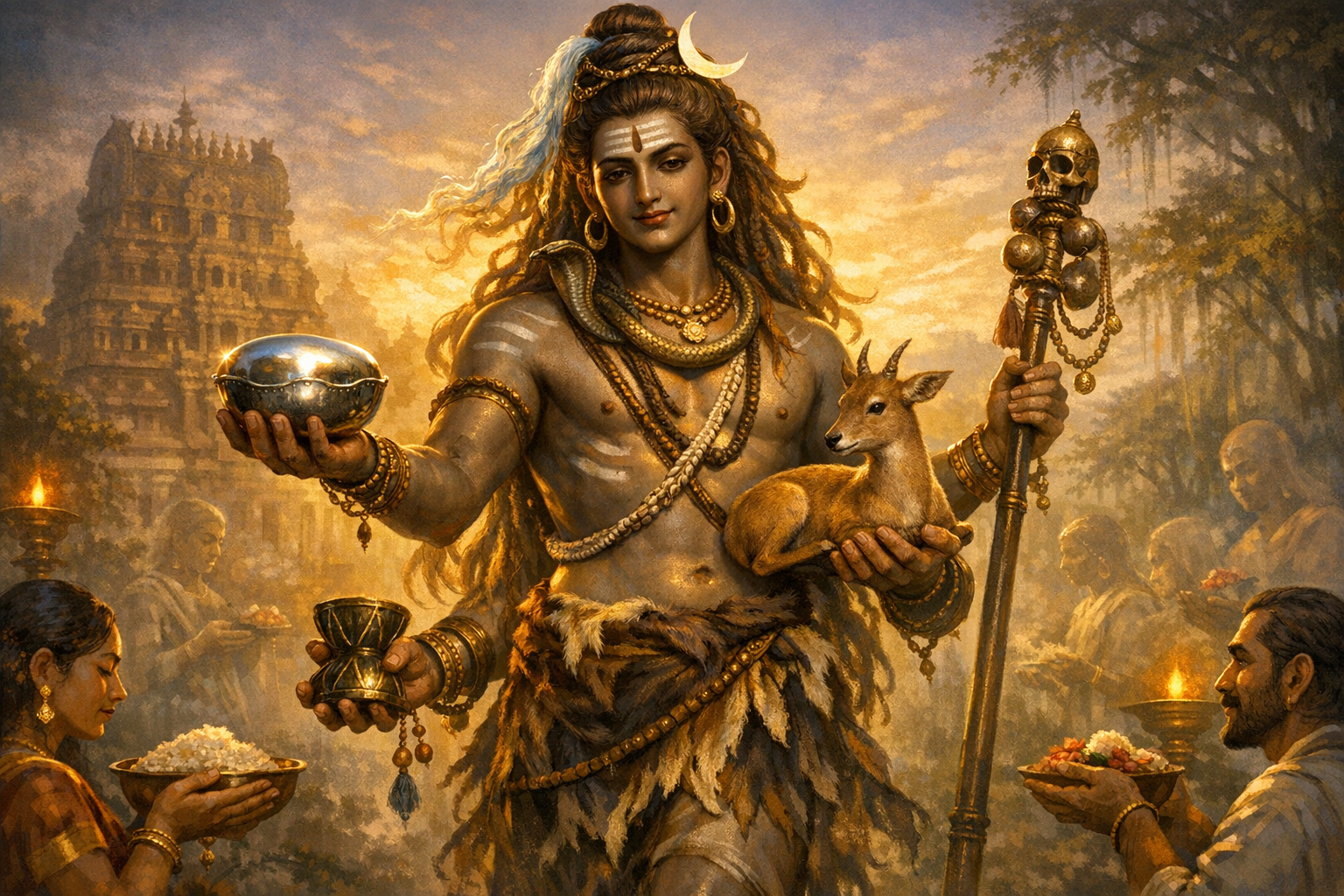
Pichandavar Shiva, widely revered across South India, embodies the Supreme Lord as a wandering ascetic whose very presence interrogates attachment and pride. In Tamil usage, Pichandavar (also rendered Pitchandavar) is the epithet of Śiva as the divine beggar, closely aligned with the pan-Indic Bhikshatana-murti. This form, ash-smeared and often scantily clad, is neither a spectacle of deprivation nor of theatrical penance; it is a theological statement embedded in Shaiva philosophy, South Indian temple ritual, and a shared dharmic ethics of non-possession.
Etymologically, Pichandavar derives from Tamil roots linked to pichai (alms), thus denoting “the Lord who begs.” This accurate sense, grounded in Tamil Shaiva usage, corrects the common but imprecise gloss that associates the name with mere “yellow robes” or a generic “wanderer.” As Bhikshatana in Sanskrit sources, Shiva’s embodied renunciation communicates a pedagogy: divinity may assume poverty to expose spiritual pretension, transform social gaze, and restore balance between ritual correctness and inner realization.
Textual traditions locate this form in Puranic narratives and Agamic prescriptions, where Pichandavar/Bhikshatana appears after epochal events that test cosmic order. Two narrative clusters dominate: Shiva’s expiation after severing Brahma’s fifth head (a transgression requiring the atonement of a mendicant) and Shiva’s revelatory visit to the Darukavana, where rigid ritualists are instructed—through shock, humility, and grace—that rites without insight calcify into ego.
In the first strand, Shiva plucks Brahma’s fifth head and must wander with the skull-bowl (kapala) affixed to his palm, bearing the sign of brahmahatya until release at a holy ford—commonly associated in sacred geography with the Kapalamochana tirtha at Kashi. As a kapalika-style ascetic, he roams from settlement to settlement, accepting alms while enacting a cosmic lesson: even the Supreme accepts consequence within dharma’s fabric, and atonement is not a concession of divinity but an expression of its justice and compassion.
In the second, Shiva enters the Darukavana as a beautiful ascetic whose presence unsettles ascetics grown proud of orthopraxy. Their outward austerity masked inner conceit; the Lord, appearing as Pichandavar, dissolves their certainty. In Tamil Shaiva interpretations, the episode does not denigrate women or householders; rather, it punctures sanctimony and demonstrates that realized wisdom—anchored in humility and non-possession—surpasses ritual display. The wives of the sages, attracted to the divine radiance, symbolize bhakti responding to authentic presence; the rishis’ subsequent recognition restores harmony between knowledge, devotion, and conduct.
Shaiva Agamas and the broader Shilpa-Shastra corpus outline Bhikshatana’s iconography with striking specificity, even as regional workshops introduce graceful variation. Pichandavar appears youthful and lithe, often in tribhanga (three-bend) posture that conveys a fluid, ambulatory grace. The matted locks (jata) may rise in a dynamic crown with the crescent and serpents; the body is frequently nude or minimally draped in an animal skin, emphasizing ash (vibhuti) and the sacred thread formed by a serpent (sarpa-yajnopavita).
The canonical attributes vary, but a four-armed schema is common: the skull-bowl (kapala-patra) to receive alms; the antelope (mriga) symbolizing the mind’s skittishness held under control; the hourglass drum (damaru) marking cosmic rhythm; and a staff, often a khatvanga, signifying ascetic sovereignty. Attendant spirits (bhutas), forest denizens, and enraptured householders sometimes flank the Lord, underscoring that the mendicant’s path does not depart from the world but walks through it as its inner teacher.
As material culture, Pichandavar reached an apogee in the South Indian bronze tradition, particularly under the Cholas (c. ninth to thirteenth centuries CE). Master bronziers working in the lost-wax (cire perdue) technique cast Bhikshatana in panchaloha alloys, refining anatomical subtlety, rhythmic stance, and nuanced expressions of benign allure. These bronzes do not merely depict a theme; they choreograph a theological drama in metal, transforming icon into processional presence that still circulates city streets in annual temple festivals.
Within living temple ecosystems across Tamil Nadu—at Chidambaram, Tiruvarur, Tiruvenkadu, Madurai, and many others—Pichandavar’s utsava-murti periodically leaves the sanctum to “seek alms.” Devotees, in turn, offer rice, jaggery, or coin, but the deeper offering is inward: the “alms” of ego, certainty, and hoarded identity. In this sense, the mendicant’s bowl is a mirror tilted at society, inviting reflection on what is necessary, what is excess, and what is ultimately true.
The performative dimension of such processions is central to South Indian temple culture. Priests, musicians, and artisans collaborate in an embodied theology where drumbeats of the tavil and the shimmer of lamps cohere into a moving classroom. Observers often remark that the first sight of the skull-bowl elicits an immediate reckoning: if the cosmic Lord begs, then possession is relative, and stewardship—rather than ownership—defines righteous life.
Iconographically, Pichandavar is frequently juxtaposed with Shiva Nataraja and Somaskanda in South Indian sanctuaries, together delineating an arc from cosmic rhythm (Nataraja) to intimate grace (Somaskanda) to radical detachment (Pichandavar). The triad articulates a complete Shaiva grammar: the universe dances, the family sanctifies, and the renouncer liberates. None negates the others; each balances excesses that arise when one principle is pursued without the rest.
Philosophically, Pichandavar dramatizes aparigraha (non-possession) and the transience of worldly identification. The skull-bowl does not fetishize death; it frames impermanence (anitya) and disciplines the mind to receive life as alms from the Absolute. The deer in hand becomes a precise pedagogy: the mind, like a deer, startles and sprints; in the Lord’s hand it rests, alert yet unafraid, reconciled to guidance rather than seized by compulsion.
Socially, this murti invites discernment between chosen renunciation and enforced poverty. In fact, many South Indian traditions use the Pichandavar procession to catalyze charity—annadana and community kitchens—underscoring that non-possession as a vow is not an excuse for neglecting those dispossessed by circumstance. Here, the divine mendicant does not normalize suffering; he redirects the community to alleviate it, and to do so without pride.
Comparative dharmic perspectives illuminate Pichandavar’s wide resonance. The Buddhist bhikkhu on alms-round (piṇḍapāta), the Jain vow of aparigraha embodied by munis, and the Sikh practice of ego-reducing seva in langar each articulate, in their own doctrinal frames, humility and shared sustenance. Shiva as Pichandavar thus aligns with a pan-dharmic wisdom: relinquish clinging, serve boldly, and honor many valid paths to realization. Such unity in diversity strengthens civilizational harmony without flattening doctrinal distinctiveness.
From a ritual-legal standpoint, Agamic manuals regulate image proportions, hand poses (mudras), and processional conduct, integrating theology, aesthetics, and liturgy into a continuous practice. The meticulous attention to measurements and gestures signals that renunciation is not carelessness; it is cultivated freedom, achieved through discipline rather than accident.
Art-historically, Chola and post-Chola ateliers refined Bhikshatana’s elegance: elongated torsos, gently flexed knees, and soft, knowing smiles. The alloy’s sheen and the subtle chasing on serpents, antelope fur, and hair fillets reveal the artisan’s intuition: metal can suggest motion, and motion can suggest compassion. Many temple treasuries still house such bronzes, ceremonially awakened in festival cycles; others, now in museums, remind global audiences of the South Indian synthesis of metaphysics and metallurgy.
Ethically, Pichandavar challenges acquisitive modernity by proposing stewardship over accumulation. For professionals, pilgrims, and students alike, the question posed is practical: which possessions serve dharma, and which possess the possessor? The answer, never merely private, has public ramifications—sustainable consumption, equitable distribution, and cultural preservation become extensions of inner clarity.
In devotional literature and temple hymns, epithets for the divine mendicant foreground paradox: the Lord of all worlds who asks for a handful of rice, the bearer of the Ganga who walks village lanes, the slayer of delusion who greets householders with a bowl. These inversions are not rhetorical flourishes; they are pedagogical devices that refine love from transaction into trust.
For those encountering Pichandavar for the first time—in bronzes at a South Indian shrine, or in processions sweeping through narrow streets—the experience tends to be visceral. Children wave, elders bow, and musicians modulate tempo as the mendicant pauses at thresholds. At that liminal moment, private life and sacred time interpenetrate: kitchens send out fragrance, lamps flicker, and the town itself appears to offer alms to its own better nature.
Theological balance is crucial. Shaiva traditions caution that the Darukavana narrative critiques hypocrisy, not women, householding, or study. Rites, doctrine, and family all find rectification in humility. In this reading, Pichandavar is the ally of responsible ritual, generous householding, and rigorous learning—precisely because he strips away pride, not practice.
Geographically, the veneration of this form extends across Tamil Nadu and into parts of Karnataka and Andhra traditions, often integrated with major festival calendars such as Arudra Darshanam for Nataraja and other brahmotsavams. While specific observances vary by sthala purana and lineage, the shared grammar—procession, symbolic alms, and reflective teaching—binds these regions into a recognizable Shaiva liturgical landscape.
Culturally, Pichandavar becomes a living index of South Indian heritage, where theology, music, craft, and civic participation intertwine. The procession’s choreography provides continuity for hereditary artisans and priests; its message nourishes students and seekers in equal measure. The mendicant’s lesson is perennially modern because its target—ego masquerading as certainty—reappears in every age with new masks.
For comparative religion and philosophy, Pichandavar invites careful mapping between symbol and ethical outcome. Non-possession, when rightly understood, enlarges responsibility rather than shrinking it; compassion grows as grasping declines. Such insights resonate across Hinduism, Buddhism, Jainism, and Sikhism, where the shared vocabulary of restraint, service, and inner freedom undergirds plural yet harmonizing paths.
In contemporary discourse on cultural heritage, the survival and integrity of Pichandavar icons—within temples and in public collections—matters. Communities, scholars, and conservators increasingly collaborate to document provenance, support lawful repatriation where warranted, and ensure that living ritual contexts remain vibrant. The mendicant, paradoxically, becomes a guardian of patrimony: to be worthy givers, communities must know what they have received.
Ultimately, Pichandavar Shiva offers an austere kind of tenderness. By walking as a beggar, the Supreme meets society at eye level and returns dignity to giving. The bowl is thus both vessel and verdict: what one places in it—grain, coin, pride, or fear—reveals one’s readiness to live lightly, love deeply, and serve without display.
Seen in this light, Pichandavar is not a marginal curiosity within Shaivism but a central, corrective principle. The form unites South Indian temple culture, classical iconography, and a civilizational ethics that honors many paths. It teaches that unity in diversity is not a slogan but a spiritual discipline: to receive truth wherever it appears, and to give without needing to count.
Inspired by this post on Hindu Blog.