
Among the many luminous forms of Devi Shakti, Mangala Chandi occupies a distinctive and deeply meaningful place in Hindu spirituality, Hindu iconography, and the wider study of sacred feminine traditions. She is not understood merely as a goddess of good fortune, nor only as a fierce destroyer of negativity. Her name itself holds the key to her theological depth: Mangala suggests auspiciousness, welfare, blessing, and sacred well-being, while Chandi evokes the intense, protective, and formidable power of the Divine Mother.
This duality is not a contradiction. It is the foundation of her spiritual significance. Mangala Chandi embodies the truth that grace is not always soft, and fierceness is not always destructive. In the dharmic imagination, protection, purification, discipline, compassion, and prosperity often arise together. The same maternal power that nourishes life also confronts forces that threaten balance, truth, and dharma.
In this sense, Mangala Chandi may be approached as a profound expression of Shakti: the cosmic energy through which existence is created, sustained, corrected, and renewed. Her form invites contemplation not only of divine power, but also of the human need for courage, ethical clarity, and inner auspiciousness. For many devotees, her image is emotionally powerful because it does not separate tenderness from strength. It recognizes that life requires both blessing and bravery.
The name Mangala Chandi therefore carries layered meaning. Mangala points to what is beneficial, fortunate, and spiritually elevating. It is the quality associated with harmony, prosperity, right timing, sacred order, and divine favor. Chandi, associated with the fierce aspect of Devi, points to the power that refuses to tolerate adharma, injustice, arrogance, and spiritual ignorance. Together, the two words reveal a goddess whose auspiciousness is active, protective, and transformative.
This understanding is especially important because popular readings of Hindu deities sometimes divide divine forms into simple categories: gentle or fierce, benevolent or terrifying, maternal or martial. Mangala Chandi challenges such narrow classifications. Her sacred form shows that the Divine Mother can bless the household, protect the community, destroy inner impurities, and guide the devotee toward a more disciplined life. Her fierceness is not cruelty; it is a compassionate force directed toward restoration.
Within the broader framework of Hindu Goddess traditions, Mangala Chandi is related to the wider theological world of Durga, Chandika, Chamunda, Kali, and other forms of Devi. These forms are not isolated divinities competing for attention, but interconnected expressions of one sacred feminine reality. Each form emphasizes a different dimension of Shakti. Durga often represents invincible protection, Kali represents time and radical transformation, Lakshmi represents abundance and auspicious prosperity, Saraswati represents wisdom, and Chandi represents the blazing energy that destroys disorder and restores dharma.
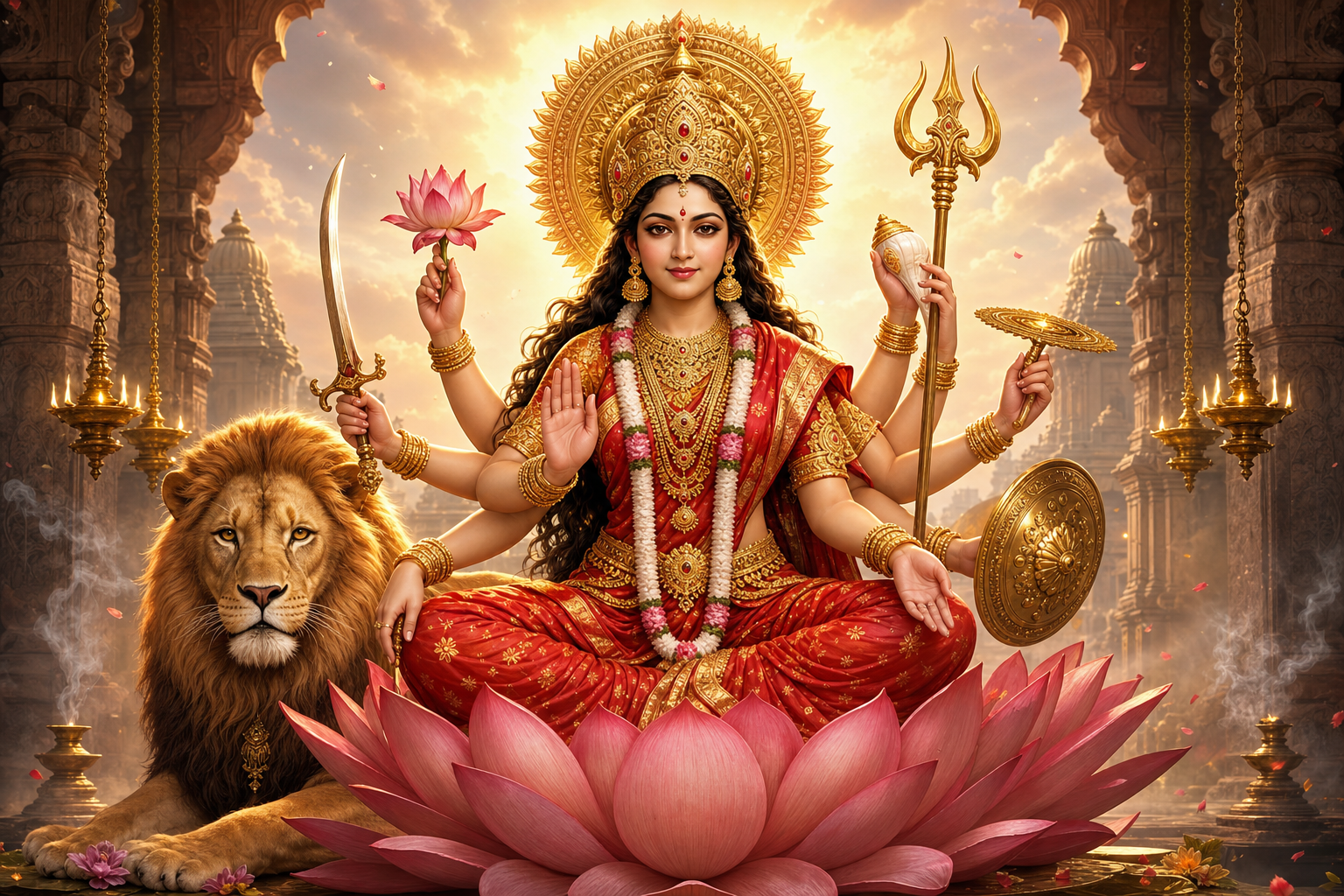
Mangala Chandi stands at the meeting point of auspicious grace and fierce intervention. This makes her especially compelling in the study of iconography, because her form is never merely decorative. Every gesture, weapon, ornament, posture, and expression carries symbolic significance. Hindu sculptures and sacred images are not simply artistic objects; they are visual theology. They communicate doctrine, devotion, metaphysics, and spiritual psychology through form.
Her iconography may vary across regions, temples, manuscripts, and local traditions. In some devotional contexts, she may be visualized with a serene yet commanding face, adorned with ornaments and a crown that signify divine sovereignty. In other contexts, she may appear with weapons, multiple arms, and a dynamic posture that emphasizes her protective and martial power. Such variations should not be treated as inconsistencies. They reflect the living nature of Hindu traditions, where regional devotion and scriptural imagination often enrich one another.
The face of Mangala Chandi is central to understanding her presence. A calm expression does not reduce her fierceness; it reveals mastery over it. In Hindu iconography, divine composure often indicates supreme control. The goddess does not act from anger in the ordinary human sense. Her intensity is cosmic, purposeful, and governed by wisdom. This distinction is crucial. Her fierce form is not emotional excess, but disciplined spiritual force.
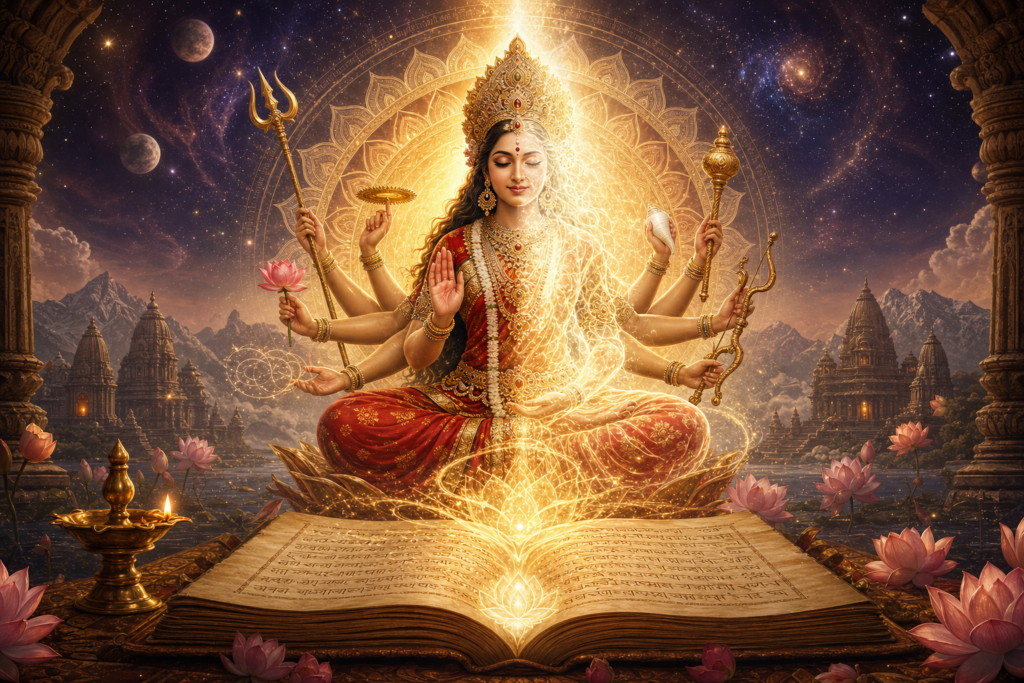
When Mangala Chandi is shown with multiple arms, the symbolism is equally rich. Multiple arms in Hindu art do not suggest monstrosity or exaggeration. They indicate the deity’s ability to act simultaneously on many planes of existence. The Divine Mother protects, blesses, nourishes, destroys ignorance, grants fearlessness, and supports dharma at once. The many arms reveal the many functions of divine consciousness.
Weapons associated with Chandi-like forms of Devi, such as the trident, sword, discus, mace, bow, arrow, noose, or shield, should be read symbolically as much as mythologically. The sword may signify discrimination, the ability to cut through illusion and falsehood. The trident may represent mastery over the three gunas, the three divisions of time, or the threefold structure of existence. The noose may suggest the power to bind harmful tendencies, while the shield may represent protection from forces that disturb spiritual balance.
Her blessing gestures are equally important. The abhaya mudra, when present, communicates fearlessness. It assures the devotee that the fierce goddess is not to be feared by those who seek refuge in dharma. The varada mudra, associated with generosity and boon-giving, indicates that her power is not merely corrective but also nurturing. Together, these gestures show that Mangala Chandi is both protector and benefactor.
The color symbolism surrounding Mangala Chandi often draws from the wider language of Devi worship. Red, frequently associated with Shakti, may signify life-force, energy, passion, fertility, courage, and sacred intensity. Gold may symbolize auspicious prosperity and divine radiance. White may suggest purity and clarity. Black or dark hues, when associated with fierce goddess forms, do not signify evil; they often represent cosmic depth, time, mystery, and the power that absorbs all limitation.
Her ornaments also carry meaning. The crown signifies sovereignty over cosmic order. Necklaces, anklets, armlets, and earrings do not merely beautify the form; they represent fullness, dignity, and the richness of divine manifestation. In Hindu sacred art, beauty is not superficial. It is a sign of completeness. The goddess is adorned because she is the source of abundance, rhythm, and sacred order.
If Mangala Chandi is shown seated or standing on a lotus, the symbolism becomes even more layered. The lotus is one of the most powerful symbols in Hindu, Buddhist, and Jain traditions. It grows from mud yet remains unstained, making it a visual expression of purity amid worldly conditions. In the context of Mangala Chandi, the lotus can suggest that auspiciousness does not require escape from life. It requires the ability to remain inwardly pure while acting courageously within the world.
The presence of a lion or tiger in related Devi iconography points to courage, royal power, and mastery over primal forces. The animal vehicle is not a mere mount; it is a symbolic extension of the deity’s nature. When the goddess rides or stands near such a creature, the image conveys that instinct, strength, and worldly power have been brought under divine direction. Force becomes dharmic when governed by wisdom.
Mangala Chandi’s spiritual significance is therefore inseparable from the concept of dharma. She protects not only individuals, but the moral and cosmic order that allows life to flourish. Her auspiciousness is not limited to material prosperity. It includes right conduct, inner strength, family well-being, communal harmony, and the purification of harmful impulses. Her worship reminds devotees that true blessing includes the courage to correct what is disordered.
This is one reason her form remains emotionally resonant. Human life is rarely divided into neat categories of joy and struggle. Families seek prosperity while facing uncertainty. Communities seek peace while confronting conflict. Individuals seek spiritual growth while wrestling with fear, anger, pride, and attachment. Mangala Chandi speaks to this lived complexity. She does not offer a sentimental spirituality that denies difficulty. She offers a vision of grace strong enough to face it.
In the devotional imagination, the fierce goddess often appears when ordinary strength is insufficient. This does not mean that devotees should understand fierceness as aggression. Rather, it suggests disciplined moral power. Mangala Chandi represents the sacred capacity to say no to adharma, no to inner weakness, no to injustice, and no to spiritual laziness. Her fierceness is the energy of awakening.
At the same time, her Mangala aspect prevents the fierce dimension from becoming one-sided. She is auspicious, benevolent, and oriented toward welfare. This balance is essential. In dharmic thought, power without auspicious intention can become destructive, while auspicious intention without power can become ineffective. Mangala Chandi unites both. She is the blessing that has strength, and the strength that remains rooted in blessing.
The study of Mangala Chandi also illuminates the broader philosophical richness of Hinduism. Hindu deities often embody paradoxes that are not meant to be solved but contemplated. Shiva is both ascetic and householder. Vishnu is both cosmic and intimate. Devi is both motherly and martial. These paradoxes reflect a worldview in which reality itself is multi-layered. Divinity is not reduced to a single mood, function, or theological abstraction.
This complexity is also visible in the relationship between image and worship. A sacred sculpture or icon of Mangala Chandi is not treated merely as an aesthetic representation. In temple and domestic practice, the image becomes a focus for devotion, meditation, mantra, offering, and remembrance. The devotee does not simply look at the image; the image shapes perception. It trains the mind to recognize auspiciousness within strength and compassion within discipline.
The symbolic reading of her form can also support personal spiritual reflection. The demons confronted by fierce goddess forms may be understood not only as mythic beings but also as inner tendencies: arrogance, greed, resentment, fear, confusion, and forgetfulness of the sacred. In this reading, Mangala Chandi’s weapons are tools of inner transformation. Her battle is also the devotee’s struggle for clarity.
Such interpretation does not diminish the traditional devotional understanding. Instead, it expands its relevance. Hindu scriptures and sacred stories often work on multiple levels at once: cosmic, ethical, ritual, psychological, and philosophical. Mangala Chandi can therefore be revered as a divine being, contemplated as a theological symbol, studied as an iconographic form, and internalized as a model of courage and auspicious action.
Her place in Hindu sculpture also deserves careful attention. Sacred artists did not create goddess images only to display technical skill. They worked within inherited systems of proportion, gesture, ornamentation, and symbolic association. The goal was to make divine qualities perceptible. Even when regional styles differ, the central purpose remains the same: to give form to the formless, to make spiritual truth accessible through visual beauty.
In many traditional settings, the viewer’s response to such an image is not detached observation but reverential encounter. The sculpture gathers memory, devotion, theology, and community practice into one sacred presence. This explains why Hindu sculptures remain living cultural objects rather than relics of the past. They continue to guide worship, identity, festivals, scholarship, and artistic imagination.
Mangala Chandi’s iconography also supports a broader dharmic appreciation of sacred feminine power. Hindu, Buddhist, Jain, and Sikh traditions differ in theology, practice, and historical development, yet all preserve deep respect for discipline, compassion, wisdom, ethical conduct, and liberation from ignorance. A careful study of Devi traditions can therefore encourage unity rather than division. It can help readers appreciate how diverse dharmic paths speak to shared concerns: suffering, courage, purity, responsibility, and inner awakening.
From an academic perspective, Mangala Chandi is significant because she brings together religion, art history, symbolism, ritual practice, and lived devotion. From a spiritual perspective, she matters because she reveals a truth that remains relevant in every age: auspiciousness must be protected. Peace must be sustained by courage. Prosperity must be guided by dharma. Compassion must sometimes take a fierce form to defend what is sacred.
Her dual grace is therefore not merely a theological idea. It is a practical lesson. A household that seeks Mangala Chandi’s blessings seeks not only comfort but strength. A devotee who meditates on her form seeks not only prosperity but purification. A community that remembers her sacred presence remembers that dharma requires both tenderness and resolve.
The most profound aspect of Mangala Chandi’s symbolism may be the way she transforms fear. Fierce imagery can appear unsettling when viewed without context. Yet within Hindu spirituality, such imagery often serves a healing purpose. It teaches that the forces that frighten the ego may liberate the soul. The goddess who appears formidable is also the mother who removes fear. Her intensity becomes a refuge.
For this reason, Mangala Chandi should be understood neither as a purely gentle goddess nor as a purely wrathful one. She is a complete form of Devi Shakti, expressing auspicious welfare and fierce protection in one sacred presence. Her iconography teaches through beauty, power, posture, gesture, and symbol. Her spiritual significance lies in the reminder that divine grace does not avoid the realities of conflict, suffering, and disorder. It enters them, transforms them, and restores balance.
In a world often marked by fragmentation, anxiety, and moral confusion, Mangala Chandi’s sacred form remains deeply relevant. She offers a dharmic model of integrated strength: compassionate without weakness, fierce without hatred, beautiful without superficiality, and auspicious without passivity. Her worship and study invite a more mature understanding of the Divine Mother, one in which blessing and protection are not separate gifts but two movements of the same eternal Shakti.
Inspired by this post on Hindu Blog.



Leave a Reply
You must be logged in to post a comment.