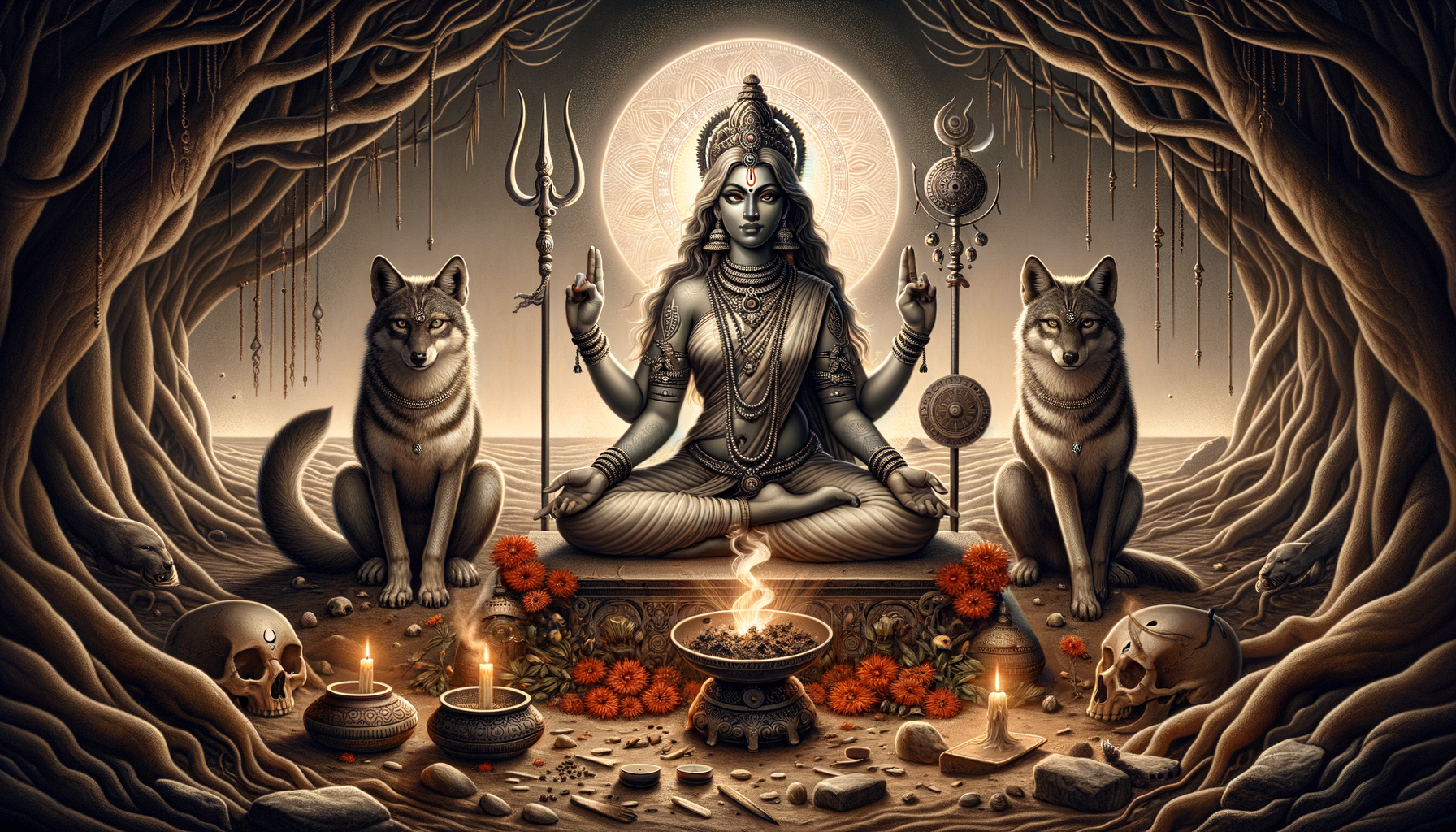
Goddess Chamunda occupies a singular place within Hindu symbolism as a fierce embodiment of Shakti who resides at the threshold between life and death. Described in the Devi Mahatmya as the vanquisher of Chanda and Munda, Chamunda is portrayed with a gaunt frame, sunken eyes, protruding teeth, and a garland of skulls. Her presence in cremation grounds and her association with jackals are not meant to terrify alone; they serve as profound reminders of impermanence, fearlessness, and the sacred power that transforms decay into wisdom.
In Tantric iconography, Chamunda appears amidst the śmaśāna (cremation ground), holding the kapala (skull cup), trident, and drum, sometimes with a severed headvisual metaphors for cutting through ignorance, sustaining cosmic rhythm, and absorbing the essence of truth. The skeletal aesthetic is intentional: it strips away ornamentation to reveal elemental reality. Each featureemaciation, bones, and ashsignals the uncompromising clarity of confronting mortality and the limits of ego.
The jackals that accompany Chamunda function as powerful symbols in Hindu Symbols and ritual imagination. As liminal scavengers, jackals inhabit borderlands and thus represent guardianship over thresholdsbetween village and wilderness, life and death, fear and liberation. Their howls echo the voices of the cremation ground; in this setting, they become messengers that summon courage rather than dread. Read this way, jackals signify discernment in the face of chaos and the sacred intelligence that reorders what has fallen apart.
Within spiritual practice, Chamunda’s imagery directs attention to the psychological work of transformation. The cremation ground is the inner field where attachments are surrendered, and anxiety about endings is faced directly. Devotees describe the deity’s energy as protective and emancipatory: the abhayamudra (gesture of fearlessness) assures safety, while the kapala invites contemplation of impermanence and compassion for all beings who suffer. Such contemplation reframes fear as a doorway to resilience, clarity, and ethical strength.
These meanings resonate across the broader dharmic family. Vajrayana Buddhism’s charnel-ground meditations cultivate insight into impermanence and nonattachment; Jain reflections on anitya (impermanence) and maranasmarana (mindful recollection of death) encourage disciplined compassion; Sikh teachings on nirbhau (fearlessness) and living in hukam (divine order) inspire courageous humility. Seen together, these perspectives affirm a shared civilizational vision: wisdom arises when mortality is acknowledged without despair and responded to with courage and care.
Temple traditions highlight the constructive, community-facing dimension of this symbolism. During Navaratri or Ashtami, collective recitation of stotra, lighting of lamps, and offerings such as red flowers, incense, sesame, and neem leaves are observed as non-harmful forms of devotion. In village shrines and urban temples alike, the presence of Chamunda evokes communal protection and ethical vigilancean assurance that society can withstand darkness through unity, compassion, and disciplined spiritual practice.
Read as a whole, the figure of Chamunda and the imagery of jackals offer an integrated philosophy of courage: to accept endings, honor the dignity of life, and transform fear into wisdom. Rather than sensationalizing death, this symbolism restores perspectivereminding communities that love, responsibility, and truthful living outlast the transient forms they protect. In this way, Chamunda’s cremation-ground grace becomes not a menace but a refuge for those seeking clarity and fearlessness on the path of Dharma.
Inspired by this post on Hindu Blog.