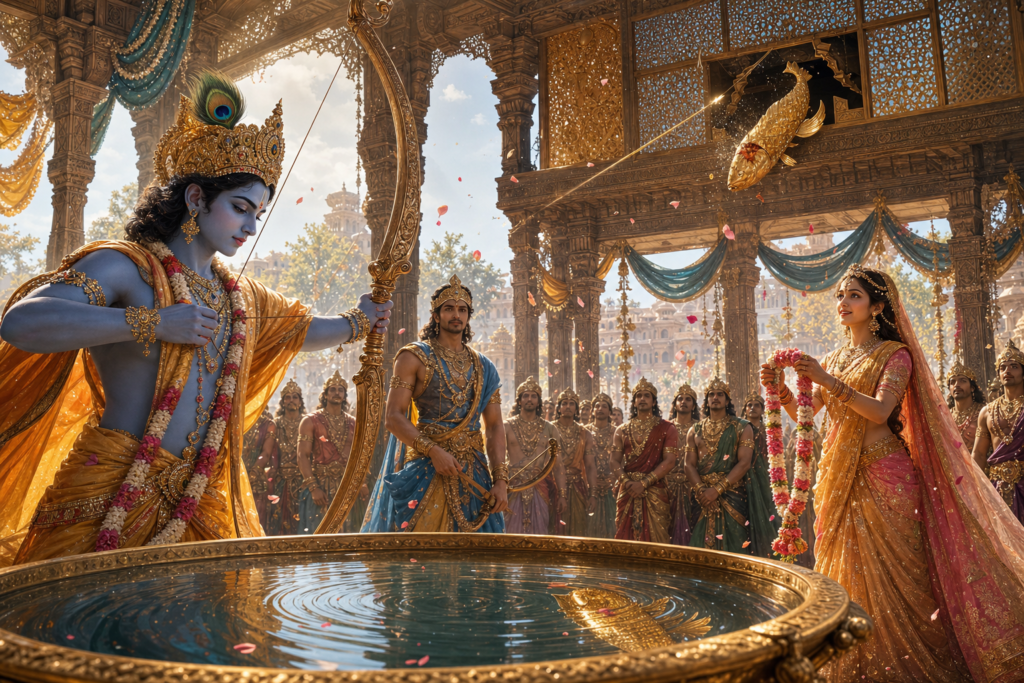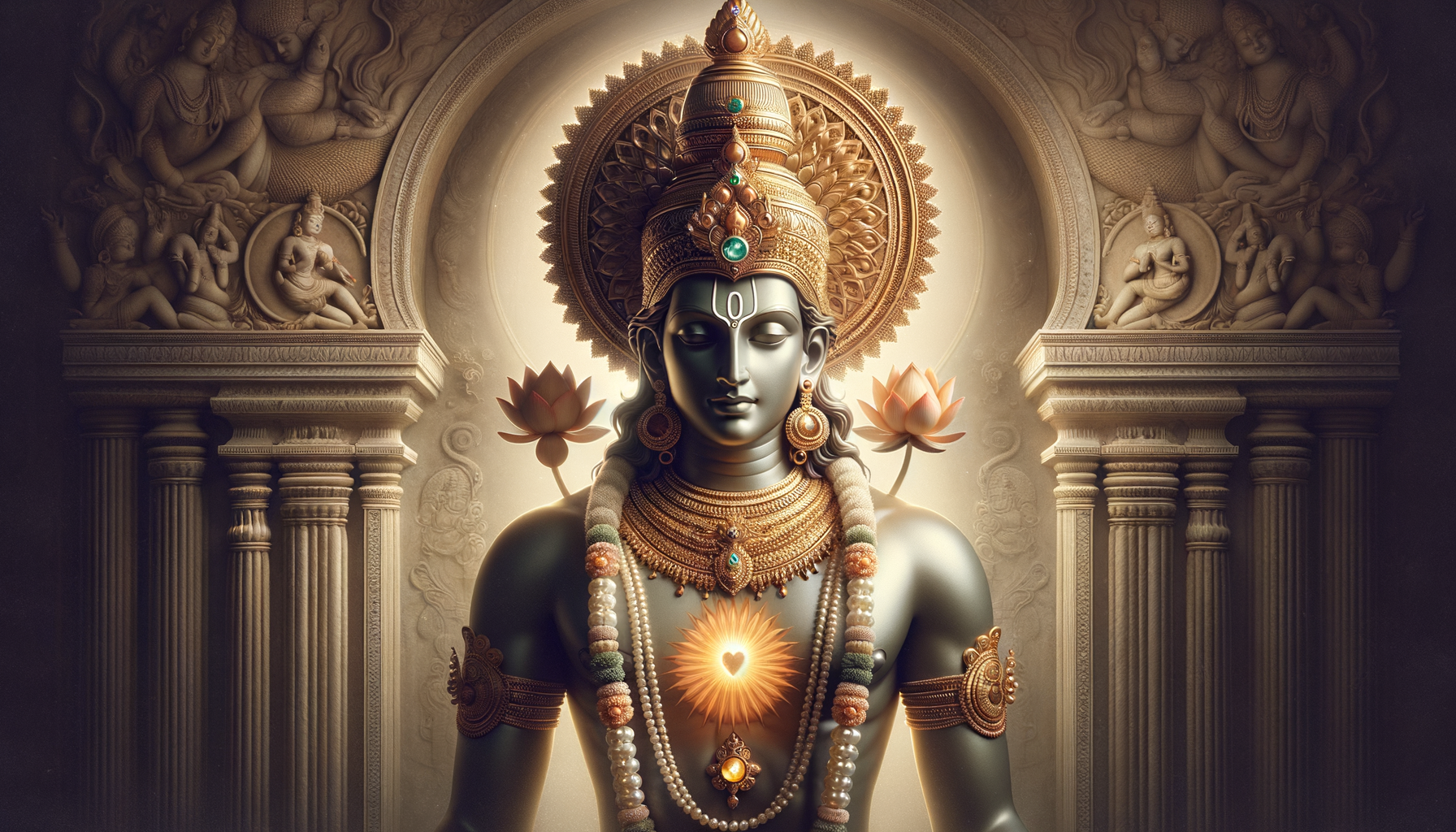
The Kirita Mukuta, the radiant crown of Lord Vishnu, stands as a central emblem in Vaishnava iconography, signifying divine sovereignty anchored in dharma. Across ancient cave temples such as Ellora and Badami, sculptors rendered this mukuta with exquisite precision, communicating not mere royal authority but the cosmic custodianship vested in Vishnu as preserver of the universe.
In traditional Hindu symbolism, the crown represents the rightful alignment of power with moral law. The Kirita Mukuta’s tiered form, jeweled crest, and lotus or kirtimukha motifs are not purely decorative; they encode the idea that temporal leadership derives legitimacy from spiritual clarity and self-mastery. This reading aligns with a wider Hindu ethos that exalts sovereignty only when it safeguards rtacosmic order.
Complementing the crown is the Kaustubha gem, the luminous jewel adorning Vishnu’s chest. Purānic narratives, especially in the Bhagavata Purana and Vishnu Purana, recount its emergence during the Samudra Manthana (Churning of the Ocean). Worn near the heart, the Kaustubha is often interpreted as a symbol of stainless purity, self-luminous consciousness, and compassionate presencequalities that guide divine rule from within.
Scholarly tradition also notes the distinction between the Kaustubha and the Shrivatsa mark; while the Shrivatsa is a sign or whorl near the heart, the Kaustubha is an actual jewel. Together, crown and gem form a meaningful dyad: head and heart, discernment and compassion, governance and grace. This integrated symbolism communicates the ideal of leadership that is simultaneously firm and benevolent.
Art-historical evidence suggests a consistent visual vocabulary from the Gupta and post-Gupta periods through the Chola bronzes, where the Kirita Mukuta and Kaustubha appear as defining attributes of Vishnu. References in the Shilpa Shastras support the taxonomy of mukutas (including kirita and karanda forms), guiding artisans on proportion, ornament, and posture so that the image conveys theological depth alongside aesthetic refinement.
For many visitors undertaking darshan in temples, the encounter with these symbols evokes a quiet synthesis of reverence and reflection. The crown draws attention upward, inviting clarity and steadiness of mind, while the Kaustubha turns attention inward, toward the heart’s unconditioned light. In this way, Vaishnava iconography gently teaches that authority without compassion is incomplete, and compassion without discernment is unguided.
Parallels across dharmic traditions reinforce this unifying insight. In Buddhist art, the ushnisha and jeweled crowns of bodhisattvas, often paired with the cintāmaṇi (wish-fulfilling jewel), convey enlightened wisdom guiding compassionate action. Jain imagery venerates the Shrivatsa on the chest of the Jinas as an emblem of auspicious presence and inner purity. Sikh tradition upholds miri–pirithe harmonious balance of temporal responsibility and spiritual authorityreflected symbolically in the dastar (turban) and in the Khalsa ideal. These analogues underscore a shared dharmic aspiration: leadership shaped by inner illumination and ethical restraint.
Contemporary relevance flows naturally from this iconography. The Kirita Mukuta encourages disciplined clarity in daily decision-making, while the Kaustubha invites an ethic of empathy and service. Together they offer a contemplative framework for personal conduct and communal harmonyprinciples that strengthen unity across Hinduism, Buddhism, Jainism, and Sikhism.
A simple practice during temple visits can deepen this understanding. While contemplating the crown, reflect on cultivating steady awareness and responsibility. While contemplating the gem, rest attention at the heart, acknowledging the primacy of kindness, integrity, and fearlessness. Such reflections transform viewing into learning, and learning into living.
Ultimately, the Kirita Mukuta and Kaustubha gem present a complete vision of sacred kingship rooted in wisdom and compassion. As enduring features of Vaishnava iconography, they do more than adorn the divine form; they model a path where head and heart align, power serves principle, and spiritual insight guides communal well-beingan ideal cherished across the wider dharmic family.
Inspired by this post on Hindu Blog.