Channel 5’s Springtime on the Farm, produced by Daisybeck Productions, documented a two-day immersion at Bhaktivedanta Manor’s New Gokul Farm near Watford, Hertfordshire, capturing traditional hand-milking, attentive cow care, oxen working the fields, and the Holland Farm horticultural project.
New Gokul Farm, part of ISKCON (International Society For Krishna Consciousness), is widely noted for a dharmic, ahimsa-oriented model of dairy and cow protection (go-seva), where agricultural practice and spiritual ethos converge within a modern United Kingdom context.
Springtime provided an optimal lens for Channel 5 to examine seasonal transitions in British farmingpasture revival, calving and lactation curves, field preparation, and the rebalancing of soil moisturewhile situating New Gokul’s practices within broader conversations about regenerative agriculture and animal welfare.
Hand-milking at New Gokul Farm exemplifies a low-stress, high-attention method rooted in animal bonding and careful hygiene. Routine includes udder cleansing, fore-stripping to assess milk quality, gentle milking with a consistent cadence, and post-milking teat care to protect the teat sphincter, all conducted in calm conditions that prioritize cow comfort.
While mechanized milking can increase throughput, hand-milking supports individualized observationsubtle shifts in udder texture, milk flow, or temperament can be identified early, enabling prompt responses that may reduce mastitis risk and support sustained lactation without compromising welfare.
From a technical standpoint, the approach complements the ‘Five Freedoms’ guiding UK animal welfare, balancing nutritional adequacy, freedom from discomfort and distress, and opportunities for species-typical behavior through low-noise, predictable routines.
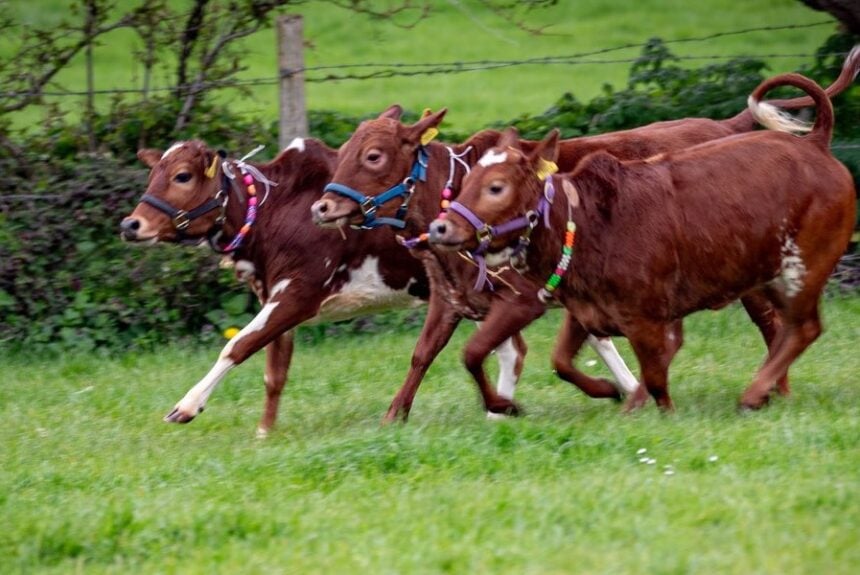
Comprehensive cow care at the gaushala spans pasture-based nutrition, mineral supplementation, hoof care, regular veterinary oversight, and structured rest, with a zero-slaughter commitment that extends protection to both cows and oxen throughout the animals’ natural lives.
Oxen working the fields introduce a quiet, human-scale traction system that aligns with soil health objectives. Animal traction can reduce topsoil compaction relative to heavy machinery, preserve soil aggregates, and allow precise implementsploughs, ridgers, and harrowsto operate at agronomically sensitive speeds.
Training focuses on yoke fit, voice cues, and incremental load progression to safeguard the animals’ musculoskeletal health. The measured pace of oxen supports accurate seed placement, consistent bed formation, and careful inter-row cultivation that together reinforce weed suppression with minimal chemical inputs.
In cultural terms, oxen embody a living continuity of dharmic agriculture, where labor is integrated with reverence. This symbolism is not merely aesthetic; it reinforces ethical decision-making around inputs, stocking rates, and land use that prioritize long-term fertility over short-term extraction.
The Holland Farm horticultural project complements the dairy by closing nutrient loops. Farmyard manure, composted bedding, and green manures are cycled into vegetable and herb production, creating a circular agroecology where fertility is renewed and reliance on external inputs is reduced.
Horticultural practice applies integrated pest management, diverse rotations across brassicas, legumes, roots, and salads, living mulches for moisture retention, and polytunnel management for season extensionan evidence-based suite that balances yield stability with biodiversity enhancement.
Water stewardship includes mulching, drip irrigation where appropriate, and attention to soil organic matter as a natural reservoir, supporting resilience in dry spells and mitigating runoff during heavy spring rains.
Milk quality conversations often surface around protein variants such as A2 beta-casein; while consumer interest in A2 milk is growing, New Gokul’s emphasis rests on ethical husbandry, welfare-centric routines, and careful handling from cow to containerfactors consistently associated with milk safety and palatability.
The daily schedule interweaves seva with science: feed rationing anchored in rumen biology, mineral balances calibrated to pasture analyses, and routine health checks that document body condition scores, locomotion, and behavioral cues indicative of well-being.
Over two days, Daisybeck Productions structured filming to track dawn milking, mid-morning pasture work, and afternoon horticultural sequences, sequencing wide establishing shots with close observational footage to convey both system-level logic and the micro-interactions between carers and animals.
Production protocols minimized disturbance by working within established herd routines, using low-profile equipment where feasible, and coordinating with staff so that lighting, camera angles, and movement patterns respected the animals’ flight zones and resting times.
Contextual narration connected New Gokul Farm to broader UK trends in sustainable farming, including interest in low-carbon operations, reduced chemical dependency, and locally anchored food systems that build community resilience.
At the heart of this portrayal lies a unifying dharmic ethicahimsa, karuṇā, and sevathat resonates across Hinduism, Buddhism, Jainism, and Sikhism. The shared commitment to compassion for living beings and responsible stewardship of land offers common ground for interfaith collaboration in agriculture.
For Jain practitioners, the zero-slaughter protection and attention to maternal bonding align with an aspiration to minimize harm; for Buddhists, mindful husbandry reflects an applied compassion; for Sikhs, the dignity of farm work and the ethics of langar connect with equitable, sustainable foodways; for Hindus, go-seva and Vedic culture anchor respect for Gau Mata within contemporary environmental stewardship.
Visitors frequently remark on the atmosphere: the soft sounds of hand-milking at dawn, the steady creak of a wooden yoke, and the earthy scent of compost turningsensory cues that transform sustainability from an abstract ideal into an immediate, embodied experience.
By featuring New Gokul Farm in Springtime on the Farm, Channel 5 and Daisybeck Productions have documented not only a set of techniqueshand-milking, cow care, oxen traction, and integrated horticulturebut also a values-based framework capable of informing British agriculture’s transition toward regenerative, humane, and community-centered practice.
The resulting narrative is both technical and humane: a demonstration that productive farming can advance animal welfare, soil health, and cultural heritage simultaneously, inviting viewers to evaluate agricultural success not only by yield, but by the well-being of animals, people, and the land.
In this light, New Gokul Farm serves as a case study in how dharmic principles can be operationalized within UK regulatory settings to deliver credible outcomes in cow protection, environmental stewardship, and sustainable agriculture.
Inspired by this post on Dandavats.