Day 3 of Sadhu Sanga 2026 stood out as a reflective culmination of multi-day bhakti immersion, bringing into focus how shared practicekirtan, scriptural contemplation, and sevanurtures unity across dharmic traditions. The term “sadhu-sanga” denotes intentional association with practitioners committed to dharma, a principle that resonates not only within Vaishnavism but also across Buddhist Sangha, Jain samayik circles, and Sikh sangat. In keeping with the ethos of Vasudhaiva Kutumbakam, the gathering emphasized harmony of faiths without diluting the integrity of each path.
Situated within the Bhakti Tradition and the broader Sanatana Dharma landscape, sadhu-sanga functions as a living classroom where the Guru-Shishya Relationship is renewed through listening (śravaṇa), chanting (kīrtana), remembrance (smaraṇa), and service (seva). These complementary disciplines cultivate sattva, stabilize attention, and reorient daily life around ethical action and inner clarity. Participants frequently describe Day 3 as the point where insights consolidate into practical commitments.
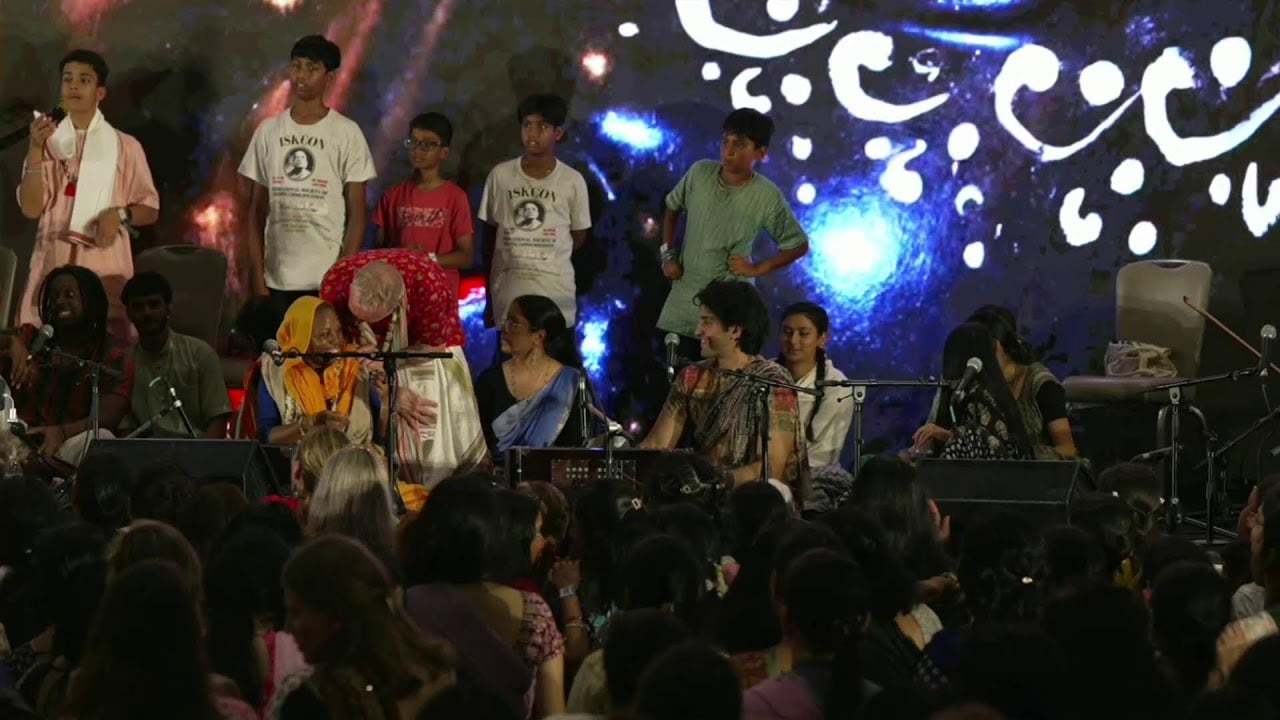
Kīrtana formed the acoustic heart of the program, typically arranged in call-and-response structures that synchronize breath, attention, and affect. Musical choices often draw from classical ragas and cyclic tālas, supporting extended, meditative flow. This architecture is not merely aesthetic; it channels collective focus into a sustained sankirtana capable of dissolving social barriers and fostering communal belonging.
From a contemplative science perspective, group chanting leverages entrainmentalignment of rhythmic patterns across breath, heartbeat, and movement. Slow, even exhalations stimulate vagal tone, which is associated with calm alertness and prosocial emotion. When hundreds chant together, the result is a measurable shift toward coherence that aids emotional regulation and deepens contemplative absorption.
Mantra practice on Day 3 typically integrates nama-japa with congregational singing, allowing quiet, bead-based repetition to inform and stabilize the more dynamic flow of kirtan. A 108-bead mālā structures attention by providing tactile feedback and a natural cadence for breath. This integration reflects guidance found across the Bhagavad-Gita and the Bhagavata Purana, where remembrance of the Divine Name is framed as both method and goal.
Phonetically, sacred syllables function as precise carriers of meaning and affect. Their vibrational profiles shape articulation, posture, and respiration, gradually training the practitioner toward one-pointedness. Over time, these micro-adjustments support gross-to-subtle refinement, enabling sustained mindfulness during scriptural discourse and meditation.
Scriptural study on the final day commonly distills earlier discussions into a concise sadhana framework. In Vaishnava settings, commentators often draw intertextual threads among the Bhagavad-Gita, the Bhagavata Purana, and allied Vaishnava texts to highlight how satsanga catalyzes devotion, insight, and ethical agency. The takeaway is pragmatic: association directs aspiration and, through repetition, aspiration matures into character.
Ethics surfaced as a recurring theme, especially the cultivation of humility (amanitvam), compassion (daya), and nonviolence (ahimsa). Vaishnava etiquetteavoiding offense (aparadha), honoring teachers, and caring for fellow practitionerswas framed as essential for protecting the delicate ecology of devotion. These norms mirror comparable ethical commitments in Buddhist vinaya principles, Jain anuvrata, and Sikh rehat maryada.
Interfaith resonance enriched the atmosphere without blurring doctrinal contours. The Sikh tradition of sangat and kirtan, the Buddhist Sangha’s emphasis on mindfulness and loving-kindness (mettā), and Jain practices such as pratikraman and samayik were acknowledged as compatible lenses for understanding the power of disciplined community. Rather than collapsing differences, the gathering elevated unity in spiritual diversity as a shared civilizational strength.
Community service featured prominently through organized seva and shared meals, a pattern long exemplified by prasadam in Hindu temples and langar in Sikh gurdwaras. These practices translate devotion into hospitality, erasing hierarchies at the point of nourishment. The social impact is twofold: immediate care for attendees and a lived demonstration of dharma as inclusive stewardship.
Digital access extended the reach of Day 3 to those unable to attend in person. Public coveragesuch as material published on the Friends Forever channelcommonly captures the arc from quiet japa to expansive congregational singing, allowing distant viewers to synchronize their own practice with the event’s rhythm. When approached mindfully, such media can supplement, not replace, local satsanga.
Participants frequently consolidate their experience on the final day by articulating a personal sadhana blueprint. Common commitments include a set daily window for nama-japa and scriptural reading, weekly participation in local satsanga, regular seva aligned with personal skills, and mindful digital use to protect contemplative time. This blueprint translates peak inspiration into stable habit.
Practical measurement helps sustain momentum without reducing spirituality to metrics. Practitioners often track rounds of japa, minutes of kirtan, pages of study, and hours of service as gentle indicators of consistency. The emphasis remains qualitativedepth, attention, and kindnesswhile quantitative markers provide structure and accountability.
Youth engagement and diaspora participation emerged as vital concerns, especially in contexts where cultural continuity relies on accessible, high-quality instruction. Programs that weave music, narrative, and participatory learning lower entry barriers while preserving rigor. When elders mentor through the Guru-Shishya Relationship, transmission accelerates without sacrificing authenticity.
A noteworthy pattern across dharmic lineages is the role of sound in shaping community: Vedic kīrtana and bhajans, Sikh shabad kirtan in prescribed rāgas, Buddhist Pali chanting, and Jain navkar mantra recitation all use voice to gather attention and elevate collective mood. This shared acoustics of devotion makes interfaith dialogue experiential rather than merely conceptual, advancing harmony of faiths through felt understanding.
Day 3 also emphasized cultural heritage as living practice rather than museum memory. By situating devotion within festivals, temple traditions, and everyday ethics, the gathering reaffirmed Sanatan Dharma’s capacity to adapt to modern life while guarding perennial wisdom. Such continuity counters deracination by anchoring identity in practice, service, and study.
In summary, Sadhu Sanga 2026Day 3 functioned as a convergence point where music, mantra, scripture, and service coalesced into a coherent path. The event highlighted how bhakti disciplines refine attention, strengthen ethical resolve, and knit diverse communities into a compassionate whole. In spirit and in method, it affirmed the civilizational principle that spiritual progress and social harmony advance together.
Carried forward into daily life, these insights invite continued association with practitioners, steady cultivation of nama-japa and kīrtana, respectful study of the Bhagavad-Gita and Bhagavata Purana, and committed seva in local communities. When anchored in unity in spiritual diversity, such practice becomes a durable contribution to peace and well-being for all.
Inspired by this post on Dandavats.