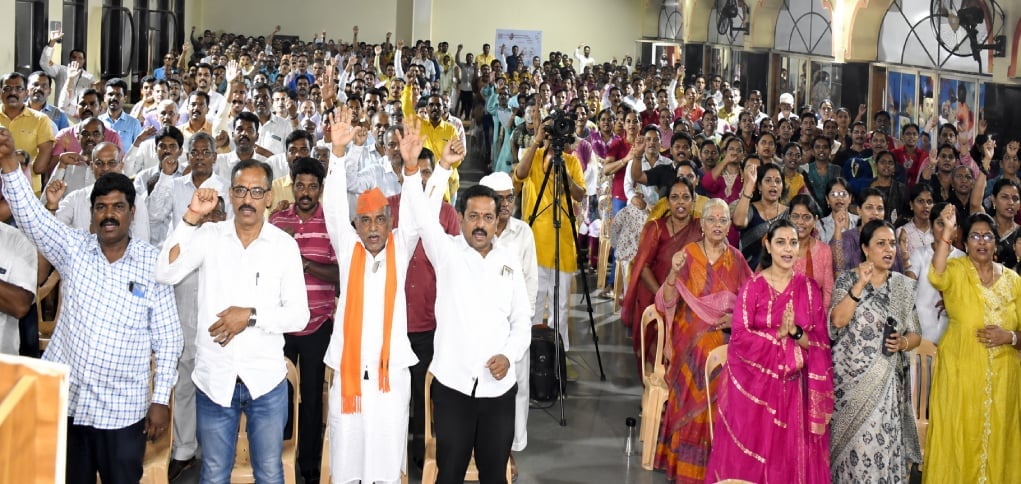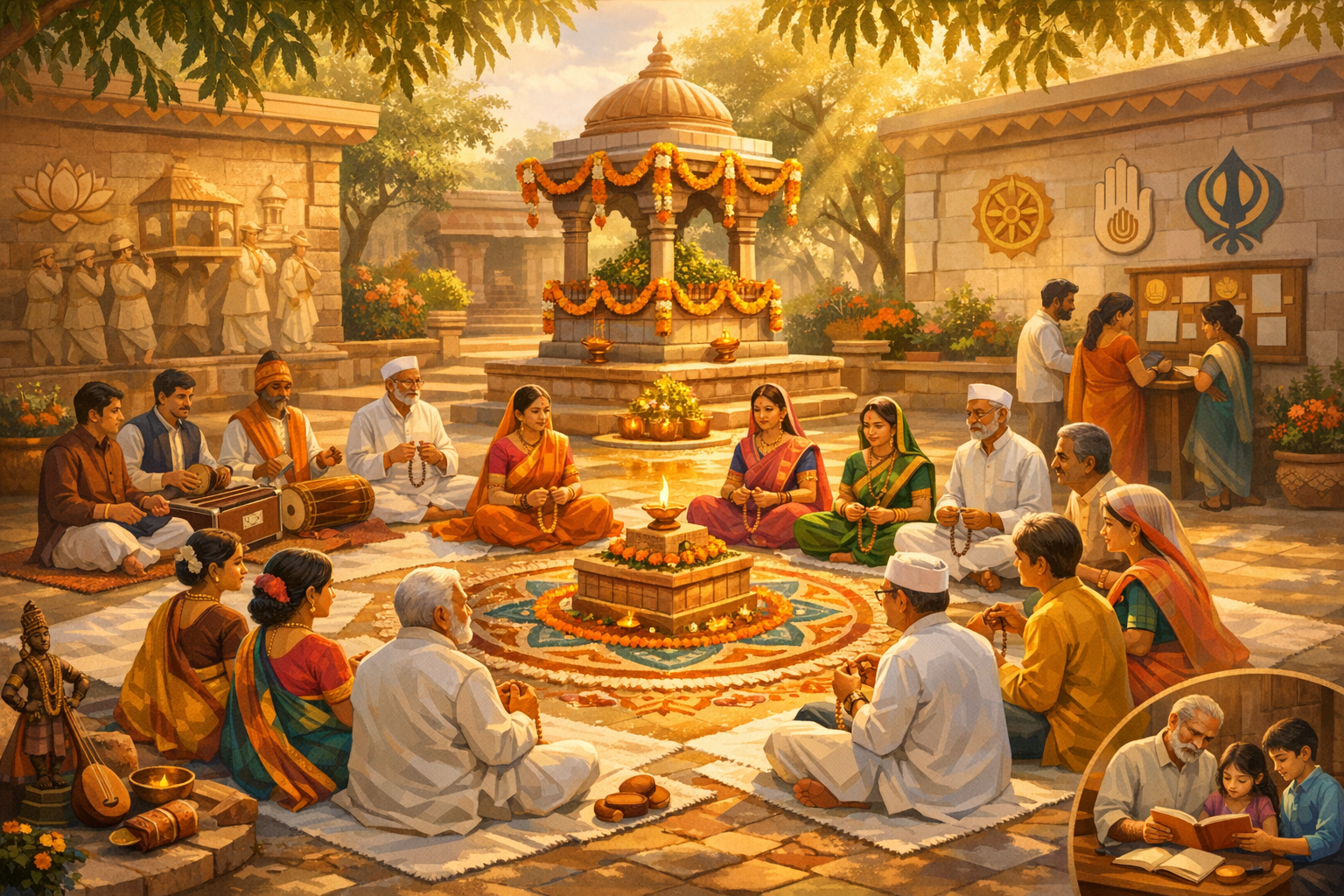
Across multiple districts in Maharashtra, a series of Hindu Rashtra-Jagruti Sabhas drew robust, orderly participation from devotees and community stakeholders, highlighting a renewed civic appetite for dharmic literacy, social organization, and contemplative practice through chanting the Name of God. Reports from local coordinators and participants consistently described an atmosphere of seriousness, mutual respect, and constructive engagement focused on practical, non-political community strengthening.
Thematically, the sabhas converged on three pillars: religious education (dharma literacy), organization of Hindu society (sangathan and institution-building), and spiritual disciplines such as japa and kirtan. These strands were framed as complementaryeducation providing clarity of values, organization enabling collective seva and resilience, and spiritual practice cultivating inner steadiness and compassion that sustain long-term social harmony.
Maharashtra’s own civilizational landscape provided a natural context for these assemblies. The Warkari tradition, the abhangs of Sant Dnyaneshwar, Tukaram, and Eknath, and the region’s long heritage of kirtan and collective pilgrimage (vari) were frequently invoked as precedents for morally formative, community-centered religious participation that is open, ethical, and service-oriented.
Speakers placed the sabhas within a broader dharmic horizon that includes Hinduism, Buddhism, Jainism, and Sikhism as interrelated traditions with shared commitments to ethical living, non-violence, self-discipline, and inner cultivation. The call for unity in spiritual diversity emphasized respect for different paths (Ishta, sadhana methods, and monastic-lay ecologies), while aligning community energies toward social cohesion and public good rather than sectarian competition.
On religious education, the assemblies foregrounded dharma literacy as a public value. The emphasis was on accessible learning about itihasa–purana, key ideas from the Upanishads and the Bhagavad Gita, lives of saints, temple traditions, and the ethical vocabulary of ahimsa, satya, daya, and dana. This vision complements contemporary educational initiatives to integrate Indian Knowledge Systems with critical thinking, language skills in Marathi and Sanskrit, and applied civics rooted in constitutional values.
Presentations outlined a modular approach to curricula: foundational narratives and values for children; textual literacy and comparative perspectives for adolescents; and specialized seminars on rituals, arts, and philosophy for adults. Weekend sabhas, temple-based study circles, and digital classrooms were proposed as scalable formats. Teacher preparation, transparent governance of content, and parental involvement were repeatedly identified as quality anchors.
Pedagogically, speakers advocated dialogic methodsstorytelling and abhang recitation for younger learners; guided sastrartha (structured debate) for advanced cohorts; and project-based learning that documents local temple heritage, oral histories, and traditional arts. The goal articulated was not indoctrination, but moral clarity, cultural competence, and aptitude for respectful dialogue across religious and philosophical lines.
Moving from learning to social architecture, the sabhas examined organization (sangathan) as a civic competency. Proposed models included federations of temple trusts, bhajan mandals, youth clubs, and women’s groups with shared charters for seva, cultural programming, and relief work. Clarity on by-laws, ethical fundraising, financial transparency, and compliance with Indian law were presented as non-negotiable safeguards.
Speakers recommended lightweight governance frameworkscodes of conduct, grievance redress systems, and periodic auditsto preserve trust and prevent politicization. Emphasis was placed on inclusive representation, intergenerational leadership pipelines, and collaboration with civic bodies during festivals, health camps, and disaster response. The organizing ethos rested on dignity, consent, and accountability.
A practical strand addressed how digital tools can strengthen community coordination without eroding privacy. Simple event management platforms, open calendars, document repositories for charters and minutes, and volunteer registries were cited as enablers of continuity, institutional memory, and equitable participation across neighborhoods and districts.
Many interventions illustrated how organized communities can translate values into action: language tutoring for under-resourced children, heritage walks, temple cleanliness drives, senior-care visitation programs, and support for traditional artists. The sabhas framed seva as a shared dharmic language that naturally aligns Hindu, Buddhist, Jain, and Sikh organizations around tangible public benefit.
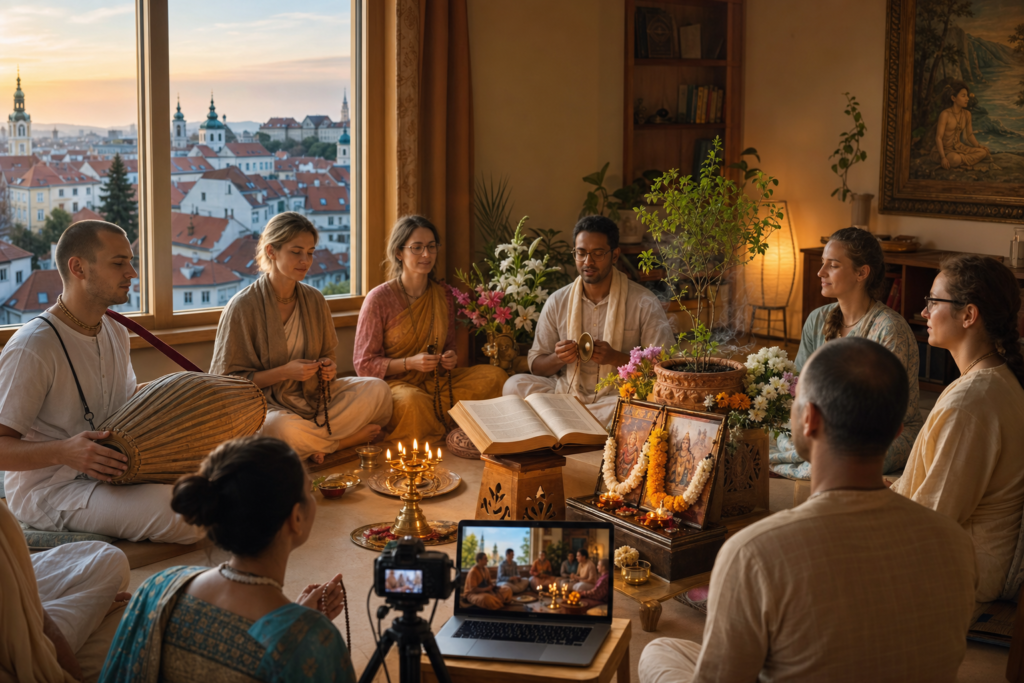
The contemplative axis of the gatherings focused on japathe repetition of the Divine Nameas a widely accessible practice that stabilizes attention and tempers reactivity. Speakers differentiated vaachika (audible), upamshu (whispered), and manasika (mental) japa, and encouraged participants to choose modes consonant with time, place, and personal temperament.
Drawing on a growing body of research on contemplative practices, the sabhas noted that rhythmic mantra repetition is associated in studies with parasympathetic activation, improved heart-rate variability, and reduced perceived stress. Parallel findings from Sikh kirtan, Buddhist mantra recitation, and Jain samayik were mentioned to highlight convergent benefits across the dharmic spectrum, without prescribing a single technique.
Practical guidance emphasized short, consistent sittingssuch as 12–20 minutes dailypaired with steady breath and a chosen Ishta. The advice was intentionally non-sectarian: whether the Name is “Rama,” “Krishna,” a bija mantra, the sacred syllable “Om,” or a Sikh or Buddhist refrain, the discipline of regularity and sincerity was presented as the active ingredient that refines attention, softens speech, and deepens empathy.
Participants frequently described a gentle, shared stillness arising during collective japa and kirtana felt sense of what sociologists call “collective effervescence,” harnessed here toward ethical self-regulation rather than spectacle. Anecdotal reflections highlighted family memories of evening bhajans and neighborhood satsangs, suggesting that simple, repeatable rituals can rehabilitate attention in a distracted age.
The sabhas also addressed pluralism directly. Multiple speakers underscored that unity does not require homogeneity; it requires principled hospitality across practices and philosophies. The language of the assemblies explicitly rejected coercion and affirmed constitutional freedoms, positioning dharmic education and practice as resources for civic friendship across communities.
City-level snapshots illustrated context-sensitive design. In Pune, sessions near universities reportedly focused on student mentorship, internships with heritage organizations, and Sanskrit–Marathi language clubs. In Nashik, discussions connected sabha programming with the Kumbh’s infrastructural and cultural knowledge. In Nagpur, volunteer training modules on event stewardship and first-aid were highlighted. In Mumbai, the diaspora’s role in archiving oral histories and supporting traditional arts received attention.
Youth engagement emerged as a priority. Proposals included campus reading circles on the Bhagavad Gita and Dhammapada, open mic abhang evenings, digitization of palm-leaf manuscripts and temple records, and mentorships pairing elders with students for intergenerational skill exchange. The guiding aim was to make tradition both intelligible and livable for digital natives.
Women-led initiatives were showcased as drivers of social capital, from coordinating prasadam logistics and cleanliness drives to leading bhajan sessions and neighborhood study groups. The sabhas framed these roles not as auxiliary but as central to community continuity, institutional competence, and the transmission of values with rigor and warmth.
Elders were recognized as living libraries who carry the ethos of shraddha in speech and conduct. Sessions encouraged systematic documentation of elders’ memoriespilgrimages, festival protocols, artisanal knowledgeso that intangible heritage becomes an intergenerational commons rather than a fragment of nostalgia.
Concerns regarding the potential politicization of sabhas were discussed with candor. In response, facilitators reiterated procedural neutrality, transparent finances, nonpartisan codes of conduct, and a consistently inclusive vocabulary that welcomes Buddhists, Jains, and Sikhs into programming design and delivery. The sabhas’ legitimacy, it was argued, rests on service capacity, ethical consistency, and respect for diversity.
Safeguards proposed included training volunteers in conflict de-escalation, articulating clear norms for speech, encouraging evidence-based claims in educational content, and establishing liaison channels with local authorities for large gatherings. These measures were framed as expressions of dharmic responsibility rather than external compliance.
Ethically, the sabhas anchored discourse in ahimsa (non-violence), satya (truthfulness), and seva (service), with japa positioned as a practice that incrementally domesticates anger and fosters forbearance (kshama). The aspiration was to cultivate citizens who are steady in disagreement, generous in interpretation, and reliable in community obligations.
As a forward pathway, speakers recommended district calendars that braid together study circles, seva campaigns, youth retreats, and inter-sabha exchanges, ensuring that momentum translates into measurable community benefitliteracy support, cultural preservation, environmental stewardship, and compassionate outreach to the vulnerable.
Participants were encouraged to begin with manageable disciplines: a daily japa slot, a monthly reading circle, and a quarterly seva commitment, scaling up only when continuity is secure. This incremental approach aligns with the dharmic preference for niyama (orderly regulation) and nairantarya abhyase (unbroken practice) over intermittent intensity.
In synthesis, the Hindu Rashtra-Jagruti Sabhas in Maharashtra presented a sober, actionable blueprint: educate clearly, organize ethically, and practice steadily. By situating Hindu society within a larger family of dharmic traditions and emphasizing unity in spiritual diversity, the assemblies modeled a civic spirituality that is both rooted and expansivecapable of deepening inner discipline while widening circles of care.
The overall impression, corroborated by community voices and local observations, is that enthusiasm alone did not define these gatherings; rather, disciplined hope, procedural seriousness, and a shared willingness to learn, serve, and chant together marked a constructive step toward durable social harmony in Maharashtra.
Inspired by this post on Hindu Jagruti Samiti.