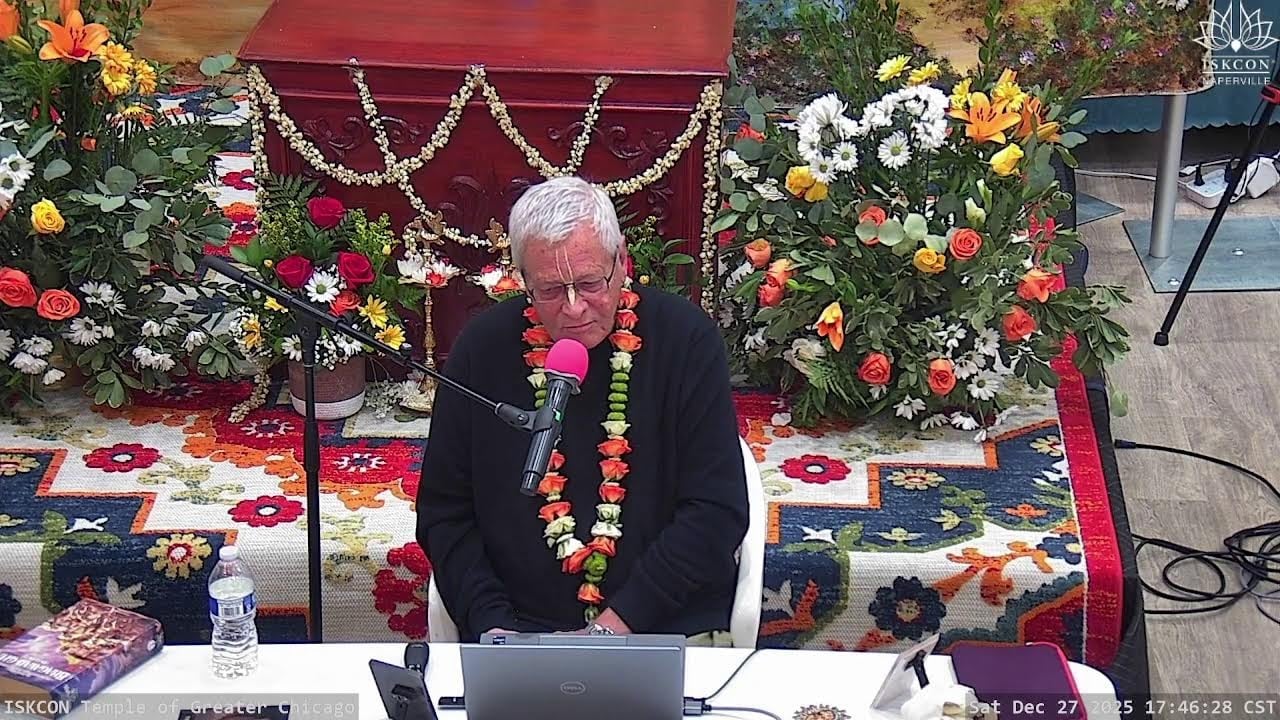
On December 27 in Naperville, HG Gopal Bhatta Prabhu reflected on the enduring responsibilities of spiritual communities as elders withdraw from the forefront of public lifethe moment when a “fading ācārya” invites collective maturity. The discussion situated this transition within a broader dharmic context, emphasizing how intergenerational stewardship sustains spiritual heritage, community cohesion, and cultural continuity across the Hindu Dharma and allied dharmic traditions.
Central to the reflection was a guiding instruction attributed to Srila Prabhupada: “I have built the skyscraper skeleton, now you all intelligent American and European boys and girls fill in the spaces nicely in good taste. Do not deviate from our high standard.” (Letter to Sridama, 22 Dec 1971). This metaphor frames a clear mandatelater generations are asked to complete, refine, and beautify the edifice of service without compromising the founding standards of conduct, devotion, and scholarship.
Within this framework, the second generation is seen as consolidating a basis for unityarticulating shared principles, building institutions, and cultivating the Guru–Shishya Traditionwhile the third generation is encouraged to express a rich diversity of practice, culture, and outreach, all anchored in uncompromising excellence. In a diaspora setting such as Naperville, this progression balances stability with innovation, ensuring that ISKCON’s Bhakti Tradition, and more broadly the dharmic ethos, remain vibrant, relevant, and ethically grounded.
These insights are consonant with the wider family of dharmic pathsBuddhism, Jainism, and Sikhismwhere disciplined practice, seva, ahimsa, satya, and contemplative inquiry form a shared civilizational grammar. Unity in Diversity is not merely a slogan but a method: diverse modes of worship and learning flourish within a common commitment to high standards, community service, and spiritual integrity.
Intergenerational transmissionthrough teaching, study, and lived exampleemerges as the decisive factor in sustaining spiritual heritage. The Guru–Shishya Tradition, as practiced in ISKCON and other lineages, cultivates humility, responsibility, and fidelity to parampara while welcoming cultural creativity. Such formation equips younger practitioners to steward temples, sanghas, and community projects with both competence and compassion.
Practical pathways highlighted include rigorous education in scriptures and ethics; cross-tradition dharmic dialogues that reinforce mutual respect; collaborative seva addressing local needs; and initiatives that support youth leadership, kirtan, and study circles. Each of these avenues advances community cohesion, safeguards high standards, and models Unity in Diversity in a manner suitable for contemporary civic life.
In sum, the reflection in Naperville presented a clear and constructive vision: honor the legacy of the ācāryas by upholding high standards, deepen intergenerational bonds through the Guru–Shishya Tradition, and cultivate a unifying dharmic culture where Hinduism, Buddhism, Jainism, and Sikhism collectively contribute to a capacious, ethical, and service-oriented future.
Inspired by this post on Dandavats.