
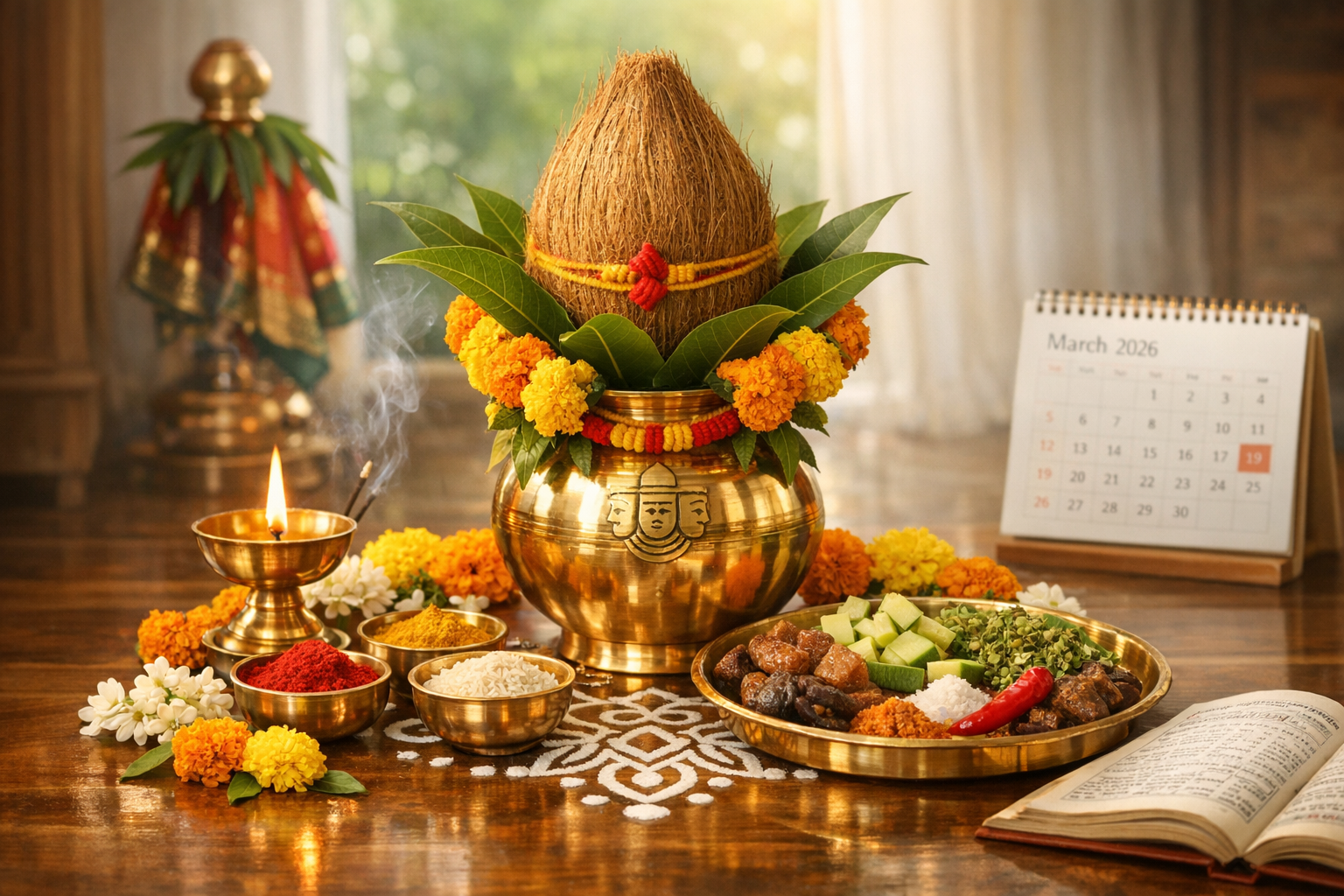
Brahma Pooja, also known regionally as Brahma Damana Puja, is a venerable observance on Ugadi (Gudi Padwa Chaitra Shukla Pratipada), the first day of the Hindu lunisolar year aligned to the Shalivahana Shaka tradition. In 2026, Ugadi/Gudi Padwa and the Brahma Damana Puja fall on 19 March, marking the advent of Parabhava Nama Samvatsaram. As the New Year opens, Lord Brahma the cosmic architect and source of knowledge (vidyā) receives special worship to sanctify time, intention, and action for the year ahead.
The ritual’s rationale is embedded in Vedic cosmology. Ugadi inaugurates a fresh cycle of lived time (kāla), and Samvatsara the annual unit is framed within larger cycles of Kalpa and Manvantara invoked during the sankalpa (ritual resolve). Honoring Brahma at this threshold acknowledges the metaphysical principle that creation (sṛṣṭi), order (ṛta), and right knowledge (veda) must be consciously invoked for dharmic living through the coming year.
Within this context, the title Parabhava Nama Samvatsaram functions as a mnemonic in the 60-year Jovian cycle, used across Vedic almanacs (panchāṅga). Aligning the sankalpa to the named year is not merely calendrical formality; it integrates household practice with a sophisticated time-reckoning framework comprising tithi (lunar day), vāra (weekday), nakṣatra (lunar mansion), yoga, and karaṇa. Panchāṅga-based observance underwrites the spiritual discipline of beginning new undertakings in an auspicious and mindful way.
The expression Brahma Damana Puja is preserved in certain regional lineages to denote the New Year’s ritual attention to Brahma. While textual prescriptions vary by śākhā and family tradition (paramparā), the core intent is consistent: to set a learned, ethical, and sattvic orientation toward life’s duties as a new Samvatsara commences.
For 2026, households may plan the puja during Chaitra Shukla Pratipada, preferably in prātaḥ-kāla (morning) once the Pratipada tithi is in effect at the location. If Pratipada spans two sunrises, the conventional priority is to observe on the day when Pratipada prevails at local sunrise. As with all tithi-based observances, local panchāṅga guidance ensures accurate alignment.
Preparations typically begin with śauca (ritual cleanliness), sanctifying the shrine area, and arranging a modest altar. Many households employ a kalaśa (pot) as a symbolic presence for Brahma, alongside images of one’s iṣṭa-devatā. Offerings assemble the classical set: gandha (fragrance), puṣpa (flowers), akṣata (unbroken rice), dhūpa (incense), dīpa (lamp), and naivedya (food). The use of yellow or golden-hued flowers is common owing to their association with radiance and knowledge.
After invoking Ganesha for removal of obstacles, the sankalpa is articulated, explicitly naming Chaitra Shukla Pratipada, the location, and Parabhava Nama Samvatsaram. This simple yet profound announcement situates the worshiper in place, time, and purpose within the Vedic cosmological order. The avāhana (invitation) to Lord Brahma may be accompanied by recitation of selected Vedic verses or stotras that extol creation, wisdom, and truthful speech (satyavāc).
Puja upacāras vary across traditions. Many households observe pañcopacāra (five offerings) or, where feasible, ṣoḍaśopacāra (sixteen offerings). The meditative focus is on Brahma as caturmukha (four-faced), signifying the four Vedas and omnidirectional presence of knowledge. Practitioners often report that lighting the first lamp of the year before the kalaśa invokes a palpable sense of renewal, anchoring resolve with humility and gratitude.
Naivedya holds distinct Ugadi character. In Andhra and Telangana, Ugadi pachadi a balanced mixture of neem, jaggery, tamarind, mango, salt, and chili is offered and then shared as prasāda. The six tastes (ṣaḍ-rasa) symbolize life’s composite experiences: sweetness of success, bitterness of challenges, sourness of change, astringency of restraint, spice of effort, and the essential salt of balance. This sensory “map” becomes a contemplative aid to cultivate equanimity for the year ahead.
Panchāṅga śravaṇam the annual almanac reading traditionally follows or accompanies the puja. A learned family elder, priest, or invited astrologer presents the Samvatsara’s indicators, including the five limbs of the calendar and summaries like āya-vyaya (broad income–expenditure outlooks) and graha-gochara highlights. While interpretive styles differ, most communities treat these readings as frameworks for reflection, prudent planning, and ethical intention rather than deterministic forecasts.
Regional expressions harmonize under the same philosophical canopy. In Maharashtra and Goa, Gudi Padwa features hoisting of the gudi a silk cloth with neem and mango leaves crowned by an inverted pot symbolizing auspicious victory and clarity. Many Maharashtrian households incorporate a brief invocation to Brahma’s creative intelligence alongside gudi-hoisting, linking regional custom with the pan-Indic New Year theme of mindful renewal.
Temple and household practices interrelate in meaningful ways. While dedicated Brahma temples are historically fewer than those for Shiva or Vishnu, Brahma is ritually present in Vedic homas, daily sankalpas, and festival invocations, particularly at calendrical thresholds. On Ugadi/Gudi Padwa, numerous temples frame special pujas and panchāṅga readings; households integrate these communal merits by mirroring simplified forms at home.
The ritual also resonates across the broader dharmic family. Buddhist traditions honor Brahmā as a high celestial being within cosmology, Jain traditions emphasize fresh vows of right conduct around spring festivals, and the Sikh Nanakshahi calendar opens the month of Chet in March, celebrating renewal and ethical living. Across Hinduism, Buddhism, Jainism, and Sikhism, spring New Year observances share a unifying emphasis on introspection, compassion, and collective well-being values that Brahma Damana Puja seeks to anchor at the start of the Samvatsara.
For practice-oriented households, three layers of significance often stand out. First is cosmological alignment: acknowledging time’s sacred architecture through sankalpa and panchāṅga. Second is ethical cultivation: the six tastes of Ugadi pachadi and prayers to Brahma reinforce resilience, honesty, and learning. Third is communal continuity: reading the almanac together, sharing prasāda, and greeting neighbors deepen social cohesion and shared dharmic values.
Ritual variations are natural and respected. Some families emphasize brief, contemplative worship followed by panchāṅga śravaṇam; others incorporate extended offerings, home homa, or recitations such as Vishnu Sahasranāma or stotras to Saraswati, foregrounding knowledge and speech. The unifying objective remains the same: to begin Parabhava Nama Samvatsaram with clarity, devotion, and responsibility.
From a practical standpoint, households may prepare sustainably using local, seasonal flowers, eco-friendly lamps, and reusable altar items. This attention to care and stewardship aligns with the dharmic ethos of harmony with nature that Ugadi and Gudi Padwa have long embodied.
In 2026, observing Brahma Damana Puja on 19 March within Chaitra Shukla Pratipada and participating in panchāṅga śravaṇam provide a complete New Year framework. Those living outside India should consult local panchāṅgas or temple announcements to account for time-zone shifts and tithi transitions, ensuring that the observance honors both tradition and astronomical precision.
Approached with reflection and joy, Brahma Pooja on Ugadi/Gudi Padwa becomes more than a ritual marker; it becomes a deliberate reorientation toward learning, truthfulness, and community. Beginning Parabhava Nama Samvatsaram by invoking Brahma’s creative wisdom helps shape a year grounded in knowledge, compassion, and unity across the dharmic spectrum.
Inspired by this post on Hindu Pad.
