On 19 March 2026, the Sri Govindaraja Swamy Temple in Tirupati will observe the Ugadi Asthanam, the ceremonial New Year assembly marking the advent of the Parabhava Nama Samvatsaram in the Telugu calendar. In alignment with Tirumala Tirupati Devasthanam (TTD) protocols, the day unfolds through a sequence of time-honoured Vaishnava rituals that frame the New Year with devotion, accountability, and communal blessing.
Ugadi, the Telugu and Kannada New Year anchored in the Shalivahana era, is both astronomically grounded and culturally integrative. It synchronizes the lunar-solar almanac with agrarian cycles and family rites, while resonating with spring New Year observances across the broader dharmic family—Hindu, Buddhist, Jain, and Sikh communities—each marking renewal in their distinct calendars yet sharing a common ethos of hope, self-reflection, and collective welfare.
Sri Govindaraja Swamy Temple is among the most significant shrines of Tirupati, revered for its presiding deity Sri Govindaraja in the Anantashayana (reclining) posture. Temple tradition attributes the consecration of the deity to Sri Ramanuja in the early 12th century CE, and the soaring seven-tiered rajagopuram continues to testify to the temple’s architectural prominence and uninterrupted liturgical life within Andhra Pradesh’s sacred geography.
Ritually, the temple follows the Vaikhanasa Agama, with daily nityarchana and festival-specific utsavas administered under TTD. Within this framework, Ugadi Asthanam functions as a royal durbar of the deity—an institutionalized moment that symbolically renews cosmic order (rita), ethical governance (dharma), and the community’s social contract through prayer, proclamation, and ritual accountability.
As announced, the festival day begins with Suprabhatam, followed by Thomala Seva, Koluvu, Panchanga Sravanam, and Archana in the morning; in the evening, Panchanga Sravanam and Ugadi Asthanam are conducted. Each segment operates with a clear ritual logic—awakening the Lord, adorning with garlands, convening the royal court, proclaiming the almanac, and offering names and flowers—so that devotional sentiment is balanced by scriptural order.
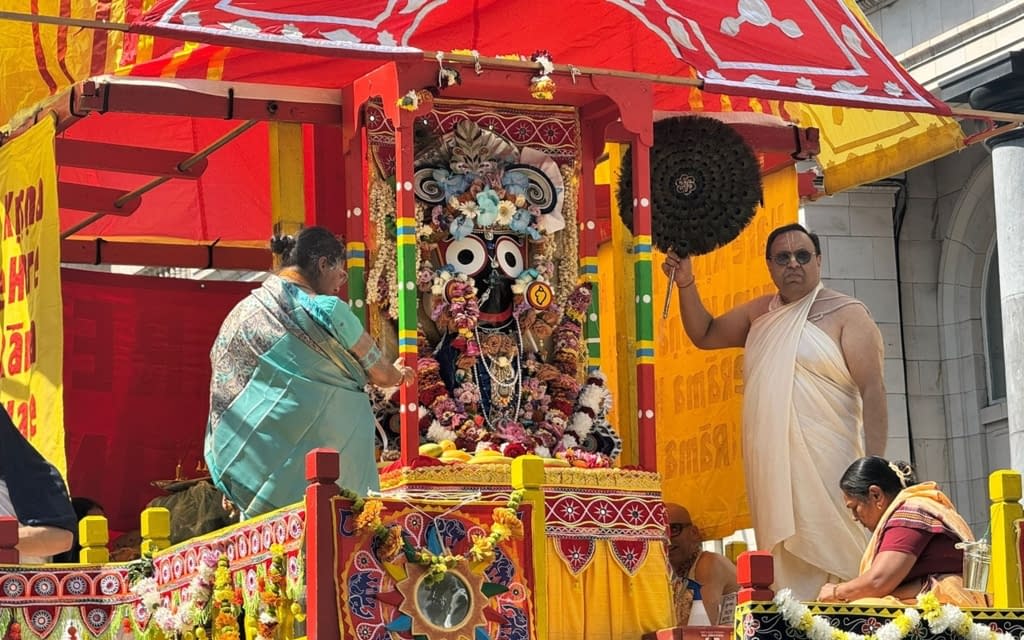
Suprabhatam at dawn serves as a sonic awakening—a gentle but formal invitation for the Lord to bless the new cycle of time. Thomala Seva then clothes the deity in a living tapestry of tulasi and seasonal flowers; the garlands’ geometry, fragrance, and color harmonize with mantra and music, embodying the aesthetics of bhakti that Vaishnava theology holds as a pathway to grace.
Koluvu follows as a courtly assembly before the presiding Lord. In this setting, the traditional aaya–vyaya (income–expenditure) report is ritually presented, signifying that sacred institutions remain answerable to the deity and, by extension, to dharma and society. On Ugadi, this ethic of transparency acquires special force as the community turns the page to Aaya Vyaya 2026-2027, aligning spiritual intention with responsible stewardship.
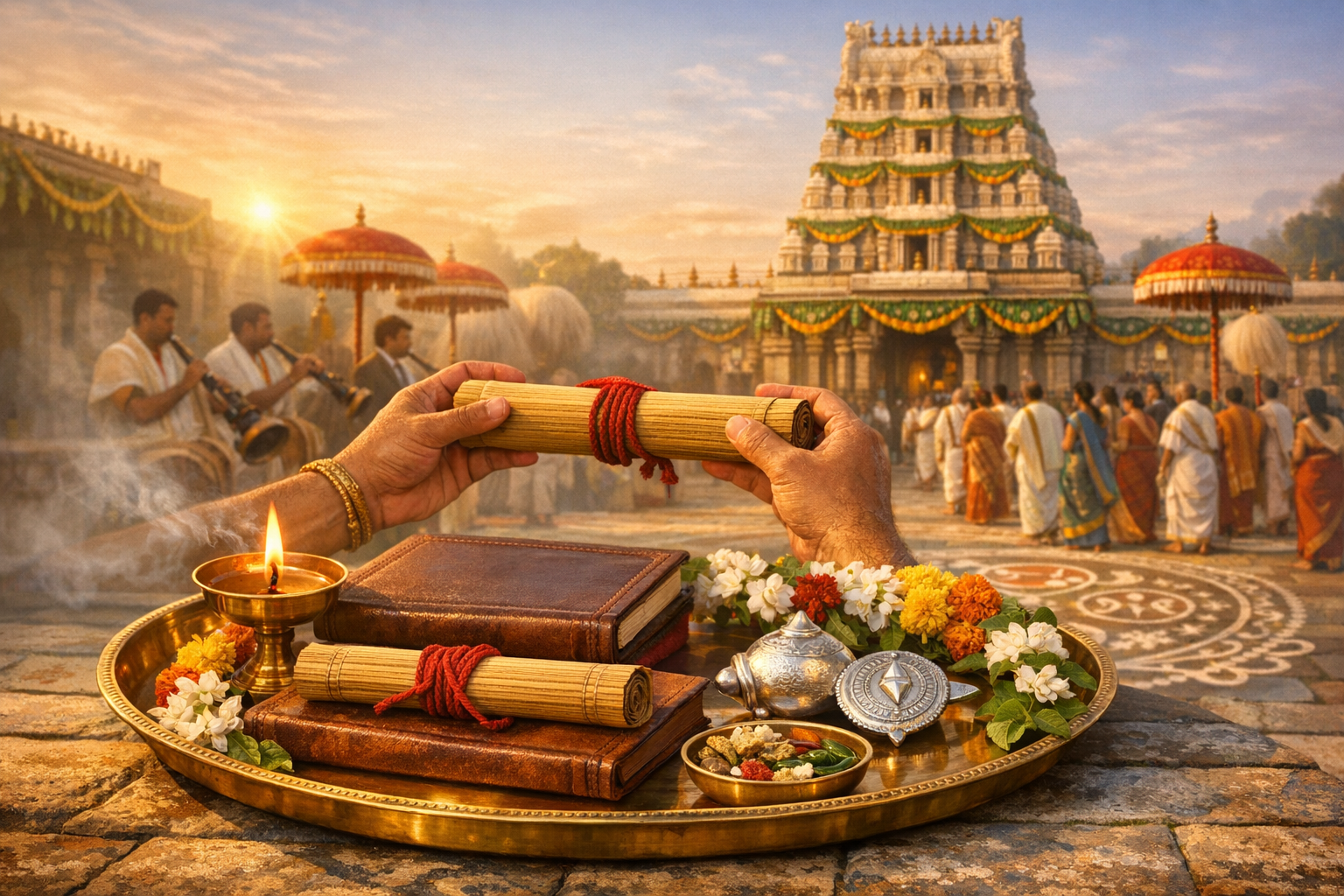
Panchanga Sravanam is the public recitation of the annual almanac for the Parabhava Nama Samvatsaram. Technically, the panchanga’s five limbs—Tithi (lunar day), Vara (weekday), Nakshatra (lunar mansion), Yoga (luni-solar conjunction), and Karana (half-day)—are read alongside summaries of graha gochara (planetary transits), eclipses, and regional muhurtas. This proclamation, compiled by panchangakaras using sidereal astronomy (drik) or traditional vakya computations, informs decisions on education, agriculture, travel, enterprise, and sadhana for the year ahead.
Archana, the litany of names offered with flowers and sanctified intent, seals the morning’s sequence by yoking individual aspirations to collective well-being. In Vaishnava praxis, nama-smarana and archana are not merely devotional; they are technologies of attention that refine the mind and ready households and institutions to inhabit the new samvatsara with clarity and restraint.
In the evening, a second Panchanga Sravanam reiterates the almanac’s essential guidance for wider congregations, culminating in the Ugadi Asthanam—an elevated ceremonial durbar that confers royal honors (maryada) upon the deity. The asthanam stands as a liturgical mirror of righteous kingship, reminding the community that justice, prosperity, and compassion must be re-enacted afresh with every cycle of time.
The experiential texture of the day is characteristically South Indian: veda-parayanam and nadaswaram set an acoustic horizon; lamps, sandalwood, and jasmine articulate a devotional atmosphere; and Thomala Seva’s flower-work renders theology visible. Devotees consistently describe a palpable sense of renewal—an emotional clarity that blends reverence with the resolve to live mindfully in the coming year.
Households in Tirupati and across Andhra Pradesh often complement temple worship with Ugadi Pachadi, a preparation that integrates six tastes to acknowledge life’s varied rasas—joy, sorrow, anger, fear, disgust, and surprise—and to embrace equanimity. The symbolism resonates widely across dharmic traditions, where spring festivities, though calendrically diverse, similarly enjoin inner balance, community harmony, and service.
Large footfalls are customary at Sri Govindaraja Swamy Temple for Ugadi. Devotees generally benefit from early arrival, adherence to the temple’s dress code, and attentive participation during sevas to preserve a serene atmosphere. TTD’s crowd-management protocols facilitate orderly darshan; however, devotees are advised to follow on-site announcements for any sequence adjustments necessitated by festival logistics.
For those new to Panchanga Sravanam, a practical approach is to note the year’s samvatsara name (Parabhava), key graha transits, and community-specific muhurtas, and to consult household elders or local scholars for contextual interpretation. Read this way, the almanac becomes a shared civic instrument—linking personal schedules to agrarian rhythms, institution timetables, and the ethics of time stewardship.
The festival also sustains Tirupati’s living heritage economy: flower growers, garland weavers, brass and bell makers, temple cooks, and musicians all contribute to the day’s sanctity. Annadanam and community service undertaken by devotees and institutions reinforce a dharmic social compact that extends beyond the temple’s walls into everyday life.
In comparative perspective, Ugadi Asthanam at Sri Govindaraja Swamy Temple parallels the observances at Tirumala, where festival asthanams and Panchanga Sravanam likewise foreground royal symbolism, liturgical precision, and public guidance. While specific sevas and timings vary by shrine and administrative needs, the shared architecture of worship across TTD temples underscores a cohesive civilizational grammar.
As Ugadi 2026 dawns, the Sri Govindaraja Swamy Temple’s sequence—Suprabhatam, Thomala Seva, Koluvu, Panchanga Sravanam, Archana, and the evening Ugadi Asthanam—offers a comprehensive pathway from awakening to accountability, from proclamation to participation. In renewing the covenant between the sacred and the social, the day invites all—devotees, residents, and visitors—to cultivate wisdom, restraint, and unity in the Parabhava Nama Samvatsaram.
Inspired by this post on Hindu Pad.