March 2026 in the Sri Venkateswara Swamy Temple at Tirumala is distinguished by three closely sequenced Asthanams: Ugadi Asthanam, Sri Ramanavami Asthanam, and Sri Rama Pattabhisheka Asthanam. These observances, traditionally conducted in the Garudalwar Sannidhi, embody the temple-court (Asthanam) ethos of Vaishnava ritual life and offer pilgrims a rare, concentrated window into the liturgical heritage curated by Tirumala Tirupati Devasthanam (TTD).
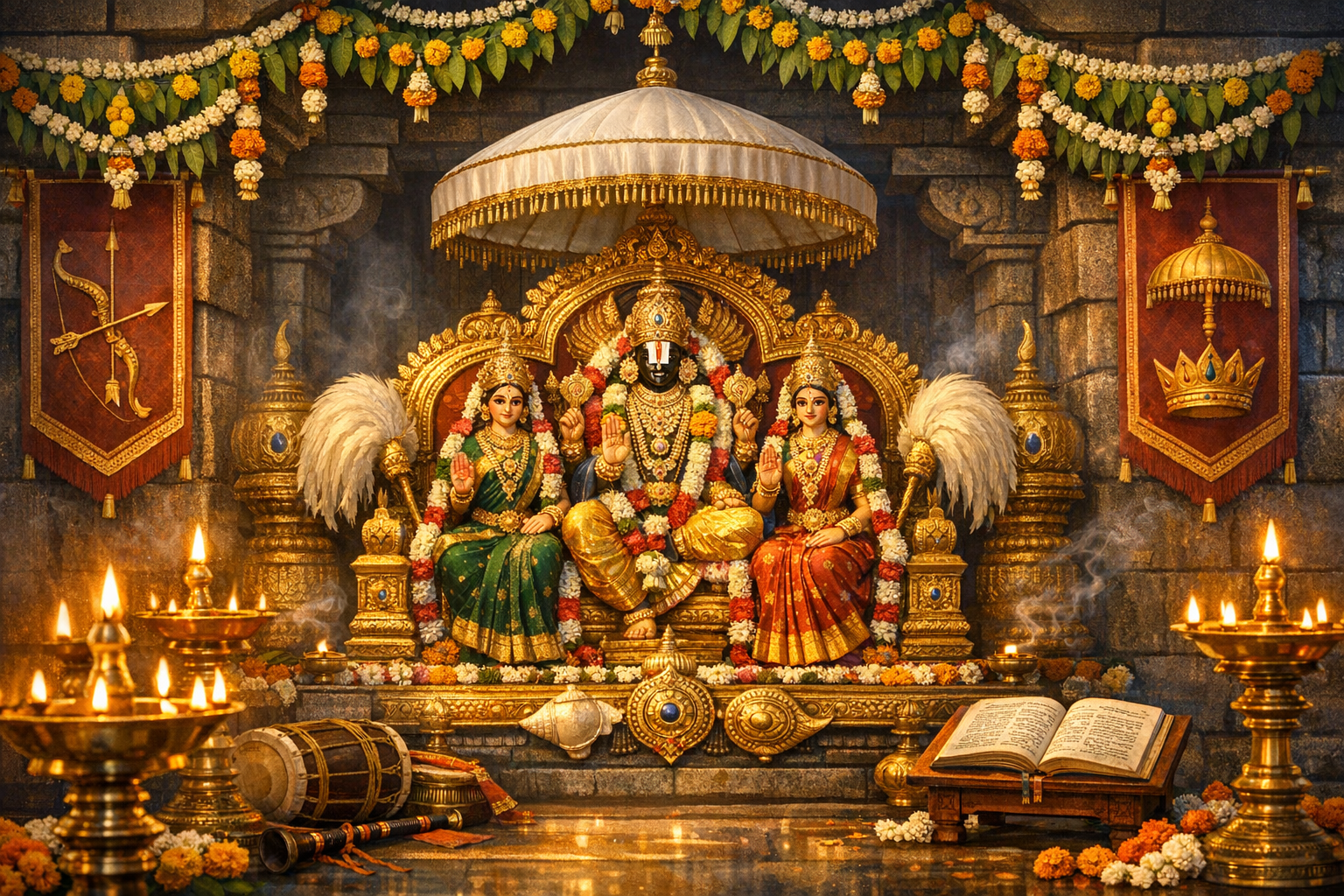
Asthanam, in the Tirumala context, denotes a formal “Temple Court” sitting in which the Utsava MurthisMalayappa Swamy with Sridevi and Bhudeviare ceremonially enthroned on a simhasana before the Garudalwar Sannidhi. The courtly frame is not symbolic pageantry alone; it is a theological statement in which the Lord is acknowledged as the sovereign, the temple as His royal court, and the assembled devotees as participants in a living continuum of dharma, seva, and saranagati (refuge).
Although exact micro-rituals vary by festival and year, an Asthanam typically integrates Veda parayanam, sankha-dhwani, mangaladhwani by temple musicians, special naivedyam, and a concluding deepa-harati. The courtly aesthetics are reinforced through ceremonial regalia such as chatra (parasol) and chamara (yak-tail fan), and through the spatial sanctity of the Garudalwar Sannidhi, where the Lord’s presence is encountered in a mode that is both intimate and majestically public.
Ugadi Asthanam inaugurates the new lunar year and, for 2026–2027, marks the advent of Parabhava Nama Samvatsaram. In Tirumala, Ugadi is not only a calendrical reset but also a spiritual recommitment aligned with Vaishnava sampradaya. The day is often accompanied by Panchanga Sravanaman exposition of the year’s almanacframed by Vedic recitations and temple protocols. Within the Asthanam, the emphasis rests on invoking auspiciousness (mangalam) for the new year, honoring the Lord as the ultimate giver of shubha-phala (benefic outcomes), and reaffirming the community’s covenant with dharma.
Sri Ramanavami Asthanam focuses devotionally on Sri Rama as Maryada Purushottamaan exemplar of dharma in action. While the Sri Rama Kalyana tradition is especially renowned in Bhadrachalam, Tirumala’s observance accords primacy to Sri Rama’s birth-tithi through courtly veneration, Ramayana parayanam in various fora, and a ritual arc that situates Rama-bhakti within the larger Vaishnava worship of Vishnu as the supreme. The Asthanam subtly bridges avatara-tattva with the living temple tradition by celebrating values associated with Rama Rajya: justice, compassion, and good governance grounded in dharma.
The Sri Rama Pattabhisheka Asthanam, usually observed on the day following Sri Ramanavami, ritually recalls the coronation of Sri Rama. This “Rajyotsava” idiom emphasizes rightful sovereignty anchored in truth, restraint, and service. In a temple-court mise-en-scène, the Pattabhisheka Asthanam publicly affirms that the Lord’s rulership is both spiritual and ethical, inviting devotees to internalize Rama’s kingship as a template for personal conduct and civic virtue.
Liturgically, these three Asthanams complement each other. Ugadi sanctifies beginnings under the aegis of the Lord’s grace; Sri Ramanavami centers the avatara’s birth as an ethical north star; Pattabhisheka enshrines righteous rulership as a societal aspiration. Taken together, March 2026 in Tirumala becomes a compact season of renewal, remembrance, and resolve.
From a procedural standpoint, TTD schedules Asthanams according to tithi and the temple’s daily and weekly seva matrix. On Asthanam days, darshan patterns may be adapted to accommodate the court ritual. Certain sevas can be curtailed, advanced, or rescheduled, and crowd management protocolsbarricading, queue diversions, and time-slot calibrationsare deployed to uphold both sanctity and safety. Pilgrims benefit from verifying official TTD notifications as dates approach, as tithi-based observances can align on different Gregorian days across regions and time zones.
Devotees who attend these Asthanams frequently describe a distinctive devotional texture: the quiet of pre-dawn Veda parayanam that gradually crescendos into the resonant soundscape of nadaswaram and tavil; the luminous arc of deepa-harati before the enthroned Lord; and the palpable collective sankalpa when the temple-court acknowledges the Lord as Dharma-samsthapanakarta (the one who establishes righteousness). The Garudalwar Sannidhi, in particular, frames this experience with a sense of proximityan ancient promise rendered immediate.
Ritual nuance at Tirumala follows the Vaikhanasa Agama. In an Asthanam sequence, one may witness elements such as astottara-archana, select alankaras suited to the festival’s mood, and special naivedyams, followed by satari (Sri Vaishnava insignia) blessings and prasada distribution. While abhishekam (tirumanjanam) is central to other days and contexts, the Asthanam’s courtly core is the enthronement itself, framed by hymns, honorifics, and disciplined liturgical choreography.
The cultural-historical grammar of Asthanam deserves emphasis. In pre-modern South India, kingship and temple ritual were mutually illuminating idioms; the temple often stood as the axis of civic life. Asthanam, therefore, survives not as an archaism but as a living pedagogy of leadership and accountability. When Sri Rama’s Pattabhisheka is recalled in courtly form, it signals a continuity between mythic exemplarity and contemporary ethical strivingreminding the community that values like satya (truth), daya (compassion), and niyama (discipline) are actionable in personal and public spheres.
These observances resonate widely across the dharmic family. While the ritual language here is Vaishnava and temple-centric, the ethical grammarnon-violence, truthfulness, generosity, self-discipline, and reverence for all lifeharmonizes with the philosophical streams of Hinduism, Buddhism, Jainism, and Sikhism. In this light, the March 2026 Asthanams at Tirumala are not only sect-specific ceremonies but also civilizational reminders of shared ideals and interrelated spiritual aspirations.
For pilgrims planning travel, a few practical considerations enhance the experience. Traditional attire is welcomed; punctual arrival for morning observances is advisable; and attention to queue guidance is essential on high-footfall days. Hydration, patience, and mindful participation ensure that the communal rhythm of darshan remains smooth for all. Those traveling with elders or children may benefit from allocating additional buffer time and selecting darshan windows that avoid peak congestion around the core Asthanam hours.
Ugadi-specific cues include engaging with the Panchang thoughtfully: Parabhava Nama Samvatsaram can be approached as a sankalpa yearsetting intentions that align personal duties (svadharma) with societal well-being (lokasangraha). For Sri Ramanavami and Pattabhisheka, Ramayana remembrance is especially resonant; even brief parayanam of Sundara Kanda narratives can enrich the temple-court experience, linking textual devotion with liturgical presence.
From a heritage perspective, the Garudalwar Sannidhi setting is crucial. Garuda, the eternal vahana of Vishnu, embodies unwavering devotion and service; situating the court in front of Garuda implicitly frames the assembly as a covenant of service. This spatial theologydeity, devotee, and divine envoy aligned in a single axishelps explain why the Asthanam is often recalled by pilgrims as the most “participatory” among festival modes: one is not merely watching; one is standing in court as a loyal subject.
The broader liturgical calendar around March involves Chaitra month rhythms, when many Vaishnava and Shaiva observances adopt a springtime hue of renewal. In Tirumala, these rhythms are carefully interwoven with daily, weekly, and monthly sevas to safeguard both continuity and intensity. The March 2026 triad of Ugadi, Sri Ramanavami, and Sri Rama Pattabhisheka exemplifies how TTD integrates calendrical precision with experiential depth.
While precise Gregorian dates and session timings are governed by lunar tithis and TTD’s operational planning, the following broad sequence can be anticipated: Ugadi Asthanam (Chaitra Shukla Pratipada), Sri Ramanavami Asthanam (Chaitra Shukla Navami), and Sri Rama Pattabhisheka Asthanam (typically Chaitra Shukla Dasami). Devotees are encouraged to consult TTD’s official notifications close to the events for final confirmation of timings, entry advisories, and any seva adjustments.
For those seeking a study pathway, the Asthanam season is an invitation to explore the Vaikhanasa Agama, the architecture and procession routes of the Srivari Temple, and the aesthetic grammar of alankara that changes with each festival. Even a modest engagementlearning the meaning of common honorifics, or the symbolism of chatra and chamaracan yield a more informed and inwardly connected darshan.
In sum, the March 2026 Asthanams at Tirumala are not discrete spectacles but stages in a continuous discipline of remembrance: Ugadi renews the covenant of time under the Lord’s grace; Sri Ramanavami centers ethical heroism; and Pattabhisheka enthrones righteous sovereignty. Together, they shape a sacred arc that invites devotees to return home not only with prasadam and memories, but with a clarified resolve to embody dharma across family, community, and society.
Note on scheduling and accuracy: All festival observances are subject to the TTD calendar, which aligns strictly to tithi. As dates approach, official TTD communications remain the definitive source for timings, route management, seva availability, and darshan advisories.
Inspired by this post on Hindu Pad.