
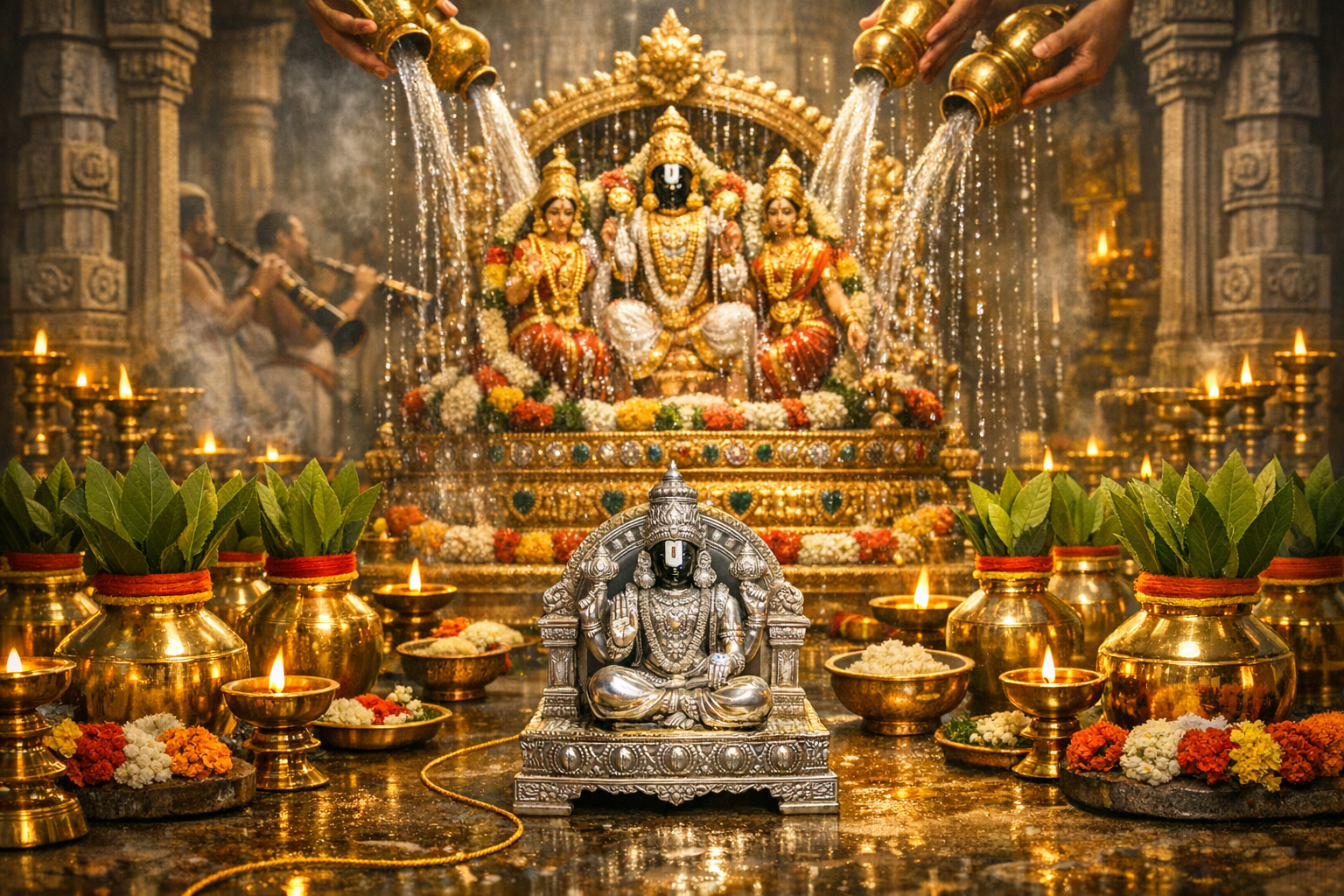
On 24 June 2026, the annual Special Sahasra Kalashabhishekam will be observed in the sanctum precincts of the Tirumala Sri Venkateswara Temple under the auspices of Tirumala Tirupati Devasthanam (TTD). The observance commemorates the epochal donation of the silver icon “Bhoga Srinivasamurty” by the Pallava Queen Samavai Perundevi—an act of patronage preserved in temple epigraphy and celebrated in living ritual.
Bhoga Srinivasamurty (also spelled Bhoga Srinivasa Murti) is a compact silver icon intimately associated with the immovable principal deity (moolavirat) of Sri Venkateswara. In Tirumala praxis, this icon serves in select daily services (notably bhoga and ekanta seva) and is ritually linked to the moolavirat by a symbolic sambandha—traditionally described as a delicate cord—signifying unbroken service, continuity of presence, and the transmission of grace.
The Sahasra Kalasabhishekam—also spelled Sahasra Kalashabhishekam—is a hallmark Vaishnava ablutional rite at Tirumala. While a regular mid-week Sahasra Kalasabhishekam is performed for the utsava murtis—Sri Malayappa Swamy with Sridevi and Bhudevi—the annual Special Sahasra Kalashabhishekam on 24 June 2026 is distinct in that it explicitly honors the historic meaning of Queen Samavai Perundevi’s endowment of Bhoga Srinivasamurty. The event thus weaves together historical remembrance, textual fidelity, and communal devotion.
The liturgical architecture of the observance follows the Vaikhanasa Agama as practiced at Tirumala. Preparations typically begin with Ankurarpanam (the seed‑sowing rite) on the preceding evening, invoking growth, purity, and auspiciousness. On the festival morning, priests undertake sankalpa (formal vow), achamana (ritual purification), and kalasha‑sthapana (installation of sacred vessels), accompanied by Vedic recitations such as Purusha Sukta, Narayana Sukta, and Sri Sukta, along with Sri Vaishnava divya prabandham. These recitations frame the rite in scriptural resonance and doctrinal clarity.
Each kalasha customarily contains sanctified tirtha prepared with fragrant and sattvika substances—tulasi leaves, sandal, camphor, and select herbal infusions—sealed with auspicious leaves (often mango) and adorned with vastra and sacred threads. The array of kalashas is arranged on a consecrated peetha within the mandapa; through mantra, mudra, and nyasa, divinity is invoked (avahana) into the waters, making the vessels carriers of consecratory power.
The abhisheka proceeds in a graded sequence: streams of sanctified water from the sahasra kalashas are ceremonially poured over the utsava murtis, interspersed with stotra recitations and a resonant soundscape of nadaswaram and percussion. The rite culminates in the pouring of a maha‑kalasha (principal vessel), bringing the ablution to completion with purnahuti (final oblation) and benedictions that extend to all assembled.
Following the ablution, alankara (adornment) and archana (worship) are performed, concluding with harati, nivedana, and the bestowal of teertha and satari to devotees. The carefully choreographed transition—from ritual bathing to ornamentation and offering—embodies the Indic idea that purity, beauty, and worship are integrally connected stages of divine service (seva).
The theological significance of a “thousand” in Sahasra Kalashabhishekam extends beyond enumeration. In Indic thought, sahasra signals plenitude and cosmic completeness, echoing the sahasranama traditions where the Divine is praised through a thousand attributes. The Tirumala rite thus locates the community within a felt sense of wholeness and continuity, re‑affirming shared devotion through the tactile medium of consecrated waters.
Historically, remembrance of Samavai Perundevi during this observance underscores the formative role of women patrons in South Indian temple culture. Her silver icon, preserved in daily worship and annual utsavas, stands as an enduring bridge between Pallava‑era generosity and contemporary practice, illustrating how inscriptions and endowments are animated in living liturgy.
In a broader dharmic horizon, ablution with consecrated water and the use of the kalasha are shared civilizational motifs. Jain pratishtha employs kalasha‑based consecrations; Vajrayana Buddhist abhisheka transmits blessing through sanctified waters; and the Sikh Amrit Sanchar prepares sanctified nectar in the bata. These cognate practices—each grounded in its own theology—reflect a common commitment to purification, ethical living, and service, values that unite Hinduism, Buddhism, Jainism, and Sikhism.
For devotees and researchers alike, 24 June 2026 offers a living case study in ritual continuity at one of the world’s most visited pilgrimage centers. Observant participation—punctuality, silence during recitations, modest attire, and receptivity—enhances both personal experience and communal sanctity, allowing participants to engage the rite with attentiveness and respect.
From a heritage perspective, the Special Sahasra Kalashabhishekam demonstrates how intangible ritual knowledge, artisanal temple arts, and textual canons cohere in practice. The alignment of symbolic elements—kalasha, mantra, music, and procession‑ready utsava murtis—renders the event a vital node in Tirumala’s cultural memory and a touchstone for comparative dharmic studies and temple‑ritual scholarship.
As the temple marks this annual observance, the triad of history, ritual precision, and inclusive devotion remains central. Commemorating Bhoga Srinivasamurty within the Sahasra Kalashabhishekam not only honors a Pallava queen’s timeless gift but also invites shared contemplation on unity, service, and the sustaining power of sacred traditions across the dharmic family.
Inspired by this post on Hindu Pad.










Leave a Reply
You must be logged in to post a comment.