
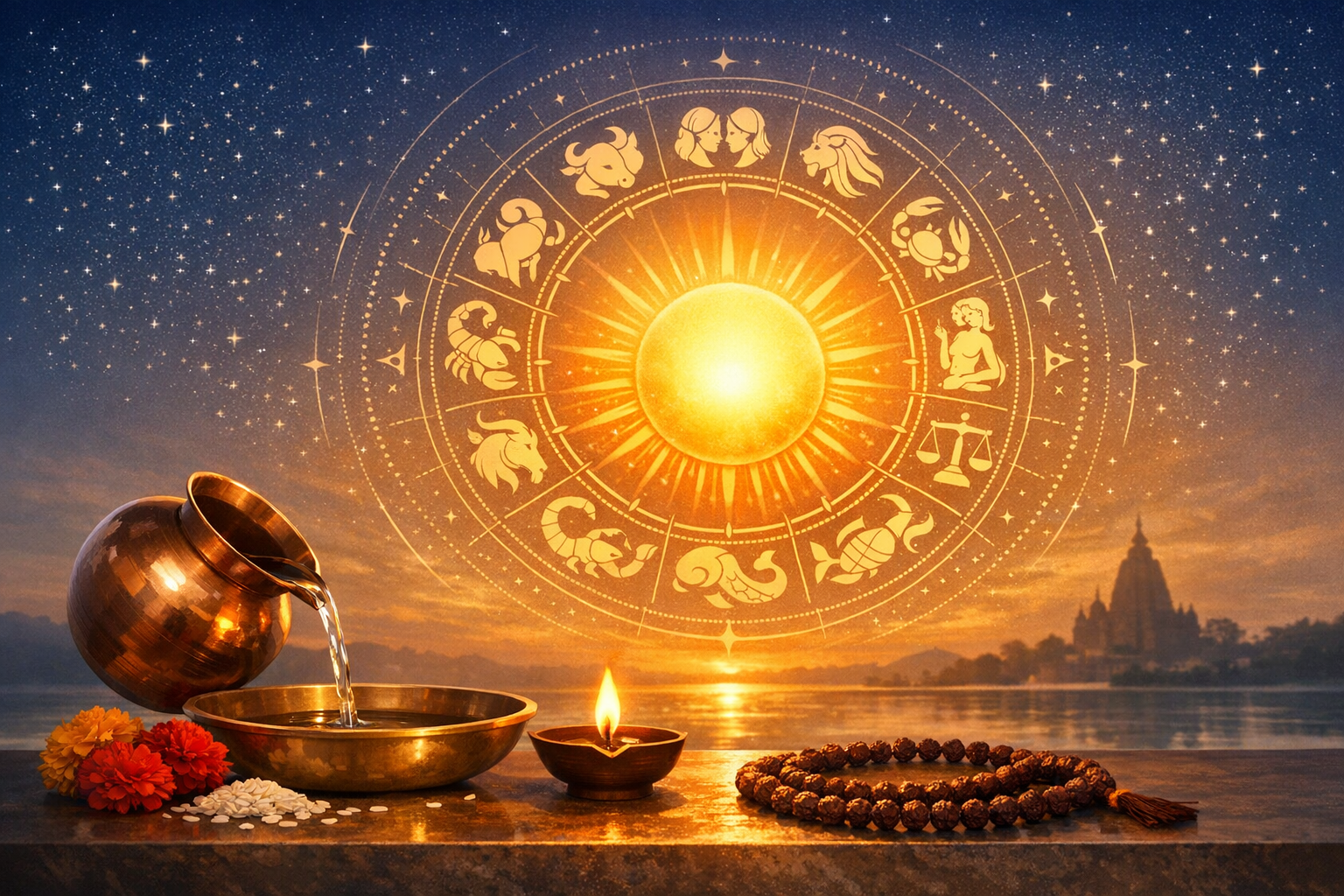
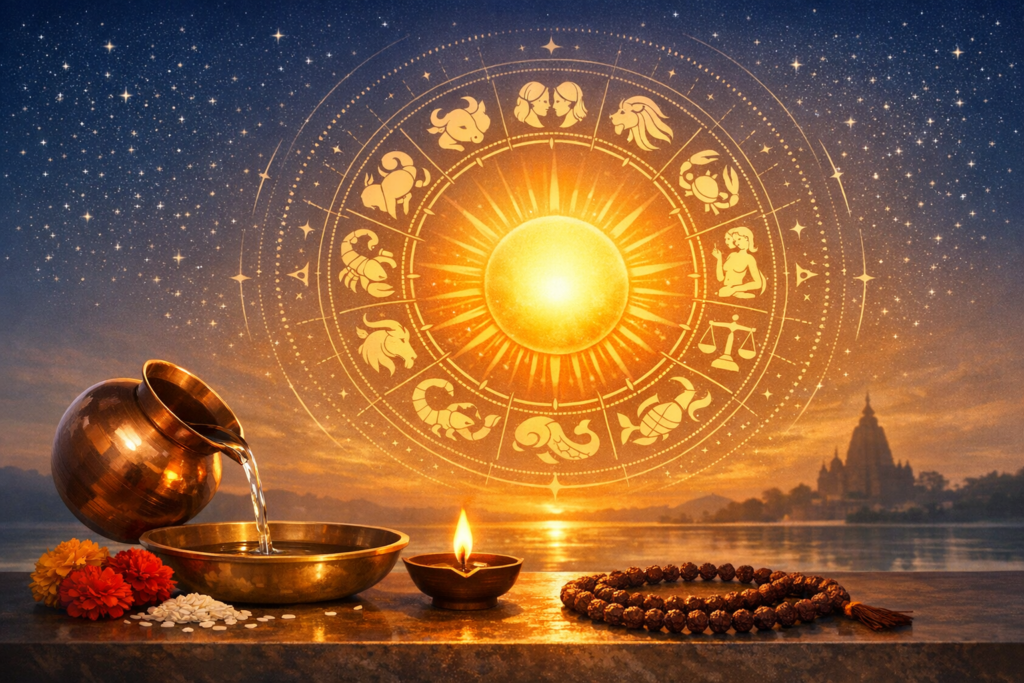
Rashi Vrata, as preserved in classical Hindu sources, is a structural and cosmically aligned vow mapped to the solar calendar rather than to lunar weekdays or a natal Moon sign. Unlike modern fasting practices that often tie observances to a weekday associated with one’s Janma Rashi, this vrata is synchronized with the Sun’s ingress (Sankranti) into each of the twelve rashis, making it a yearlong discipline that mirrors the Vedic solar rhythm (saura māna). The framing found in the Bhavishya Purana—particularly within the Prakirna (miscellaneous vows) chapters that also discuss observances such as Agneya and Yoga vratas—and later Dharmashastra digests presents Rashi Vrata as an ordered, month-by-month sadhana structured around cosmic time.
Scripturally, the logic is straightforward and elegant: the Sun (Surya) is the visible lord of time (kāla), the guarantor of day, season, and year. Aligning vrata-discipline to Surya’s transit through the twelve rashis harnesses a stable astronomical anchor, giving practitioners a predictable cadence that is uniform across regions. This solar anchoring differs from tithi- or weekday-based vrat traditions by offering a macro-cyclical framework—twelve linked observances across the year—intended to cultivate steadiness, clarity, and ethical purpose (dharma).
Calendarically, Rashi Vrata follows the sidereal solar year used in Vedic and regional Hindu calendars. Each Saṅkrānti marks the Sun’s entry into a new rashi: Mesha, Vrishabha, Mithuna, Karka, Simha, Kanya, Tula, Vrischika, Dhanu, Makara, Kumbha, and Meena. Practitioners typically consult a trustworthy pañcāṅga to determine the exact Saṅkrānti timing and the associated punya-kāla (auspicious window). Local sampradaya guidance helps determine whether worship begins at the precise moment of Saṅkrānti or at the next sunrise, a nuance that can vary by regional practice and temple tradition.
The rationale for a solar vow is both spiritual and practical. Surya is revered in the Vedic corpus as a witness to right conduct and a source of illumination—outer and inner. A vow synchronized with Sankranti leverages that symbolic and astronomical regularity to foster a disciplined life rhythm. Over twelve months, this regularity encourages resilience, measured resolve, and an ethic of service, allowing the observance to become a scaffold for steady self-cultivation rather than a sequence of ad hoc fasts.
Eligibility is intentionally broad. Householders, students, professionals, and renunciants can all undertake Rashi Vrata, with adaptations recommended according to age, health, and daily duties (svadharma). The observance, when approached with humility and sincerity, can be integrated into household puja traditions as well as community gatherings, reinforcing a shared spiritual cadence within and across Dharmic communities.
Core elements commonly shared across vrata literature provide a reliable outline for Rashi Vrata. They include a clear sankalpa (intent statement) at each Saṅkrānti, a purificatory snāna (bath), a calibrated upavāsa (fast) appropriate to one’s health, and a focused period of japa, dhyāna, and puja. Offering arghya (water oblation) to Surya at sunrise, lighting a deepa (lamp), and maintaining a spirit of mauna or restrained speech to reduce distraction are frequent components. As with most vratas, the specifics are shaped by local sampradaya and acharya guidance.
In devotional practice, Rashi Vrata often includes Surya-oriented recitation and contemplation. Many traditions incorporate hymns such as Aditya Hṛdayam or general Vedic stotras to Surya, while others emphasize the Gayatri mantra or simple nama-japa. The 12 Adityas—Mitra, Ravi, Surya, Bhanu, Khaga, Pushan, Hiranyagarbha, Marichi, Aditya, Savita, Arka, and Bhaskara—provide a contemplative scaffold through which devotees reflect on light, vitality, order, and discernment. The goal is not ritual complexity but steady attention and sincerity.
Offerings are typically simple and symbolically resonant. Arghya with clean water and akshata (unbroken rice), red or saffron-hued flowers, and deepa-puja are widespread. In some regions, practitioners add wheat, jaggery, or ghee to signify solar warmth and nourishment, followed by anna-dāna (food sharing) to persons in need. The dāna (charity) portion of the vrata is integral, converting inner restraint into outer care and ensuring that spiritual discipline is inseparable from social responsibility.
Ethical commitments (yamas and niyamas) stabilize the vow. Truthfulness (satya), non-harming (ahimsa), restraint (brahmacharya in conduct appropriate to one’s station), contentment (santosha), cleanliness (shaucha), and a commitment to learning (svādhyāya) transform Rashi Vrata from a calendrical routine into a character-shaping discipline. By centering intention and conduct, the observance prioritizes inner refinement over external display.
Across the twelve Saṅkrāntis, traditional associations of each rashi offer thematic reflections that many find meaningful: initiative and right beginnings (Mesha), stability and stewardship (Vrishabha), learning and dialogue (Mithuna), care and belonging (Karka), courage and responsibility (Simha), precision and purification (Kanya), balance and fairness (Tula), depth and transformation (Vrischika), wisdom and dharma-study (Dhanu), duty and perseverance (Makara), community and service (Kumbha), and compassion and release (Meena). These contemplative lenses are optional aids for reflection, not restrictions.
Rashi Vrata complements—rather than competes with—lunar or weekday observances. Those who observe Somavar Vrat for Shiva, Ekadashi for Vishnu, or other lunar vows can retain those practices while allowing Rashi Vrata to supply a solar backbone across the year. Many householders report that the solar cadence reduces decision fatigue by anchoring one substantive observance each month.
From a health perspective, upavāsa should be adapted to constitution and context, in harmony with Ayurvedic prudence. For some, a water-only fast is neither feasible nor advisable; fruit-based or light-sattvic meals (ekabhukta) may be more appropriate. The emphasis is on mindful restraint and clarity, not on competitive austerity. Medical guidance is sensible where needed, and compassionate self-assessment is always in order.
In practical terms, beginning at any Saṅkrānti is acceptable, though many start with Makara Saṅkrānti (Uttarayana) for its auspicious symbolism of northward solar movement. A simple field-tested routine would include: consulting a reliable pañcāṅga for Saṅkrānti and punya-kāla; preparing a clean space with water, lamp, and flowers; taking snāna; making a concise sankalpa; offering arghya to Surya; engaging in japa or stotra recitation; performing deepa-puja; and concluding with dāna and a brief diary note to track continuity and insights across the twelve months.
Practitioners frequently describe subtle yet cumulative benefits: improved time-discipline, gentler mornings shaped by sunrise remembrance, clearer priorities, and a keener sense of cyclical balance as seasons change. The vow’s solar regularity encourages alignment with circadian rhythms, often enhancing sleep and focus. Just as importantly, the monthly dāna transforms private devotion into shared wellbeing.
The observance also nurtures community and intergenerational connection. Families often gather on Saṅkrānti for shared puja and prasad, with elders transmitting simple procedures and meanings to children in a natural, unforced way. In community settings, group recitations, collective anna-dāna, and seasonal service projects at each Saṅkrānti can deepen bonds and sustain motivation through the year.
In a broader Dharmic frame, Rashi Vrata resonates with sister traditions. Buddhism’s Uposatha days, Jain fortnightly pratikraman cycles, and the Sikh Nanakshahi calendar all attest to the healing power of shared, cyclical observances. While each path preserves its integrity, they converge on discipline, ethical conduct, and service as non-negotiables of spiritual life. Recognizing this shared emphasis strengthens mutual respect and unity across Dharmic communities.
Those inclined toward calendar studies may appreciate the vrata’s astronomical underpinnings. The sidereal solar months (saura māsa) are defined by Surya’s ingress into each rashi, a cornerstone of Vedic calendar science (Jyotisha). Regional calendars—from Tamil Chithirai to Malayalam Medam and beyond—reflect the same solar transitions, even as naming conventions vary. Engagement with these systems fosters cultural literacy alongside spiritual practice.
Common questions admit simple answers. Does Rashi Vrata require a particular deity beyond Surya? It does not; Surya worship is broadly appropriate, and one’s Ishta Devata can be honored within the same observance. Must the vow tie to one’s natal chart? No; the vow is solar-structural and universal, though some choose personal reflections inspired by transit meanings. Can missed months be “made up”? Local guidance varies; steadiness and sincerity are valued more than perfectionism.
As with all vratas, local acharyas and family elders are wise guides. Variations across regions are not errors but expressions of a living tradition adapting to context while preserving a common spine—Saṅkrānti, sankalpa, restraint, worship, and charity. The spirit is to honor time, purify intention, and serve life.
In sum, Rashi Vrata offers a comprehensive, yearlong, solar-aligned discipline that is both classical and eminently practical. It integrates worship and ethics, solitude and service, astronomy and spirituality. By stepping into the Sun’s rhythm at each Saṅkrānti, practitioners cultivate steadiness, gratitude, and shared responsibility—qualities that nourish the individual while strengthening the wider Dharmic family.
Inspired by this post on Hindu Pad.







Leave a Reply
You must be logged in to post a comment.