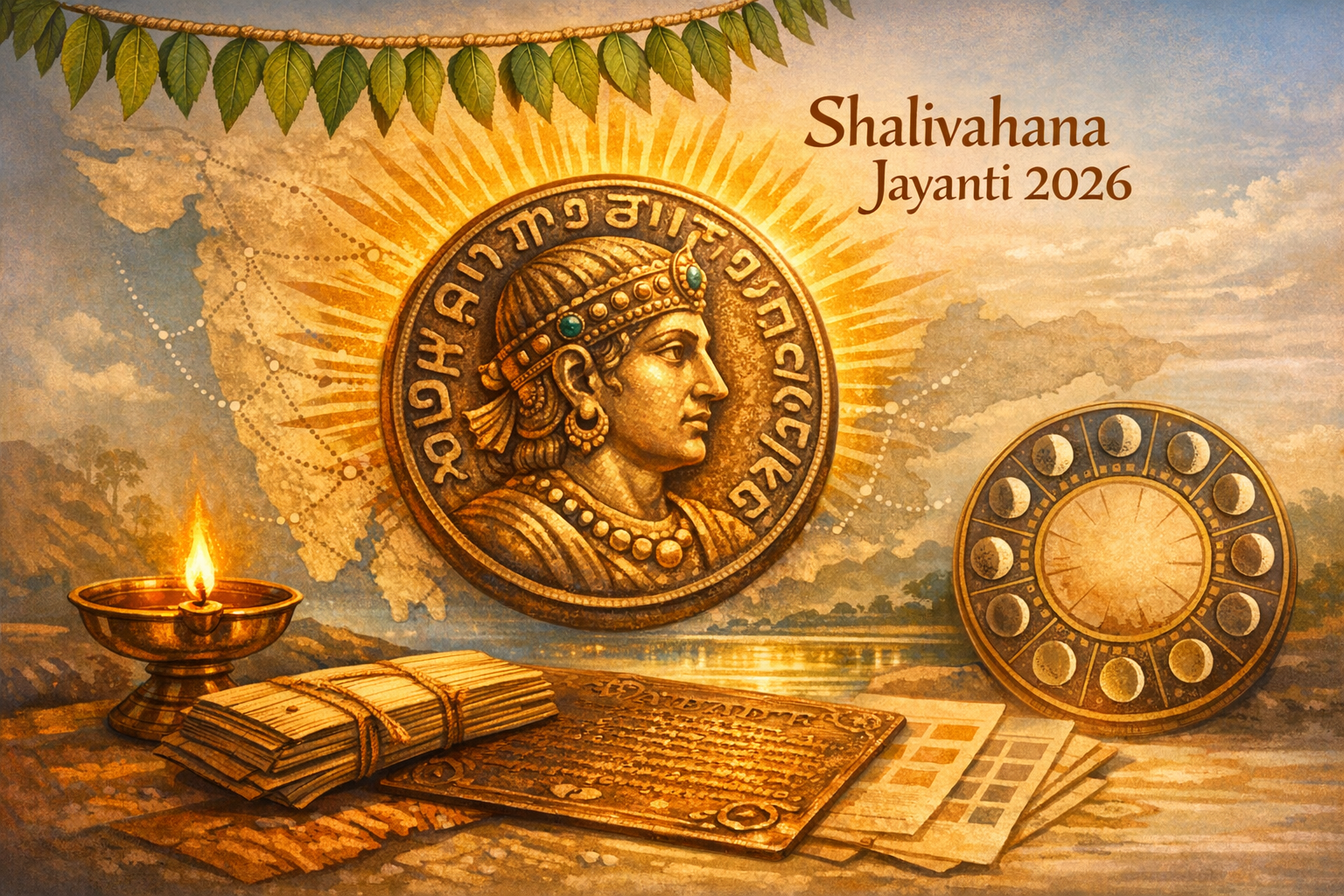
Shalivahana Jayanti in 2026 falls on Saturday, March 28, corresponding to Dashami in Shukla Paksha of the Chaitra month (often referred to as Chaitra Vijaya Dashami). This observance commemorates King Shalivahana—widely identified in traditional narratives with Gautamiputra Satakarni, the preeminent Satavahana ruler—and foregrounds a civilizational legacy that shaped time-reckoning, statecraft, and cultural life across the Deccan and far beyond.
By Hindu calendar convention, Jayanti observances are aligned to the lunar tithi rather than the civil date, and local sunrise determines the applicable day for rituals. Because the progression of tithis can shift across time zones, communities worldwide consult a regional Panchang to ensure Dashami prevails at sunrise. In 2026, mainstream Panchang listings recognize March 28 as the appropriate date for Shalivahana Jayanti across most locations.
King Shalivahana is traditionally associated with Gautamiputra Satakarni (c. 2nd century CE), whose reign consolidated Satavahana power in the Deccan. The Nashik (Nasik) Prashasti of Gautami Balashri (Gautamiputra’s mother) memorializes his political and ethical stature, describing the ruler’s commitment to dharma, the reordering of territorial boundaries after conflict, and the protection of subjects and sages. The Satavahana court, with centers such as Pratishthana (Paithan), presided over a crucial phase of post-Mauryan Deccan history marked by administrative innovation, thriving inland and maritime trade, and patronage that fostered Vedic, Buddhist, and Jain traditions in tandem.
Equally central to Shalivahana Jayanti is the Shaka (Saka) era—often called the Shalivahana Shaka—whose epoch begins in 78 CE. The era underpins the Indian national calendar (Saka Samvat) adopted for official use in 1957, in which the New Year begins on Chaitra 1 (typically March 22, or March 21 in leap years). In 2026, Saka Samvat 1948 commences on March 22, placing Chaitra Shukla Dashami within the first fortnight of the national calendar year and aligning the commemoration with the season of spring renewal in Bharatavarsha.
The Shaka era’s influence extends across South and Southeast Asia. It structures the Balinese Saka calendar in Indonesia and historically informed the Javanese calendrical tradition. Elements of Saka-based or related reckoning appear in Southeast Asian epigraphy and calendrical practice, reflecting deep intercultural links forged through shared dharmic ideas, trade, and scholarly exchange. This interconnectedness resonates with the broader unity among Hindu, Buddhist, and Jain traditions, and invites Sikh communities to appreciate the region’s civilizational syncretism and shared timekeeping heritage.
Historical and cultural context enriches the observance. The Satavahana polity bridged the northern and southern subcontinent through routes that connected the Deccan to ports such as Sopara and Bharuch, sustaining exchange with the western Indian Ocean world noted in works like the Periplus of the Erythraean Sea. Satavahana coinage—Prakrit legends in Brahmi script—speaks to standardized governance and commercial sophistication. Artistic and religious activity in sites like Amaravati and the Western Deccan cave complexes reflects a milieu in which multiple dharmic lineages flourished without contradiction.
For households and communities, Chaitra Shukla Dashami offers a meaningful framework to celebrate values often linked to the Satavahana legacy: dharma (ethical order), kshatra (courage guided by restraint), nyaya (justice), and lokasangraha (welfare of the many). Families often begin with a simple sankalpa after sunrise, followed by puja to one’s Ishta Devata and venerable ancestors, svadhyaya (study) that includes readings on Satavahana history, and annadana or charitable acts directed toward educational or health causes. Seasonal vegetarian offerings—light, fresh preparations featuring early-spring produce—underscore the Chaitra ethos of renewal and clarity.
Temples and community organizations frequently mark the day with lectures on the Shaka era, exhibitions of coins and inscriptions, and recitations drawn from classical sources that illuminate the ethical grammar of statecraft in ancient India. In regions linked to Satavahana memory—such as Maharashtra, Telangana, and Andhra Pradesh—heritage walks or study circles revisit Pratishthana (Paithan), the Nashik caves, and the Amaravati-Nagarjunakonda archaeological landscape, instilling historical literacy alongside reverence.
Chaitra Vijaya Dashami in this context is not to be confused with Ashwin Shukla Dashami (the autumnal Vijaya Dashami of Dussehra). The Chaitra observance highlights spring’s victorious renewal of sattva (clarity and balance) and the ethical alignment associated with the New Year cycle in the Saka Samvat, while the Ashwin festival culminates the Navaratri arc later in the year. Both, however, enshrine a shared principle: the triumph of dharma when nurtured through knowledge, discipline, and compassion.
For students of time-reckoning, a technical note clarifies usage: on or after March 22, Saka Year (SY) = Gregorian Year (GY) − 78; prior to that date in a given Gregorian year, SY = (GY − 79). Thus, March 28, 2026 aligns with Saka 1948, Chaitra Shukla Dashami. In ritual practice, the tithi prevails over the weekday; hence, if regional Panchang calculations adjust the Dashami window, observants prioritize the tithi present at local sunrise.
Shalivahana Jayanti also provides a constructive opportunity for inter-traditional dialogue. The coexistence of Saka Samvat with Vikrama Samvat, regional solar calendars, and monastic and temple ritual calendars across Hindu, Buddhist, and Jain communities demonstrates India’s civilizational comfort with plurality in timekeeping—multiple precise methods serving diverse ritual and civil needs without eroding unity. Sikh communities, while guided by distinct calendrical conventions, often participate in shared commemorations and community service in the same season, advancing the common dharmic ethic of seva and social harmony.
Historiographically, the identification of Shalivahana with Gautamiputra Satakarni appears widely in traditional accounts and in popular memory, while academic discussions parse nuances among inscriptions, coin series, and Purana-derived lists. Regardless of scholarly debates on nomenclature, the era’s lived significance—as a backbone of calendrical practice and a symbol of ethical kingship in the Deccan—remains clear. The Nashik inscriptions, Satavahana coin hoards, and archaeological horizons in the Krishna-Godavari basin offer a robust dossier for further study.
In 2026, the proximity of Shalivahana Jayanti to Ugadi/Gudi Padwa and Sri Rama Navami (all within the blossoming arc of Chaitra) encourages families to integrate the festival into a month-long rhythm of reflection and renewal. Many households choose a moment of collective remembrance—speaking about the duties of just leadership, the primacy of social welfare, and the call to preserve heritage—as a practical expression of lokasangraha.
Travelers and heritage enthusiasts may deepen engagement by visiting museums and epigraphic galleries that feature Satavahana material culture, or by supporting documentation efforts that preserve inscriptions and temple records. Such initiatives align cultural pride with scholarly rigor, ensuring that reverence is anchored in evidence and that community narratives are enriched by careful study.
Ultimately, Shalivahana Jayanti serves as both commemoration and compass. The day venerates a ruler remembered for restoring equilibrium in the Deccan and celebrates the Shaka era that still regulates the Indian national calendar and informs timekeeping across parts of Southeast Asia. Observed thoughtfully—through puja, charity, study, and community dialogue—Chaitra Shukla Dashami becomes a living classroom where shared dharmic values are learned, felt, and transmitted with dignity and unity.
Inspired by this post on Hindu Pad.