
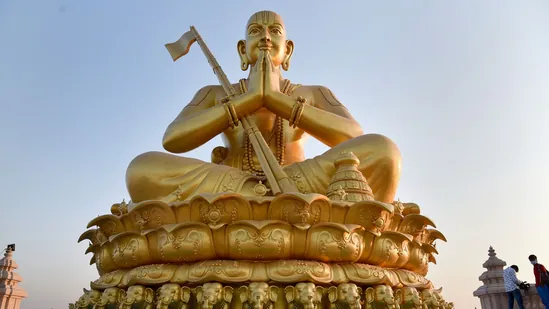
India is a land of festivals, and each festival has a unique significance and story behind it. Ramanujacharya Jayanti is one such festival that celebrates the birth anniversary of Ramanujacharya, one of the most prominent saints in Hinduism. This festival is celebrated with great enthusiasm and devotion in various parts of India, especially in the southern states.
Ramanujacharya Jayanti is a festival that celebrates the birth anniversary of Ramanujacharya, one of the most prominent saints in Hinduism. It is celebrated on the day of Vaishakha Purnima, which falls in the Hindu month of Vaishakha (April/May). This year, it falls on Tuesday, April 25, 2023.
Thiruvathirai Nakshathram Begins – 04:37 PM EST on Apr 24, 2023
Thiruvathirai Nakshathram Ends – 06:51 PM EST on Apr 25, 2023
Ramanujacharya was born in the year 1017 CE in Sriperumbudur, Tamil Nadu. He was a philosopher, theologian, and a great exponent of the Vishishtadvaita philosophy.
Life of Saint Ramanujacharya

The life of Ramanujacharya is a story of devotion and selflessness. He dedicated his life to the service of God and to the welfare of the people. Ramanujacharya’s teachings were based on the concept of Vishishtadvaita, which means “qualified non-dualism.” According to this philosophy, the Supreme Being is one and is characterized by qualities such as knowledge, power, and compassion. However, the individual souls are not separate from the Supreme Being, but are rather a part of it. Ramanujacharya emphasized the importance of devotion to God, and believed that it was the path to liberation.
Ramanujacharya Jayanti Celebration

The celebrations of Ramanujacharya Jayanti are held with great zeal and enthusiasm in various parts of India, especially in the southern states. Special prayers and rituals are performed in temples dedicated to Ramanujacharya, such as the Ranganathaswamy Temple in Srirangam, Tamil Nadu. Devotees also offer food, flowers, and other offerings to the deity. One of the unique customs followed during Ramanujacharya Jayanti is the recitation of the “Ramanuja Nootrandhadhi,” a collection of 108 verses in praise of Ramanujacharya. Devotees also sing devotional songs and bhajans in his honor. In addition, special lectures and discourses are organized to spread the teachings of Ramanujacharya.
Significance of Ramanujacharya Jayanti

Ramanujacharya Jayanti holds great significance for Hindus, especially those who follow the Vishishtadvaita philosophy. It is a time to reflect on the life and teachings of Ramanujacharya, and to deepen one’s understanding of his philosophy. It is also an occasion to seek the blessings of the saint and to renew one’s commitment to the path of devotion.
Teachings of Ramanujacharya

As mentioned before Ramanujacharya (1017-1137 CE) was a great saint, philosopher, and theologian in Hinduism. He was born in Sriperumbudur, Tamil Nadu, and is widely regarded as one of the most important exponents of the Vishishtadvaita philosophy. His teachings have had a profound impact on the religious and philosophical landscape of India. In this article, we will explore the key teachings of Ramanujacharya, and how they have shaped the Hindu tradition.
His teachings provide a Sanatan framework by highlighting the following key aspects:
- Concept of Vishishtadvaita: The central concept in Ramanujacharya’s teachings is Vishishtadvaita, which means “qualified non-dualism.” According to this philosophy, the Supreme Being (Brahman) is one and is characterized by qualities such as knowledge, power, and compassion. However, the individual souls (jivatmas) are not separate from the Supreme Being, but are rather a part of it. This idea of unity in diversity is expressed in Ramanujacharya’s famous statement, “The many are in the One, and the One is in the many.”
- Importance of devotion: Ramanujacharya emphasized the importance of devotion (bhakti) as the path to liberation (moksha). He believed that devotion to God (Bhagavan) was not just an emotional experience, but a means to achieve spiritual enlightenment. Through devotion, one can develop a personal relationship with God and experience the divine presence in all aspects of life.
- Role of grace: According to Ramanujacharya, the attainment of liberation is not solely dependent on one’s own efforts, but also on the grace (anugraha) of God. This grace is bestowed upon those who have faith, devotion, and a sincere desire for liberation. Ramanujacharya believed that it was not enough to simply perform religious rituals or study scriptures, but that one had to cultivate a loving relationship with God and seek his grace.
- Equality of all souls: Ramanujacharya believed in the equality of all souls (jivatmas), regardless of their caste, gender, or social status. He rejected the idea of social hierarchy based on birth and emphasized that all human beings were equal in the eyes of God. He encouraged the participation of all people in religious rituals and stressed the importance of treating everyone with respect and compassion.
- Concept of prapatti: Another important concept in Ramanujacharya’s teachings is prapatti, which means “surrender.” Prapatti involves surrendering one’s ego and desires to God and relying solely on his grace for salvation. Ramanujacharya believed that true surrender could only be achieved through devotion, and that it was the highest form of spiritual practice.
- Interconnectedness of all things: Ramanujacharya believed in the interconnectedness of all things, and that the entire universe was an expression of God’s divine energy. He saw all living beings as part of a larger whole and emphasized the importance of compassion and nonviolence towards all living creatures. This idea of interconnectedness is expressed in Ramanujacharya’s teaching, “The earth is my mother, and I am her son.”
- Emphasis on service: Ramanujacharya emphasized the importance of service (seva) as a means of developing devotion and cultivating a relationship with God. He believed that service to others was a form of service to God, and that one could attain spiritual growth through selfless service. Ramanujacharya encouraged his followers to engage in acts of charity and kindness towards others, and to see God in all beings.
- Rejection of animal sacrifice: Ramanujacharya rejected the practice of animal sacrifice in religious rituals, and instead advocated for vegetarianism as a means of practicing nonviolence and compassion towards all living beings. He believed that harming animals for the sake of religious rituals was contrary to the principles of dharma and that true devotion to God required compassion towards all living creatures.
- Emphasis on scriptural study: Ramanujacharya emphasized the importance of studying the scriptures (shastras) as a means of understanding the nature of God and the path to liberation. He believed that the scriptures provided guidance for ethical living and spiritual growth, and that a deep understanding of the scriptures was necessary for cultivating devotion and surrender to God.
- Synthesis of different traditions: Ramanujacharya’s teachings represent a synthesis of various philosophical and religious traditions in India, including the Vedas, Upanishads, Bhagavad Gita, and the Alvars. He believed that all paths to God were valid and that it was important to respect and learn from different traditions. Ramanujacharya also emphasized the importance of dialogue and debate, and encouraged his followers to engage in respectful discourse with those of different viewpoints.
Ramanujacharya’s teachings have had a profound impact on the Hindu tradition, and his philosophy of Vishishtadvaita has influenced the thought of many scholars and practitioners. His emphasis on devotion, grace, and the interconnectedness of all things has inspired generations of Hindus to cultivate a deeper relationship with God and to live a life of compassion and service. Ramanujacharya’s legacy continues to be felt in the present day, as his teachings continue to inspire and guide spiritual seekers around the world.
Conclusion

In conclusion, Ramanujacharya Jayanti is a festival that celebrates the life and teachings of one of the greatest saints in Hinduism. His philosophy of Vishishtadvaita has had a profound impact on the religious and philosophical landscape of India. This festival is a time to remember his teachings, to seek his blessings, and to renew our commitment to the path of devotion.
References
- “Ramanujacharya Jayanti 2023: Date, History, Celebration and Significance.” The Times of India, 23 Apr. 2023, https://timesofindia.indiatimes.com/religion/festivals/ramanujacharya-jayanti-2023-date-history-celebration-and-significance/articleshow/99725019.cms.
- “Ramanuja Jayanti.” Drik Panchang, https://www.drikpanchang.com/hindu-saints/ramanuja/ramanuja-jayanti.html.
- “The Philosophy of Ramanuja.” Hinduwebsite.com, https://www.hinduwebsite.com/philosophy/ramanuja.asp.
- “Sri Ramanuja Acharya.” Srirangam Info, https://srirangaminfo.com/sri-ramanuja-acharya/.
- Sarma, S. S. R. A. “Ramanuja.” Internet Encyclopedia of Philosophy, https://iep.utm.edu/ramanuja/.