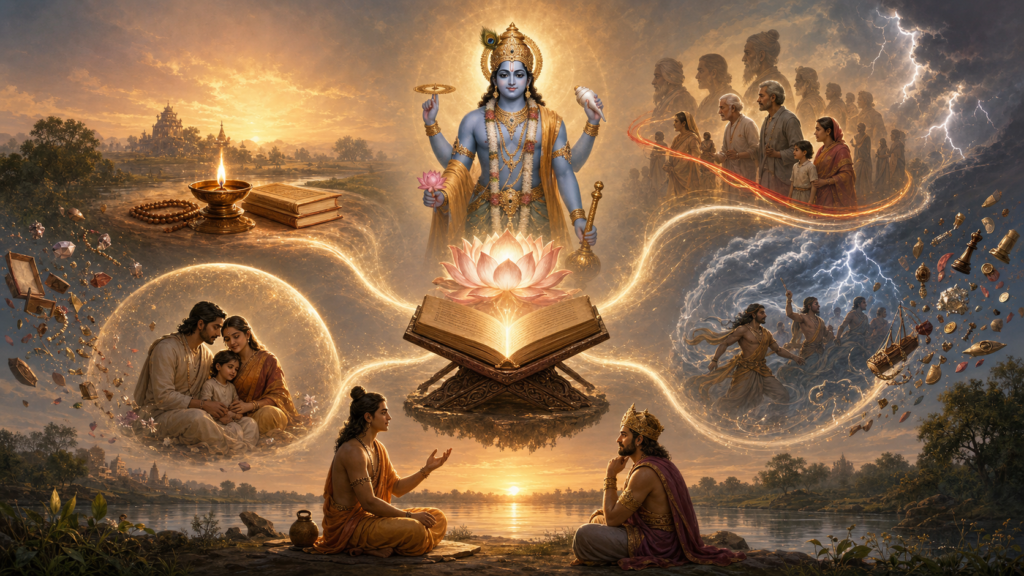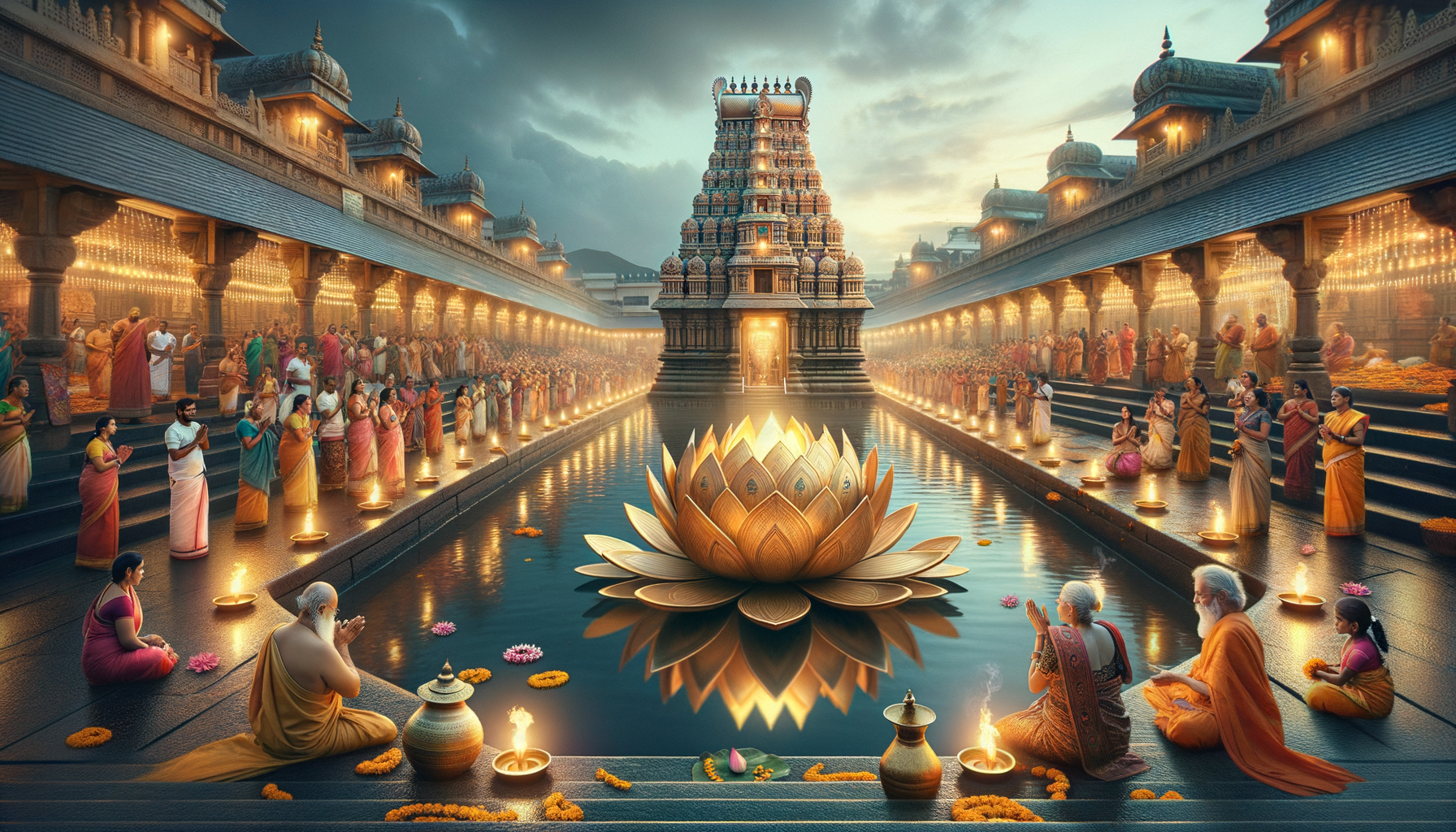
Panchami Tirtham at Padma Pushkarini in Tiruchanoor stands as the most sanctified moment of the annual Karthika Brahmotsavam of Sri Padmavathi Ammavaru. Observed on the auspicious Shukla Panchami of Karthika masam, the celebration commemorates the divine appearance of Sri Padmavati Devi upon a thousand-petaled golden lotus at the center of the temple tank, Padma Pushkarini. Devotees regard this vision as a living symbol of purity, abundance, and grace.
Ritually, the observance centers on the sacred waters of Padma Pushkarini. As the festival culminates, ceremonial processions, Vedic recitations, and devotional singing converge at the tank’s steps, after which participants undertake a holy bath known as Panchami Tirtham. For pilgrims, the act of immersion functions as both purification and renewal, aligning personal devotion with the temple’s sacred rhythm and the larger spiritual cadence of Karthika Brahmotsavam.
The theological symbolism is profound. The lotusemerging unsullied from watersignifies inner purity amid worldly complexity, while the sahasra, or thousand petals, evokes plenitude and divine completeness. Water, as tīrtha, represents a crossing from the ordinary to the sacred. These motifs resonate widely across dharmic traditions: the lotus is revered in Hinduism, honored in Buddhism as a sign of awakening, cherished in Jainism as a mark of spiritual virtue, and celebrated in Sikh scripture as an image of detachment and grace. Panchami Tirtham thereby nurtures unity in diversity, affirming a shared civilizational heritage.
The cultural experience is equally compelling. The atmosphere around Padma Pushkarini grows luminous with lamps, conches, and the cadence of stotras, while families across generations participate with reverence and joy. Pilgrims frequently recount a felt sense of serenity and belonging as the temple town of Tiruchanoor gathers in collective prayer. In this setting, seva, mutual respect, and communal harmony acquire tangible form, reflecting the integrative spirit of the festival.
In terms of seasonal placement, Panchami Tirtham generally occurs in late autumn, aligning with Karthika masam in the regional calendar. The Tirumala Tirupati Devasthanam (TTD) administers the arrangements and facilitates safe, orderly participation. Visitors often plan travel around the broader Karthika Brahmotsavam to witness processions, rituals, and cultural performances that culminate in the Padma Pushkarini observance.
As an expression of living tradition, Panchami Tirtham underscores both ecological and ethical care: mindful participation, respect for sacred waters, and community-oriented conduct. Such stewardship enhances the sanctity of the tīrtha while sustaining the ethos of inclusivity and interfaith respect that characterizes dharmic culture. The event thus functions as a bridgelinking personal sadhana with community well-being and civilizational unity.
In essence, Panchami Tirtham at Padma Pushkarini brings together devotion, symbolism, and social cohesion. The vision of Sri Padmavati Devi upon the thousand-petaled golden lotus offers a focal point for inner transformation, while the shared experience of the holy dip affirms common values across Hindu, Buddhist, Jain, and Sikh traditions. It is a luminous affirmation of spiritual continuity and harmony.
Inspired by this post on Hindu Pad.