Narasimha Chaturdashi, widely known as Narasimha Jayanti, commemorates the avatara of Lord Vishnu as Narasimhathe half-man, half-lion manifestation that restores dharma at a liminal threshold of time and space. In 2026, Narasimha Chaturdashi falls on April 30, aligning with Vaishakha Shukla Chaturdashi (the 14th lunar day of the bright fortnight of Vaishakha) in the Hindu calendar. Across India and the global Hindu diaspora, the observance brings together scriptural remembrance, vrata (fasting), puja vidhi (ritual procedures), and community celebration centered on courage, protection, and righteous action.
Calendrically, Narasimha Jayanti is determined by the presence of the Chaturdashi tithi during the Vaishakha bright half. Regional calculation methods can differ between Amanta and Purnimanta systems, and tithi start–end points vary by longitude, latitude, and local sunrise. As a practical rule followed by many traditions, puja is ideally aligned to the Madhyahna window on the day when Chaturdashi is operative, while temple festivities often culminate around dusk to recall the deity’s twilight appearance. Parāṇa (fast-breaking) is performed the following morning after sunrise when the Chaturdashi tithi has concluded; local panchang guidance should be followed for precision.
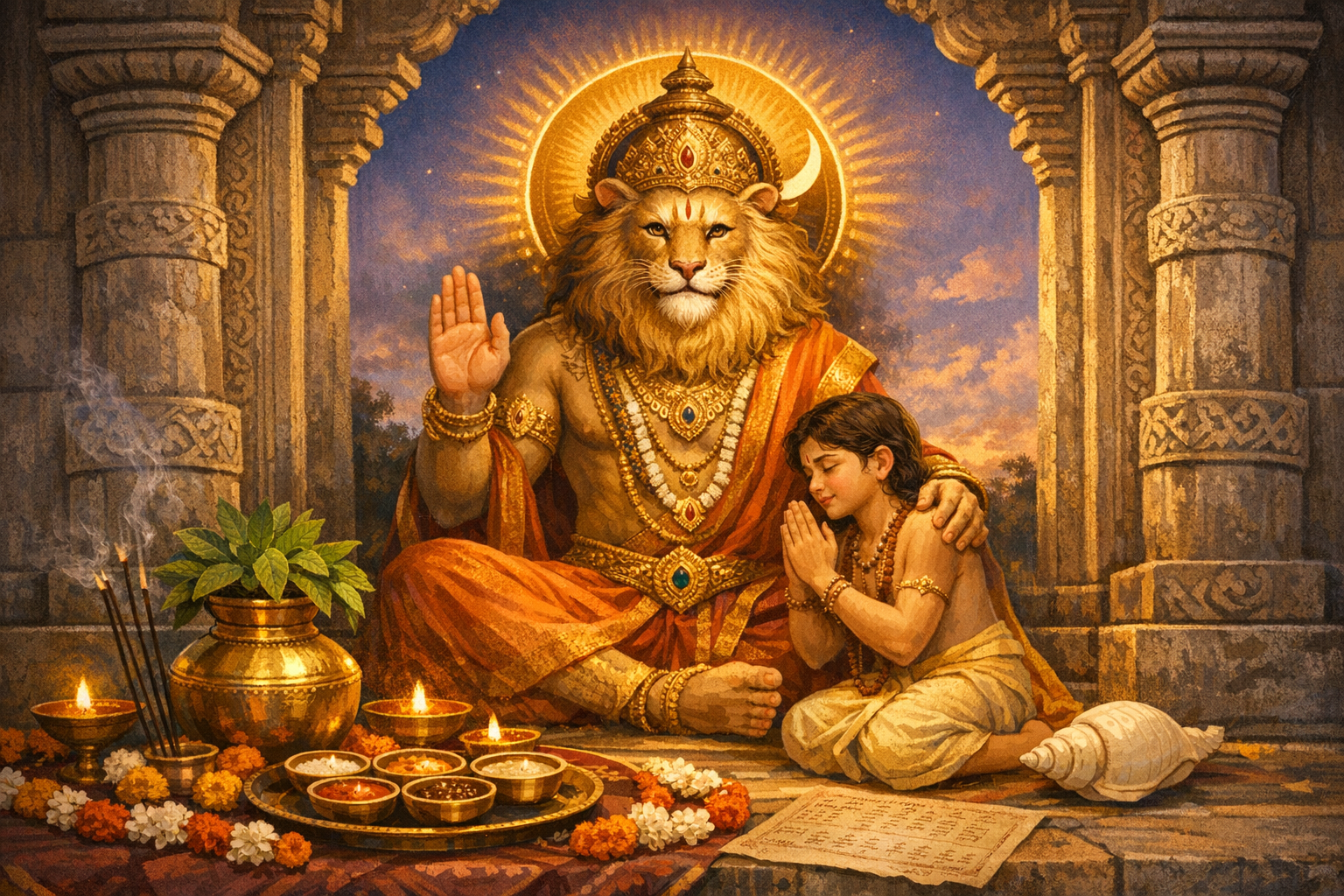
The theological arc of Narasimha Jayanti is rooted in the Bhagavata Purana and Vishnu Purana, narrating how Lord Narasimha emerged from a pillar at twilightneither day nor night, inside nor outside, man nor beastto protect the dharmic devotee Prahlada and to neutralize the adharma of Hiranyakashipu. Each narrative detail underscores thresholds: time (sandhyā), place (doorway), and form (nara–simha), illustrating the protean ways in which dharma safeguards the world beyond the constraints of literalism. The episode exemplifies the puranic maxim that dharma, when protected, protects in turn.
Philosophically, Narasimha embodies a dynamic synthesis of compassion and powerkaruṇā and śaktiexpressing Vishnu’s protective vow toward devotees and the cosmos. The avatara’s liminality functions as a doctrinal statement: ultimate reality transcends binary categories, yet appears within them to relieve suffering and restore order. For many practitioners, meditating on Narasimha evokes inner steadiness amid uncertainty, transforming fear into wise courage anchored in dharmic ethics.
Fasting (vrata) on Narasimha Jayanti is observed with sincerity and restraint, and many follow guidelines similar to those of Mahāśivarātrimaintaining a sattvic regimen that may range from nirjala (waterless) upavāsa to phalahara (fruits) based on health and capacity. The vrata commonly begins at sunrise on Vaishakha Shukla Chaturdashi and continues through the night, with parāṇa after sunrise the next day when the Chaturdashi tithi ends. Children, the elderly, and those with medical conditions may adopt moderated fasting, focusing on japa, kirtana, and a compassionate sattvic diet; dharma emphasizes intention and wellbeing over austerity for its own sake.
Puja at home can be structured in a clear sequence that balances scriptural fidelity with accessibility. After an early snāna (ritual bath) and clean preparation of the altar, one may take sankalpa to observe Narasimha Jayanti vrata for spiritual protection, removal of obstacles, and the cultivation of fearlessness. Kalasha sthāpana with sanctified water and tulasi, followed by invocation of Lord Narasimha and Śrī Lakṣmī, consolidates the ritual frame. A simple but reverent abhishekam with pañcāmṛta (milk, yogurt, ghee, honey, sugar) and water, alankara with flowers, and deepa–dhūpa offerings may follow in the Madhyahna window when Chaturdashi prevails.
Mantra recitation deepens the observance. Popular practices include chanting Om Namo Bhagavate Narasimhaya, the Narasimha Kavacha Stotra, Vishnu Sahasranama, and Śrī Lakṣmī–Narasimha Karāvalamba Stotram attributed to Ādi Śaṅkara. Many devotees report a tangible sense of solace and moral clarity when engaging these stotras in unhurried rhythm, making the worship an embodied meditation rather than mere recitation. Concluding arati and distribution of prasadam close the core ritual cycle.
Temples across Bharata and the diaspora conduct grand abhishekams, homas, and processions on Narasimha Jayanti. Celebrated centers include Ahobilam (Nava Narasimha kshetras), Simhachalam near Visakhapatnam, Melkote (Yoga Narasimha), Yadadri (Yadagirigutta), and the renowned Lakshmi-Narasimha forms in Odisha and Karnataka. While temple-specific traditions varysome accentuate Ugra Narasimha themes of cosmic protection and others emphasize Lakshmi-Narasimha’s benevolent gracethe unifying impulse remains devotion, ethical living, and communal harmony.
From a calendrical standpoint, practitioners often seek clarity on “which day” to fast if Chaturdashi spans two civil dates. A widely used guideline holds that the day on which Chaturdashi overlaps the Madhyahna period is selected for Jayanti observance. If uncertainty persists due to close tithi transitions, local panchang advisories should be followed, as they already incorporate sunrise, Madhyahna, and tithi boundaries specific to each locality. This approach ensures both scriptural consistency and astronomical accuracy.
Beyond ritual technique, Narasimha Jayanti invites ethical introspection. Practitioners commonly reflect on “the inner Hiranyakashipu”anger, pride, and injusticecontrasted with the Prahlada archetype of steadfastness, humility, and truth. Observing the vrata as a family, sharing Prahlada’s narrative with children, and aligning the day’s choices with ahimsa, satya, and compassion can convert the festival from a single-day event into an enduring practice of character formation.
Across the broader dharmic family, the lion resonates as a symbol of fearlessness, truth, and protection. In Buddhism, the lion’s roar signifies the bold proclamation of the Dharma; in Jainism, the emblem of Mahavira invokes steadfast courage; in Sikh tradition, “Singh” enshrines valor and uprightness. While the narratives and theologies are distinct, Narasimha Jayanti offers a timely reminder that Hinduism, Buddhism, Jainism, and Sikhism share a civilizational commitment to inner strength, ethical conduct, and reverence for all lifevalues that nourish inter-dharmic unity and mutual respect.
For the global community, diaspora scheduling is best approached with location-specific panchang data. The operative tithi at one longitude may differ by several hours at another, affecting the Madhyahna puja window and parāṇa recommendations. Trusted almanacs and reputable temple advisories that publish city-based timings provide the most reliable guidance for the United States, Canada, the United Kingdom, Southeast Asia, and beyond.
Safety and sustainability enhance the sanctity of practice. If performing a homa, adequate ventilation, fire safety norms, and local regulations should be observed. Eco-conscious offeringsseasonal flowers, reusable lamps, and biodegradable materialsreduce waste while preserving the atmosphere of reverence. The festival’s protective ethos aligns naturally with stewardship of the environment, a core thread across dharmic traditions.
In many households and temples, the day concludes with communal kirtan and sharing of prasadam, reinforcing social bonds through seva and gratitude. Devotees frequently note an uplift in emotional resilience as they chant Om Namo Bhagavate Narasimhaya, reporting a felt sense of protection and inner equanimity in moments of uncertainty. Such experiential insights echo the puranic assurance that divine grace and human effort work in concert to uphold dharma.
Key takeaways for 2026 include the fixed civil date of April 30 for most regions (subject to local tithi timings), an emphasis on Madhyahna-aligned puja for home observance, and thoughtful parāṇa the following morning. By combining scriptural fidelity with compassionate practicality, the festival becomes both technically sound and spiritually nourishing. Above all, Narasimha Jayanti affirms that moral courage, guided by wisdom and compassion, remains the surest path to personal and collective wellbeing.
Inspired by this post on Hindu Pad.