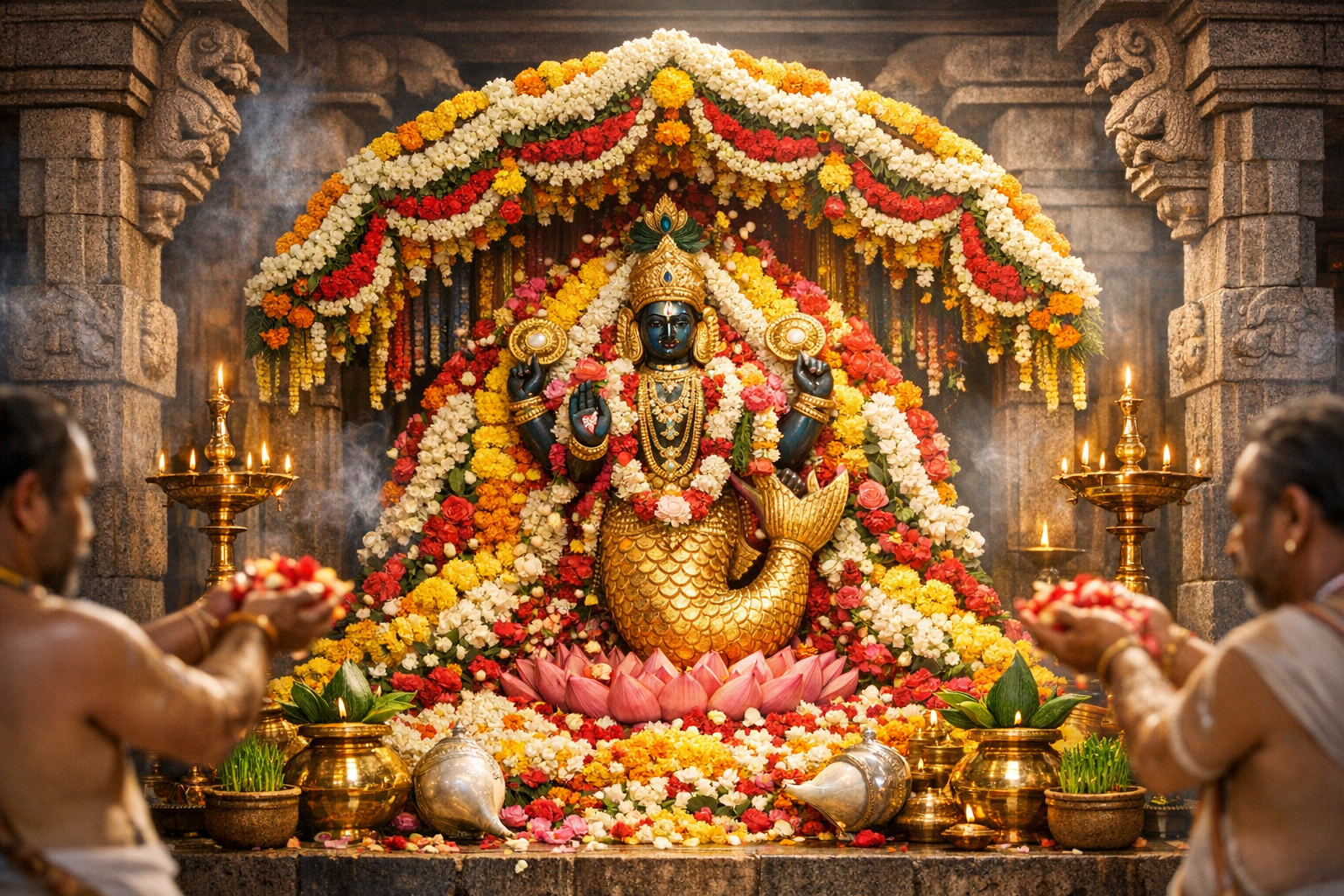
Nagulapuram (Nagalapuram) Sri Vedanarayana Swamy Temple will celebrate the sacred Pushpayagam Mahotsavam on 5 June 2026. The festival program begins on 4 June, when Punyahavachanam, Rakshabandhanam, Mrutsangrahanam, Senadhipati Utsavam, and Ankurarpanam will be conducted between 6.15 pm and 7.45 pm IST. On 5 June, Snapana Tirumanjanam is scheduled from 11.00 am IST, preceding the floral oblations of the Pushpayagam.
Situated in the Tirupati district of Andhra Pradesh and administered by Tirumala Tirupati Devasthanams (TTD), Nagulapuram Sri Vedanarayana Swamy Temple is a prominent Vaishnava kshetra renowned for its Vijayanagara-period heritage. The presiding deity, Sri Vedanarayana Swamy, is worshipped in the form of Matsya, the first avatar of Vishnu, revered in Puranic tradition for restoring the Vedashence the epithet “Vedanarayana.” The temple’s ritual life, artistic iconography, and architectural features embody a living continuum of South Indian Hindu temple culture.
Pushpayagam (also called Pushpa Yagam) is an Agamic-Vedic ceremony of offering profuse varieties of flowers to the Lord as an expression of gratitude for nature’s abundance and as a collective prayer for universal well-being. The rite underscores the sattvic symbolism of blossomspurity of intent, fragrance of virtue, and the transient beauty that evokes humility and devotion. In Vaishnava temples, this Mahotsavam follows a precise liturgical sequence to ensure sanctity (suddhi) of the site, materials, and officiants.
The pre-festival proceedings on 4 June establish the ritual ground according to Agamic injunctions. Punyahavachanam sanctifies the space and participants through mantras and sprinkling of consecrated water, aligning the kshetra (sacred precincts) with a state of ritual purity. This is foundational to all subsequent acts of worship, ensuring that every offering resonates with sacred intent.
Rakshabandhanam during temple rituals refers to the tying of a protective thread by the priests, invoking divine guardianship for the deities’ procession elements, paraphernalia, and participants. The rite symbolizes dharmic protection, reminding devotees that sacred action proceeds under divine auspices and communal responsibility.
Mrutsangrahanam, the ceremonial collection and sanctification of earth, acknowledges the temple’s bond with bhumi (the Earth). By ritually preparing sacred soil, the temple affirms ecological gratitude and the cosmological view that the Earth herself is a participant in dharmic acts. This step also marks the subtle transformation of ordinary elements into consecrated dravya (ritual materials).
Senadhipati Utsavam invokes Vishvaksenathe divine commander who oversees ritual order in Vaishnava tradition. By propitiating the Senadhipati, priests ritually “organize” the ceremonial field, seeking removal of obstacles and smooth conduct of the Mahotsavam. The festival thereby rests upon a vision of sacred order where every action is harmonized with cosmic governance.
Ankurarpanam, the sowing of auspicious seeds, embodies fertility, renewal, and the continuity of life and tradition. As tender shoots emerge, the rite signifies the germination of merits (punya), aspirations for communal welfare, and the perennial growth of dharma. In many Vaishnava temples, Ankurarpanam serves as the living emblem of hope and auspicious beginnings.
On 5 June, Snapana Tirumanjanam commences at 11.00 am IST. This sanctifying abhishekam (ritual bathing) employs panchamrita and perfumed waters, accompanied by Vedic chanting and stotra recitation. Snapana restores ritual freshness to the utsava murti and prepares the deity for the floral immersion of Pushpayagam. Within the temple’s Agamic frameworkobserved here in the Vaishnava traditionSnapana Tirumanjanam embodies the theology that devotion (bhakti) is made visible through purity, order, and beauty in worship.
The Pushpayagam proper is characterized by an abundant showering of fresh blossoms upon Sri Vedanarayana Swamy. Archakas offer flowers while intoning mantras and hymns, transforming the sanctum into a vivid tapestry of color and fragrance. The act integrates bhava (devotional sentiment) with kriya (ritual action), allowing devotees to contemplate the Lord’s auspicious attributes amid a sea of flowers. Beyond aesthetic splendor, Pushpayagam is a thanksgiving rite for seasonal harvests and a collective supplication for timely rains, health, and prosperity.
The ritual symbolism is multilayered. Flowers, gathered with care and devotion, embody non-violent, life-affirming offerings aligned with ahimsa. Their perishability invites reflection on impermanence and humility, while their fragrance suggests the diffusion of virtue in society. The rite thus operates at ethical, aesthetic, and metaphysical levels, uniting temple, community, and ecology in a single devotional act.
In the wider dharmic context, Pushpayagam resonates with shared values across Hinduism, Buddhism, Jainism, and Sikhism. The emphasis on ahimsa mirrors Jain ethical primacy; the contemplative offering of flowers parallels Buddhist puja that highlights impermanence; the collective seva and disciplined participation reflect Sikh commitments to service and sangati; and the Vaishnava Agamic framework preserves rigorous ritual discipline. Such convergences underscore a civilizational ethosdiverse in practice yet unified in reverence, compassion, and communal harmony.
Devotees frequently recount the serene atmosphere that unfolds as the sanctum is adorned, the conches resound, and the fragrance of flowers fills the air. Families often attend together, reporting a sense of intergenerational bonding as elders explain the meaning of each rite to younger members. Pilgrims and residents alike describe Pushpayagam as both a study in tradition and an experience of spiritual intimacywhere scholarly precision meets heartfelt devotion.
As a living expression of South Indian temple heritage, the Nagulapuram Pushpayagam strengthens intangible cultural heritage and sustains livelihoods through the ethical sourcing of ritual flowers and materials. Observance of temple codesdress, decorum, and queue systemshelps maintain the sanctity and safety of the proceedings. Given that timings and arrangements can evolve, devotees are advised to follow official TTD communications and local temple notices for any updates close to the festival date.
The 2026 Pushpayagam at Sri Vedanarayana Swamy Temple thus integrates history, theology, and community practice into a single, elevating celebration. With its clearly defined timings4 June for the preparatory rites and 5 June for Snapana Tirumanjanam and the Pushpayagamthe Mahotsavam exemplifies how Vedic-Agamic traditions remain vibrant, accessible, and deeply relevant to contemporary spiritual life in Andhra Pradesh and beyond.
Inspired by this post on Hindu Pad.