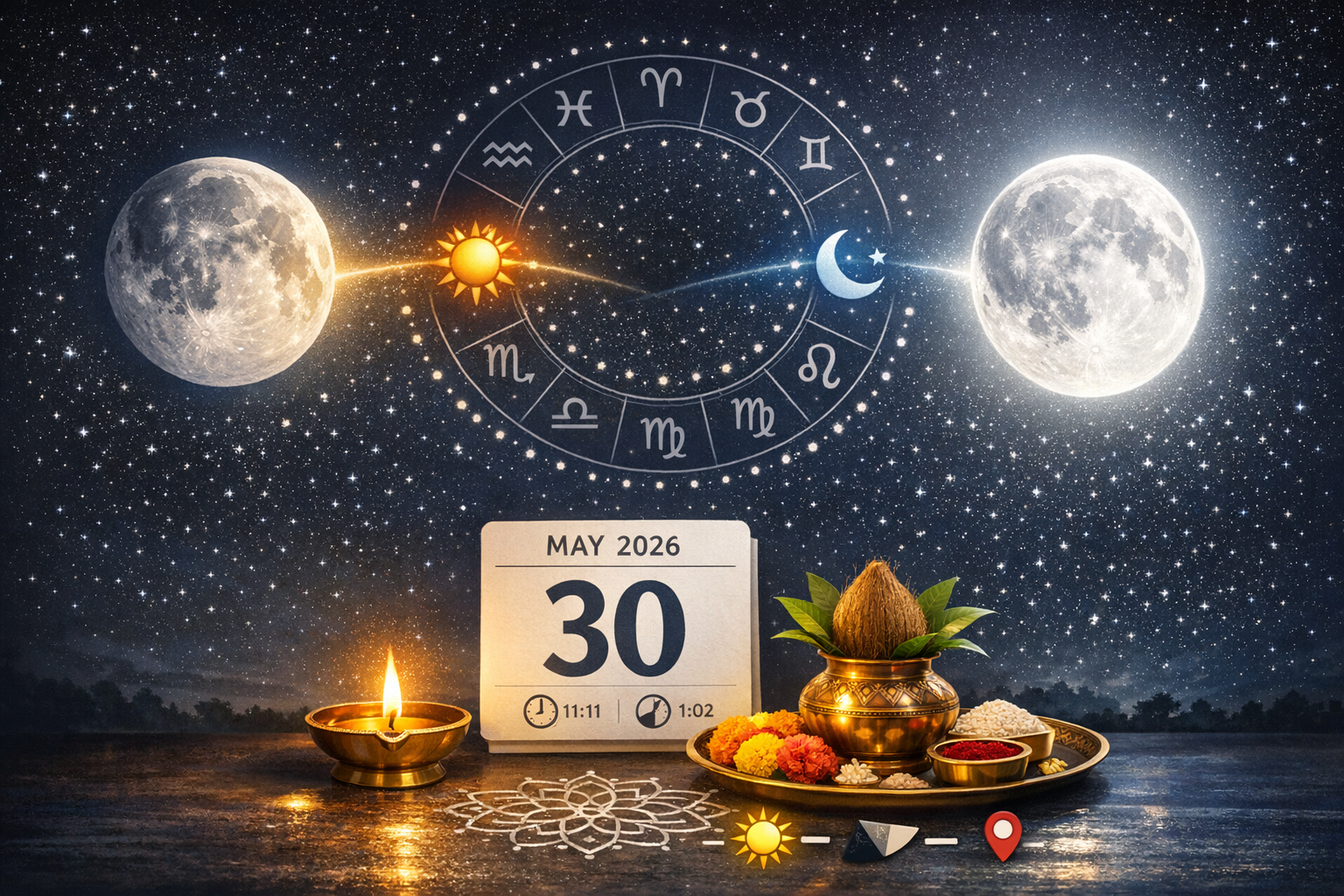
Saturday, May 30, 2026 (Gregorian) aligns in the Hindu calendar with Shukla Paksha Chaturdashi, the fourteenth lunar day of the waxing phase, prevailing until 11:11 AM in most regions. From that time onward, Purnima tithi (the full-moon day) begins and continues until 1:02, as recorded in the referenced Panchang; location-specific almanacs may clarify AM/PM notation and any date rollover. This entry provides the May 30 2026 Tithi – Panchang – Hindu Calendar – Good Time – Nakshatra – Rashi overview with practical guidance for observances and planning.
Times in a Panchang are astronomically determined and vary with longitude, latitude, and local time conventions; therefore, regional differences can shift tithi start and end by minutes or even hours. For the most reliable application to daily life, one should consult a local Panchang (with Desāntara adjustments) or a trusted calculation service set to the precise location.
Technically, a tithi is defined by the Moon–Sun angular separation increasing in 12-degree increments. Shukla Paksha Chaturdashi corresponds to an elongation of approximately 156°–168°, and Purnima tithi spans approximately 168°–180°, culminating near the exact full-moon moment when the elongation reaches 180°. Because these are continuous celestial measures, a civil date can contain more than one tithi, as is the case on May 30, 2026.
As the waxing fortnight approaches completion, Shukla Paksha Chaturdashi is traditionally regarded as a day of consolidation and refinement of intention. Many households use the closing hours of Chaturdashi to complete preparatory worship and mental resolve, allowing the mind to enter Purnima with clarity and sattva. The transition itself often feels meaningfulan inflection from effort to fruition that families recognize in their evening routines and devotional rhythms.
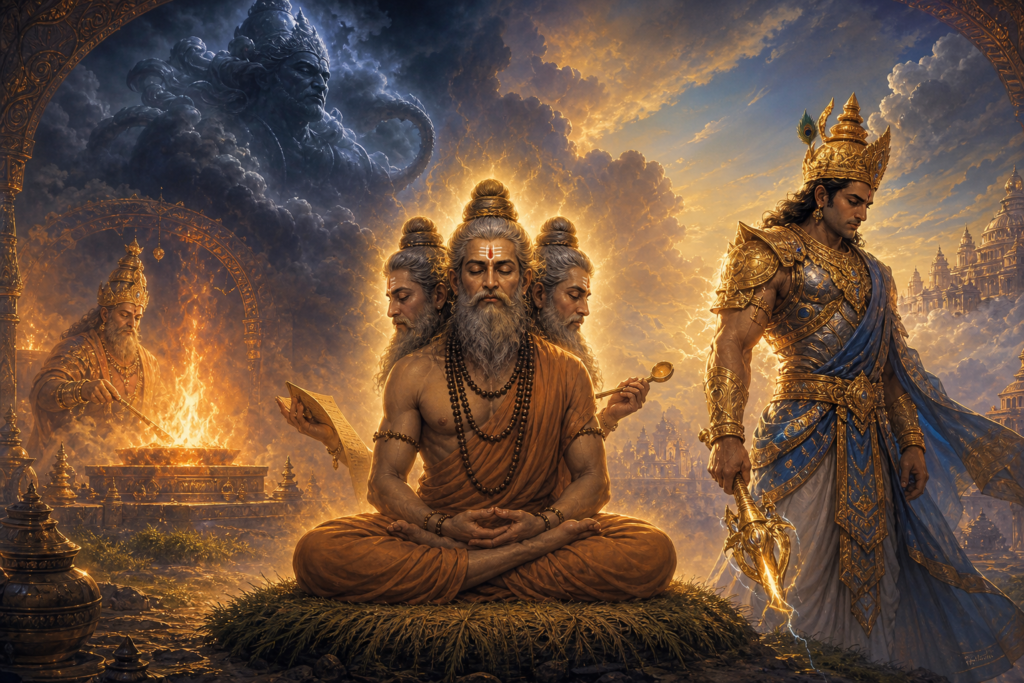
Purnima carries auspicious connotations across the Dharmic spectrum. In Hindu practice, full-moon days are widely observed with vrata, satsang, and darshana; several communities perform Satyanarayan Puja or recite stotras honoring deities associated with plenitude and wisdom. In Buddhism, the full moon is integral to observances in many traditions, and the mid-May full moon is renowned as Vesak in numerous regions. Jaina communities frequently align fasts and pratikraman cycles with lunar phases. Sikh commemorations have historically referenced the Punjabi lunar calendar (Bikrami) for certain Gurpurab dates, exemplifying the shared civilizational attention to the moon’s phases.
Good Time (Shubh Muhurat) on any given date depends on local sunrise, the day of week, and the distribution of benefic and malefic segments across the day. A widely referenced midday window, Abhijit Muhurta, centers on local solar noon and is often considered suitable for undertakings that require decisiveness and clarity. Conversely, Rahu Kalam is traditionally avoided for initiating new tasks; its clock-time shifts with the season but follows a weekly patternfor Saturday, it typically falls in the morning segment after sunrise. Additional intervals, such as Gulikai Kalam and Yamaganda, are also mapped from sunrise and should be checked for the specific location to support confident planning.
Because May 30, 2026 includes the onset of Purnima, devotees commonly schedule key rites, study, or dana toward the Purnima portion of the day while completing foundational steps earlier. This sequencing reflects a pragmatic approach that honors both the tithi transition at 11:11 AM and the luminous symbolism that Purnima embodies. Families often report that aligning significant commitments with the Purnima window fosters a sense of unity, calm, and shared purpose.
Nakshatra and Rashi are essential to a complete Panchang but are inherently location- and time-dependent. Near the end of May, the Sun is in Vrishabha (Taurus) by the sidereal framework used in Vedic astrology, so the full Moon, by definition, will be opposite the Sun on the zodiac. This typically places the lunar Rashi in the sign opposite to the Sun’s position, with the Nakshatra determined by the Moon’s precise longitude at the time of observation. Given diurnal motion and longitude sensitivity, authoritative figures for Nakshatra and Rashi on May 30, 2026 should be taken from a local Panchang cast for the chosen city.
Practical scheduling guidance for this date benefits from a clear hierarchy: first verify sunrise for the locale; next, confirm the tithi transition time (11:11 AM to Purnima, then until 1:02 per the cited source); finally, overlay local Shubh Muhurat windows and avoidance periods (Rahu Kalam, Gulikai, Yamaganda). This layered method minimizes conflict between auspicious intent and daily responsibilities, an approach many families across Hindu, Buddhist, Jaina, and Sikh lineages have found sustainable and inclusive.
From an astronomical lens, it is helpful to remember that a tithi end-point is not tied to clock uniformity but to the celestial geometry of the Sun–Moon pair. Consequently, two nearby cities can register small differences. When planning samskaras, vratas, or community programs, robust practice involves confirming the applicable Panchang for the exact venue to respect both tradition and scientific precision.
Emotionally and culturally, days like May 30, 2026 cultivate attentiveness to cycles, encouraging mindful living that balances contemplation with action. The shift from Shukla Paksha Chaturdashi to Purnima invites gratitude, seva, and learning, nurturing unity within families and across Dharmic communities. Honoring these rhythms together strengthens shared heritage while embracing the breadth of spiritual expression in the subcontinent and its global diaspora.
Summary of key facts for planning: Shukla Paksha Chaturdashi prevails until 11:11 AM (most regions); thereafter, Purnima tithi extends until 1:02 as listed in the source. Exact Nakshatra, Rashi, Abhijit Muhurta, Rahu Kalam, Gulikai Kalam, and Yamaganda should be computed for the specific location. Aligning important beginnings with Shubh Muhurat and avoiding known dosha periods preserves the Panchang’s intentharmonizing human effort with the sky’s cadence.
Inspired by this post on Hindu Blog.