Mahashivaratri at Sri Bhramaramba Mallikarjuna Swamy Temple, Srisailam, is one of the most anticipated nights of worship in the Hindu calendar. In 2026, Mahashivaratri date is February 15, drawing seekers to the Nallamala hills for a night-long observance that blends rigorous ritual practice with deep inner contemplation. The celebration at this templerevered as both a Mallikarjuna Jyotirlinga and a Bhramaramba Shakti Peethaembodies the unity of Shiva and Shakti and offers a rare confluence of devotion, scripture, and living heritage.
Mahashivaratri is observed on Krishna Paksha Chaturdashi, the fourteenth lunar day of the dark fortnight, which falls in Magha or Phalguna depending on regional calendars. The spiritual apex of the night is Nishita Kaal, the deep midnight window traditionally reserved for the Lingodbhava worship of Shiva. Devotees remain awake in jagarana, perform sequential prahar pujas through the night, and conclude their vrata with parana according to the prescribed tithi guidelines after sunrise on the following morning.
The prominence of Srisailam in the Shaiva tradition is unparalleled: it is one of the Dwadasha Jyotirlingas while simultaneously enshrining Devi as Bhramaramba, a celebrated Shakti Peetha. This dual sanctity has made Srisailam a preeminent Shiva–Shakti kshetram, where the metaphysical complementarity of consciousness (Shiva) and energy (Shakti) is ritually experienced and philosophically realized through temple worship and scriptural recitation.
Set amidst the Nallamala forests on the banks of the Krishna River (locally called Patalaganga), Srisailam’s sacred geography heightens the contemplative mood of Mahashivaratri. Pilgrims often describe the descent to Patalaganga for a snana as a liminal actan embodied transition from the busy world into a night of inner stillness, mantra, and tapas. The cool February air, the sound of temple bells, and the flicker of countless lamps contribute to a uniquely immersive spiritual ambience.
Architecturally, the temple complex reflects layers of patronage across dynasties including the Chalukyas, Kakatiyas, Reddy rulers, and the Vijayanagara Empire. Dravidian architectural elementsgopurams, mandapas, and intricately carved pillarsframe a sanctum that enshrines the swayambhu Linga of Mallikarjuna. Temple tradition also associates the Bhramaramba shrine with the Sri Chakra, underscoring the site’s long-standing Sri Vidya and Agamic currents.
While the peak of observance is the Mahashivaratri night, Srisailam typically marks the season with extended festivities and utsavas subject to the Devasthanam’s annual schedule. Flag-hoisting (Dwajarohanam), vahana processions, and special alankarams set the liturgical rhythm for the days surrounding Shivaratri. The flow of events is designed to guide pilgrims from outer celebration toward the inner quietude of Nishita Kaal.
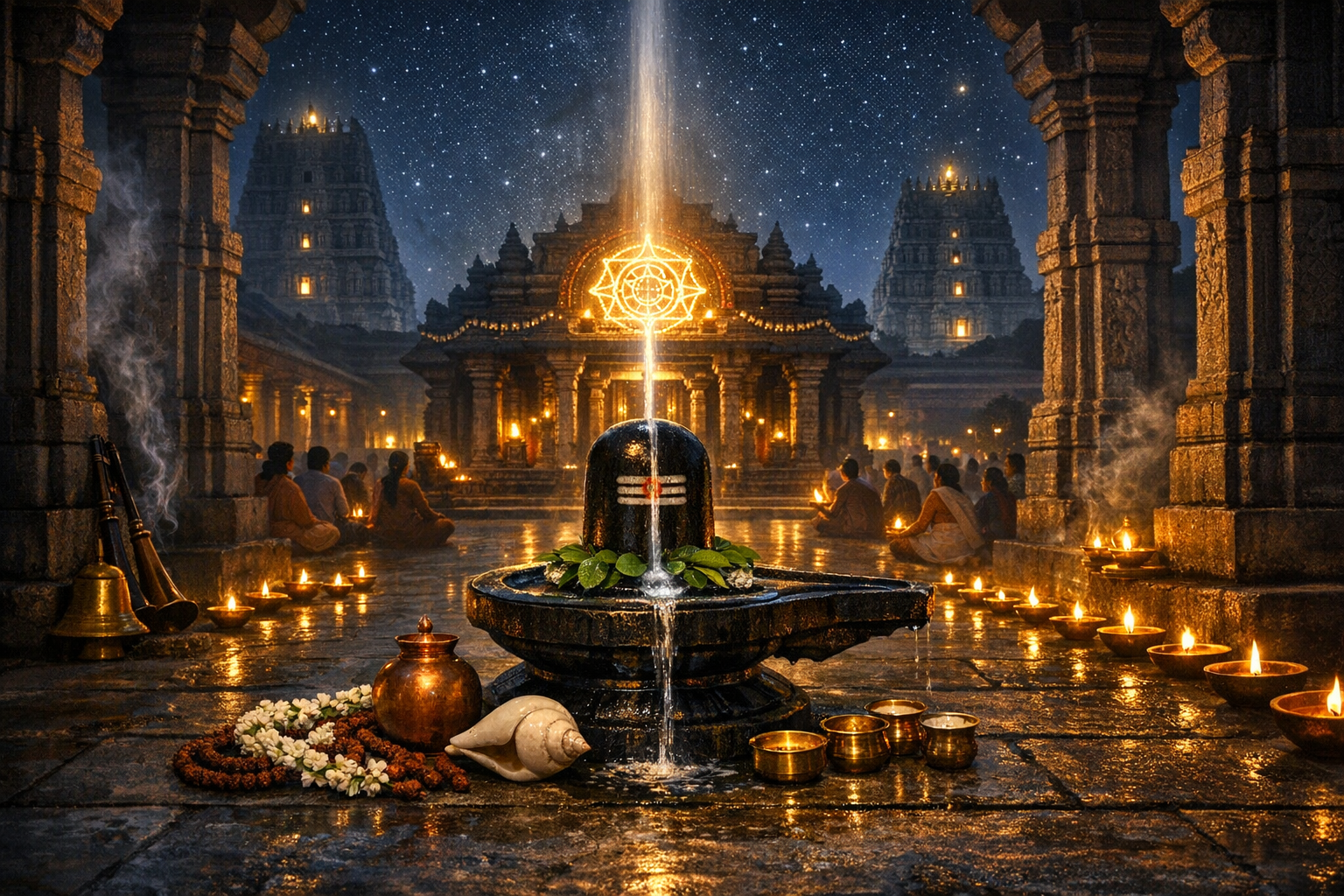
Shivaratri Puja in Srisailam Mallikarjuna Swamy Temple follows the canonical four-prahar sequence through the night. Abhishekas with pure water, milk, curd, honey, ghee, and sugar are offered, accompanied by Sri Rudram–Chamakam chanting, Panchakshari japa (Om Namah Shivaya), and Archana with bilva leaves. Each prahar culminates with deepa-aradhana in a crescendo of bells and conches, before the temple returns to a studied stillness for the next segment of worship.
Nishita Kaal ushers in the Lingodbhava-focused worship, honoring the formless emergence of Shiva as infinite jyoti (light). In Srisailam, this moment is marked with heightened solemnity. Many pilgrims speak of an intuitive hush before midnightthe sense that ritual precision, Vedic sound, and personal surrender intersect to create a sadhana experience that is both deeply personal and communally shared.
Vrata observance on Mahashivaratri emphasizes satvik self-restraint, mindful speech, mantra, and jagarana. Devotees may undertake nirjala upavasa or a lighter phalahara fast according to health and guidance. Paranathe formal breaking of the fastis performed after sunrise on the following day when the Chaturdashi tithi has concluded, with local panchang rules observed to honor the orthodox timing.
Those unable to travel to Srisailam can perform Shivaratri Puja at home with comparable sanctity. The essential elements include a clean shrine, a Shiva Linga or image, four sequential pujas through the night, abhisheka with water and Panchamrita, bilva-patra offerings, sustained japa of Om Namah Shivaya, and attentive meditation during the midnight window. The emphasis remains on purity, steadiness of mind, and scriptural recitation.
At the temple, special sevas such as Rudrabhishekam and Mahanyasa Rudrabhishekam are in high demand during the Shivaratri season. Darshan and seva arrangements are typically structured to manage large inflows of pilgrims, and advance planning is prudent. Visitors often synchronize their temple visit with their personal prahar puja rhythm to retain a reflective cadence amid the festival’s scale.
Festival-day operations may extend well into the night, and darshan windows can vary. It is common for pilgrims to arrive by afternoon, complete initial darshan and snana, and then settle into jagarana with intermittent meditation and mantra until the Nishita Kaal rites. The morning after, parana and a quiet return to daily duties are considered part of the larger vrata saṅkalpa.
Devotional decorum enhances the sanctity of the observance. Traditional attire, minimal leather goods, and a commitment to cleanliness and silence within worship spaces are encouraged. Many pilgrims carry a small prayer book with Sri Rudram, Shiva Panchakshari, and Lingashtakam to remain anchored in chant and reflection throughout the night.
Srisailam is accessible by road from Hyderabad and other major hubs in Andhra Pradesh and Telangana. The ghat approach rewards travelers with sweeping views of the Nallamala ranges. Pilgrims frequently integrate a visit to Patalaganga via the steps or ropeway, using the river-snana as a preparatory rite before entering the main temple precincts for Shivaratri Puja.
Accommodation in and around Srisailam ranges from pilgrim cottages to lodges. During Mahashivaratri, early planning is wise due to peak demand. A simple, satvik meal before the fast, warm clothing for the nighttime chill, and basic personal necessities support a balanced and contemplative experience.
The temple lies within an ecologically sensitive zone of the Nallamala forests. Responsible pilgrimage includes avoiding single-use plastics, respecting wildlife, maintaining cleanliness, and following all local guidelines. The ethic of ahimsaso central to Shiva sadhanaextends naturally to environmental stewardship during the pilgrimage.
Srisailam’s Mahashivaratri also resonates with shared values across dharmic traditions. The night-long meditation recalls Buddhist uposatha’s mindfulness, Jain upavasa’s disciplined self-restraint, and Sikh simran’s remembrance of the Divine Name. The festival thereby becomes a bridge for dharmic unity, honoring plural paths that converge in ethics, contemplation, and compassion.
Devotees regard Mallikarjunaetymologically linked to mallika (jasmine) and the Arjuna treeas a reminder of Shiva’s accessibility through simple, heartfelt offerings. When paired with Bhramaramba Devi’s grace, the temple’s liturgy models an integrated sādhana: knowledge and devotion, mantra and silence, action and repose. This synthesis is especially palpable during the midnight rites of Lingodbhava.
The temple soundscape during Shivaratri is itself a teaching. Veda parayanam, nadaswaram, and the cadence of bells punctuate the night, cueing shifts from abhisheka to archana to aarati. Many pilgrims find that the periodic return to silence between segments enables an interiorization of worshipturning the attention from the outer flame to the inner light.
A practical rhythm for the night often begins with an afternoon arrival, a preparatory snana at Patalaganga, and a serene first darshan. The evening deepens into two early prahar pujas, a mindful pause before Nishita Kaal, and then the climactic midnight worship. The post-midnight hours invite quieter japa and dhyana, leading gently to sunrise parana and the inward assimilation of the vow.
Common questions revolve around timing and procedure. Pilgrims typically confirm local panchang details for their city, align their prahar puja with the temple’s schedule if on site, and choose a vrat discipline that is health-conscious and sustainable. The guiding principle remains steadfast remembrance of Shiva through mantra, offering, and meditative wakefulness.
Mahashivaratri at Srisailam Mallikarjuna Swamy Temple functions as both a grand public festival and a finely tuned spiritual discipline. By situating precise Agamic ritual within an atmosphere of shared devotion and ecological reverence, the observance leads participants from the solemnity of midnight into the clarity of morninguniting Shiva and Shakti, temple and pilgrim, and the broader family of dharmic traditions in a single, luminous vow.
Inspired by this post on Hindu Pad.