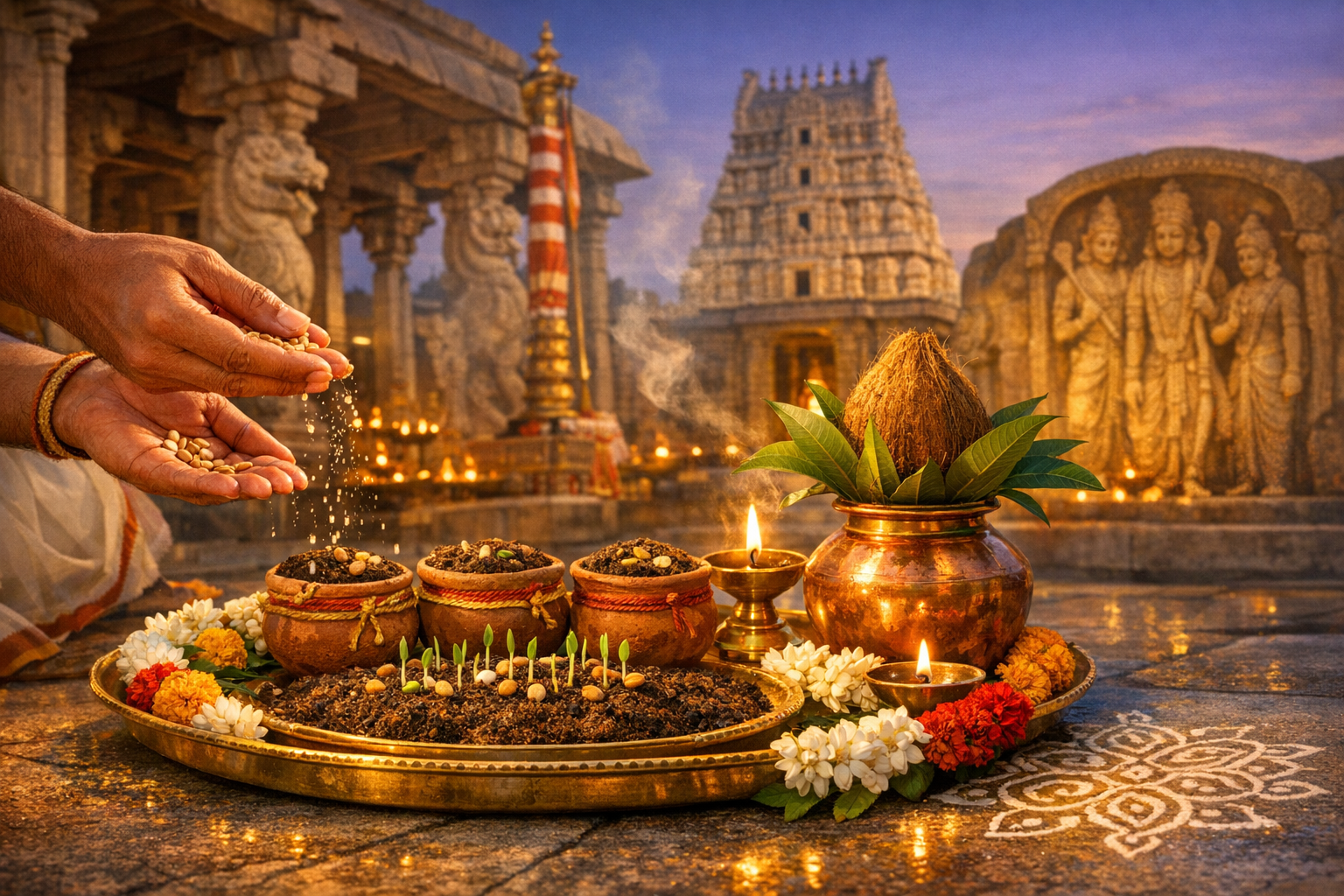
On 26 March 2026, the Ankurarpana (the ceremonial sowing of sacred seeds) will inaugurate the annual Brahmotsavams at Sri Kodandarama Swamy Temple, Vontimitta, in YSR Kadapa district of Andhra Pradesh. Esteemed for its antiquity and architectural grace, this kshetra is also प्रसिद्ध as “Ekashila Nagaram,” a reference to the rare triad of Sri Rama, Sita, and Lakshmana carved from a single stone. Under the stewardship of Tirumala Tirupati Devasthanams (TTD), the festival is prepared to unfold with scriptural rigor, cultural depth, and an ethos of shared devotion.
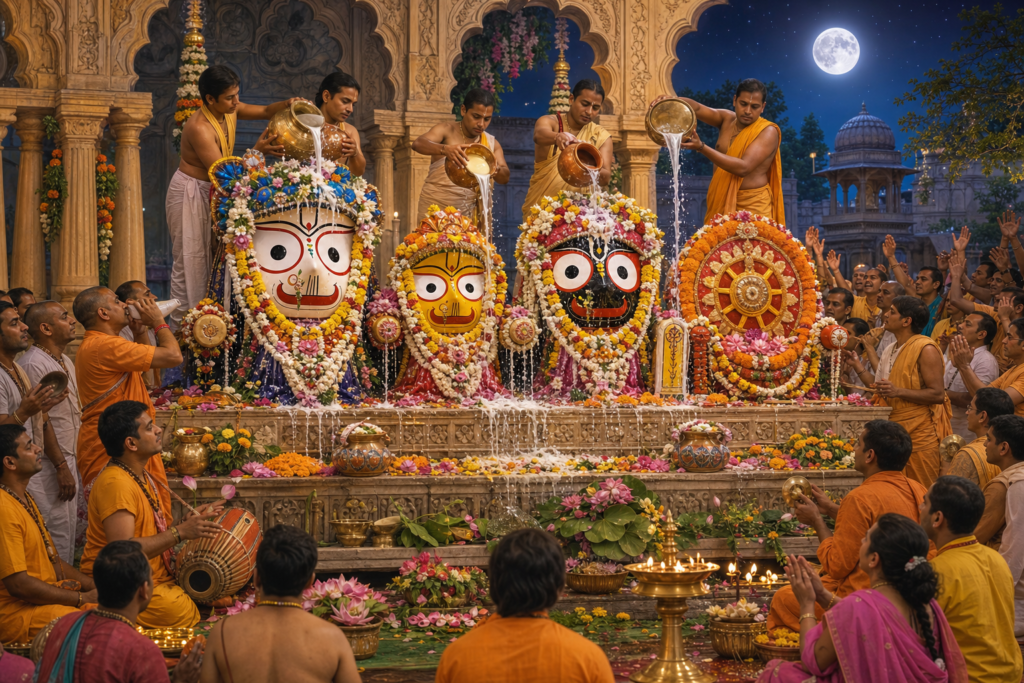
In the Agamic tradition, Ankurarpana marks the living seed of the festival itselfboth literally and symbolically. The term fuses “ankura” (sprout) with “arpana” (offering) and is performed to sanctify the forthcoming sequence of utsavas. Priests consecrate earthen pots, invoke the waters, and sow select grains (navadhanyam) as a prayer for auspicious growth, communal welfare, and the seamless completion of the Brahmotsavams.
The ritual grammar draws on Vaishnava Agamasparticularly the Vaikhanasa and allied textswhich prescribe a preparatory cycle that typically includes Mritsangrahanam (ritual collection of earth), Punyahavachana (purification), Vighneshwara puja, Rakshabandhana, and the sowing of seeds in sanctified soil. By kindling the principle of life within the temple precincts, Ankurarpana becomes an ecological and spiritual metaphor: festivals grow as carefully as seedlings, under discipline, attention, and grace.
Following Ankurarpana, Dwajarohanam (flag hoisting) traditionally signals the formal commencement of the Brahmotsavams. Over the succeeding days, the temple schedules processional worship (utsava-murtis taken in procession), alankarams, haratis, Veda parayanam, and cultural offerings that narrate the ideals of Rama-bhakti. The festival’s centerpiece is Sri Sita Rama Kalyanamcelebrating the divine marriageobserved in alignment with Chaitra Shukla Navami (expected on 27 March 2026, subject to TTD’s Panchang determinations). Other high points often include the grand chariot procession (Rathotsavam) and the concluding sanctification rites such as Chakrasnanam.
At Vontimitta, Sri Kodandarama’s shrine is noteworthy for its distinctive iconography and Dravidian architectural idiom. The sanctum enshrines the single-stone triad of Rama, Sita, and Lakshmana, a sculptural marvel that continues to invite art-historical interest for its unified composition and rare placement conventions. Around the garbhagriha, mandapas and prakara corridors carry reliefs, pillars, and iconographic programs that evoke episodes from the Ramayana and allied Vaishnava themes.
Epigraphic and stylistic evidence places substantial development of the temple complex in the Vijayanagara period (circa 15th–16th centuries), followed by Nayaka-era patronage that elaborated halls and gateways. Regional literary memory further binds the site to luminaries such as Bammera Pothana, while the Telugu savant Vavilakolanu Subba Rao (revered as “Andhra Valmiki”) is commemorated in the vicinityeach strand affirming Vontimitta as a cultural node where devotion, language, and the arts converged.
For devotees across Rayalaseema and coastal Andhra, Ankurarpana at Vontimitta resonates as a gentle yet profound beginning. Families often recall how the first grains sown in the temple’s care mirror their own seasonal hopeshealth, harmony, learning, and purposeful work. The ritual’s quiet emotion lies in its simplicity: life begins in a seed, and community is renewed in shared prayer.
Anchored in dharma, the Brahmotsavams articulate valuestruthfulness, compassion, duty, restraintthat are esteemed across the broader Dharmic family. While rooted in Hindu practice, the virtues embodied by Sri Rama’s life storyethical leadership, respect for all beings, and social concordspeak meaningfully to Buddhists, Jains, and Sikhs as well. The festival thus becomes an invitation to experience unity-in-diversity, affirming a civilizational bond that honors multiple paths to wisdom and well-being.
From a participatory standpoint, TTD’s organization typically provides structured darshan streams, volunteer support, and crowd-flow measures throughout the Brahmotsavams. Visitors are encouraged to plan for early arrivals, observe temple etiquette, and remain attentive to security advisories and traffic diversions around the temple town. Prasadam distributions, Vedic recitations, and evening processions together foster an atmosphere that is devotional, disciplined, and inclusive.
The 2026 observances are aligned with the lunisolar Panchang that governs temple timings. While Ankurarpana is slated for 26 March 2026often in the auspicious Pradosha windowsubsequent events, including the Kalyanotsavam on Navami, are synchronized to the tithi prevailing at the temple as determined by TTD’s Agama and Panchang experts. Devotees may therefore note that civil calendar dates occasionally shift slightly with local tithi boundaries.
Vontimitta is accessible by rail via Vontimitta station on the Kadapa–Tirupati route, and by road along NH-716. The nearest major airports are Tirupati and Kadapa, offering regional connectivity during the festive period. Given peak footfall during Brahmotsavams, advance travel planning and accommodation arrangements are advisable.
Heritage-sensitive measureslitter minimization, respectful photography, and adherence to queue protocolshelp sustain the site’s sanctity and ensure a dignified experience for all. The ecological symbolism of Ankurarpana also invites simple choices: avoiding single-use plastics, supporting cleanliness drives, and participating mindfully in shared spaces.
As the first sprouts are offered on 26 March 2026, the Brahmotsavams at Vontimitta reaffirm a timeless message: festivals flourish where reverence meets responsibility. With Ankurarpana as the sacred prelude and Sri Sita Rama Kalyanam as the luminous heart, the 2026 celebrations promise a devotional continuumuniting heritage and hope, ritual precision and communal joy, and the many streams of the Dharmic tradition into one confluence of grace.
Inspired by this post on Hindu Pad.