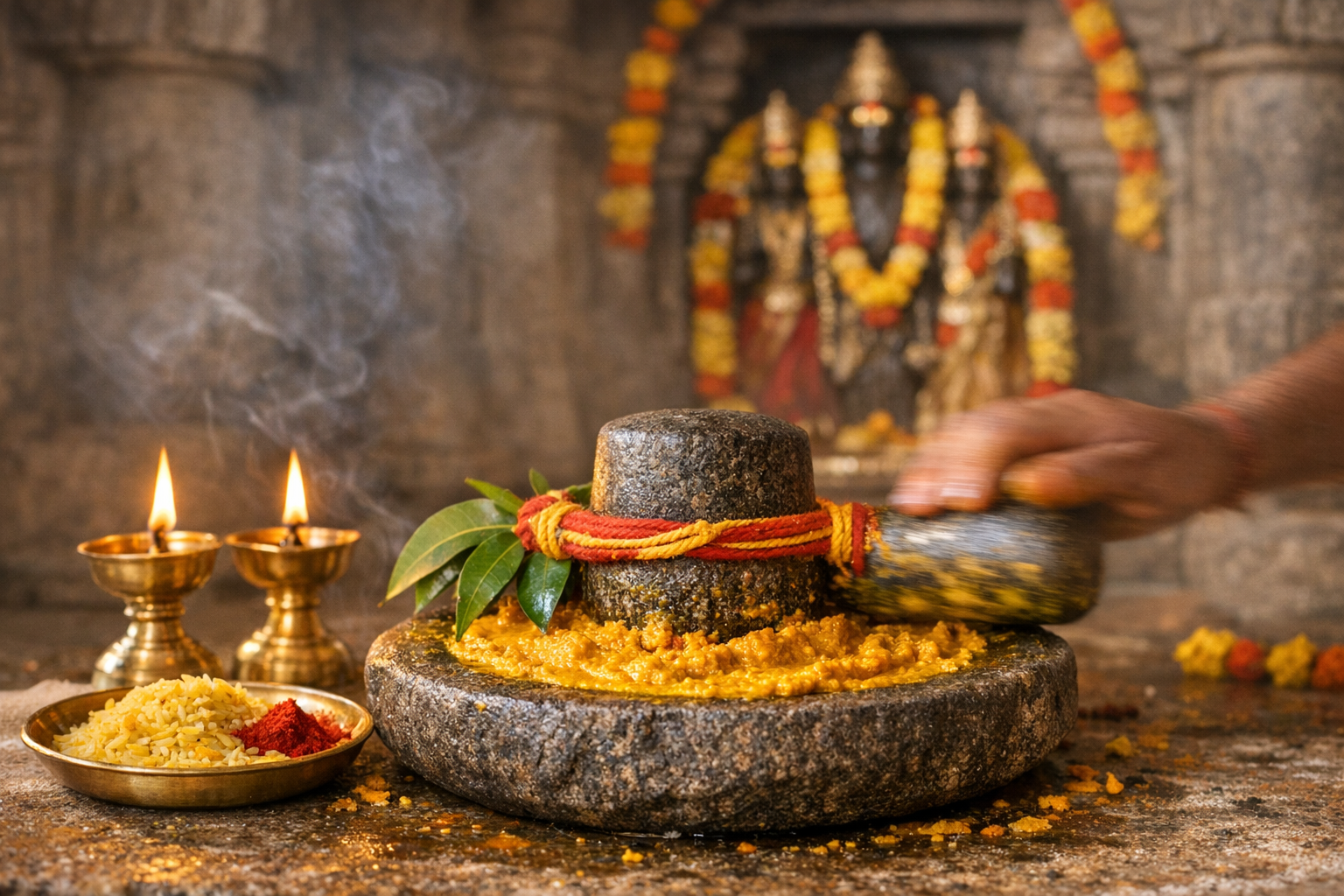
On Wednesday, March 25, 2026, the ancient Sri Kodanda Rama Swamy Temple at Vontimitta (also spelled Ontimitta) in Andhra Pradesh commences the Sri Sita Rama Kalyana Brahmotsavams with the time-honored ritual of Haridra Ghatanam. Conducted within the sanctum sanctorum (garbha-griha), this turmeric grinding ceremony formally inaugurates the sequence of auspicious observances that culminate in the celestial wedding (Kalyanotsavam) of Sri Rama and Sita during Chaitra Navratri and around Sri Rama Navami.
Haridra Ghatanam—also known locally as Haridhra Ghatanam—centers on invoking divine grace upon turmeric rhizomes (pasupu) and the traditional grinding implements, rolu and rokali. Special prayers and Vedic recitations are offered to consecrate both the substance and the stone tools, emphasizing a classical temple understanding that sacralizes not only the offerings but the very means by which they are prepared. The freshly ground turmeric paste subsequently becomes a key “mangalya” element in later rites associated with the Kalyana Brahmotsavams.
Within South Asian dharmic traditions, turmeric is associated with purity, well-being, and auspicious transition. Its golden hue signals prosperity and protection, and its plant-based, non-violent origin resonates with a shared civilizational ethic across Hindu, Buddhist, Jain, and Sikh communities. From the haldi/vatna observances in wedding customs to the drawing of sacred symbols with turmeric-tinted akshata, the cultural grammar of Haridra bridges households and shrines, embodying unity-in-diversity among India’s dharmic heritage.
At Vontimitta, the Kalyana Brahmotsavams unfold across several days, blending precise Agamic procedure with vibrant public devotion. Following Haridra Ghatanam, the festival typically features processional worship (vahana sevas) for the utsava murtis, musical and narrative offerings such as harikatha and bhajans, and, where prescribed, observances like Ankurarpanam and Dhwajarohanam in alignment with Brahmotsavam convention. The centerpiece remains the Sri Sita Rama Kalyanam, a meticulously codified ritual reenactment of the divine wedding that draws thousands of devotees during Chaitra Navratri.
The temple itself contributes to the depth of the experience. A protected monument associated with the Vijayanagara period, Vontimitta’s Sri Kodanda Rama Swamy Temple is renowned for its ekasila (single-stone) icon of Sri Rama with Sita and Lakshmana—an exceptional sculptural and theological unity that mirrors the festival’s emphasis on oneness and auspicious domesticity (grihastha-dharma). The site’s inscriptions, stone architecture, and ritual continuity render it a living archive of South Indian temple culture.
From a ritual-technical perspective, Haridra Ghatanam is anchored in the shodashopachara (sixteenfold) logic of worship and the preparatory purifications (punyahavachanam) that precede major consecrations. Archakas first make sankalpa (formal intent), ritually adorn the rolu and rokali with turmeric and kumkum, and decorate them with mango leaves and thread. As the stone meets stone in measured cadence, Vedic mantras—often including the Purusha Sukta and selections praising Sri Rama and Sita—frame the grinding as sacred labor, aligning human effort (prayatna) with divine order (rita).
The turmeric paste prepared during Haridra Ghatanam serves several functions in the ensuing days. Portions are reserved for the mangala snanam (ceremonial bathing) of the utsava vigrahas, for preparing akshata, and for select domestic-auspicious applications associated with the Kalyanam. In many South Indian temples, experienced elders explain that the very act of preparing these substances with intention is considered a yajna-like offering—an embodied meditation that sanctifies the senses and materials alike.
Devotees and volunteers frequently describe the sensory tapestry of this morning rite: the heady fragrance of freshly ground pasupu, the rhythmic, meditative sound of rolu meeting rokali, and the soft illumination of lamps within the sanctum. These cumulative impressions have a quietly pedagogical effect, guiding participants toward inner stillness and reverence. Families often recount how witnessing Haridra Ghatanam once becomes a cherished memory that draws them back to Vontimitta each Chaitra, reinforcing bonds of community and faith.
For pilgrims planning to attend on March 25, 2026, early arrival is advisable, as Haridra Ghatanam is conducted within the temple’s innermost precincts. Observing the temple dress code and maintaining decorum, especially during Vedic recitations, enhances both personal and collective experience. Photography is typically restricted near the sanctum; seeking guidance from volunteers and temple staff helps ensure appropriate participation. As schedules can vary across Brahmotsavam days, pilgrims should consult the temple’s notified program for timings of vahana sevas, special abhishekams, and the Kalyanam.
The opening rite at Vontimitta thus functions on many levels—devotional, doctrinal, and communal. As Haridra Ghatanam consecrates substance and implements, it also affirms a broader dharmic ideal: that sacredness inheres in mindful preparation, shared service, and harmonious living. In honoring Sri Sita Rama through this gentle, plant-based, and time-tested practice, the Kalyana Brahmotsavams invite devotees of diverse dharmic paths to celebrate common values—reverence, compassion, and unity—at the heart of the subcontinent’s spiritual traditions.
Inspired by this post on Hindu Pad.